Categories
Breaking News Editorial

What is Taira rock art, and what does it tell us about ancient desert culture in Chile?

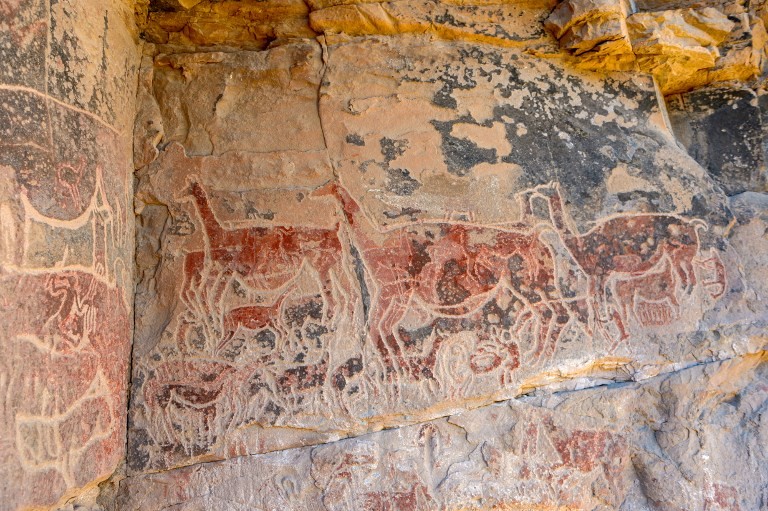
What does the Taira rock art depict? Roughly 90% of the artworks focus on llamas. Some are pregnant, others are suckling their young; and all represent life. The other 10% of the engravings depict the diversity of the desert, with foxes, snakes, ostriches, partridges and dogs featuring in scenes. Human figures are few and far between, and always drawn small. Archaeologists have posited that it is as if painting them small represents just how important desert animals were to their culture and economy. [caption id="attachment_8867" align="aligncenter" width="500"]
View of drawings at the Taira Cave in Chile, located at a height of 3,150 meters, on July 21, 2018. The paintings left by shepherds almost three millennia ago on the walls of the rocks that flank the course of the Loa River. Credit: AFP Martin Bernetti.[/caption]

The role of llamas in ancient desert culture

Archaeologist and curator at Santiago’s Museum of Pre-Colombian Art, Jose Bereguer, says that Taira art is ‘a celebration of life’. First rediscovered by Swedish archaeologist Stif Ryden in 1944, the gallery has been dated to c.400-800 BCE. 16 paintings remain, sitting 3,000 metres above sea level on the banks of the Loa River that traverses the desert. [caption id="attachment_8866" align="aligncenter" width="670"] Archaeologist Jose Bereguer, above, curator at Santiago’s Museum of Pre-Columbian Art, describes the site as “the most complex in South America” because of its astronomical importance as well as the significance to local shepherds. Credit: AFP Martin Bernetti[/caption] Previous studies tell us that the rock art was created by shepherds, who were pleading with the ‘deities that governed the skies and the earth’ to allow their llama flocks to flourish. The Alero Taira drawings, which were created in a natural shelter 30 metres away from the Loa River, give us deeper insight into the role of llamas in ancient desert culture. More than just the lead source of wealth for people inhabiting the desert, the llama was a symbolic creature used in ritual ceremonies throughout the Andes for thousands of years. The ‘Wilancha’, for instance, sees llamas given as sacrifice to ‘Pacha Mama’ (Mother Earth). Volcanoes, like springs, were considered deities by the Atacama natives, while llamas were thought to have been born of springs. Berenguer says: “No one can understand the things done 18,000 years ago because the cultures that did them have disappeared. Here, it’s possible to delve into the meaning because we have ethnography and because there are still people living in practically the same way as in the past.”

Lasting significance for indigenous peoples

The Rumualda Galleguillos is one of roughly 15 indigenous peoples that still raises llamas in the Atacama Desert. Just like their forefathers, it’s a matter of tradition and a way of life. To the Rumualda Galleguillos, these pictures are a ‘testament’ to their ancestors who did not read or write.

UNESCO plans

Now, conservationists want UNESCO to officially recognise the Taira Valley rock art as a heritage site, which will allow them to develop sustainable tourism for the region – similar to Spain’s Cave of Altamira of France’s Lascaux caves.]]>

Categories
Breaking News

Did the Romans hunt whales?

A gray area Due to centuries of whaling, the North Atlantic right whale (Eubalaena glacialis) is currently a threatened species, congregating off eastern North America. The Atlantic gray whale (Eschrichtius robustus) has completely disappeared from the North Atlantic and can only be found in the North Pacific. Neither is found in the Mediterranean today. In fact, it has long been assumed that the Mediterranean was outside the historical range for both species. You can read more about the history of whaling here. [caption id="attachment_8733" align="aligncenter" width="536"] Atlantic Northern Right Whale mother and calf. Credit: Wikimedia Commons[/caption]

Calving season in the Med

Due to the migratory nature of both species of whale, their presence east of Gibraltar means that they would have entered calving season in the Mediterranean Sea. Co-author of the study Dr Camilla Speller, from the University of York, says: “Our study shows that these two species were once part of the Mediterranean marine ecosystem and probably used the sheltered basin as a calving ground. “The findings contribute to the debate on whether, alongside catching large fish such as tuna, the Romans had a form of whaling industry.”

Roman scandal

The paper speculates that small rowing boats and hand harpoons could have been used to capture the creatures; similar to the medieval Basque whaling methods used in the following centuries. Lead author of the study Dr Ana Rodrigues, from the French National Centre for Scientific Research, adds: “[The] Romans did not have the necessary technology to capture the types of large whales currently found in the Mediterranean, which are high-seas species. But right and gray whales and their calves would have come very close to shore, making them tempting targets for local fishermen.”

The ripple effect: what this means for other research

If coastal whales were in fact present in the Mediterranean, some previously perplexing sources suddenly make a lot more sense. Anne Charpentier, lecturer at the University of Montpellier and co-author in the study, said: “We can finally understand a 1st-Century description by the famous Roman naturalist Pliny the Elder, of killer whales attacking whales and their new-born calves in the Cadiz bay. “It doesn’t match anything that can be seen there today, but it fits perfectly with the ecology if right and gray whales used to be present.” As a result, the authors of the study are urging historians and archaeologists to re-examine their material in light of the knowledge that coastal whales were once part of the Mediterranean marine ecosystem. [caption id="attachment_8812" align="aligncenter" width="500"] A Roman mosaic with fishing scene, found in Hippolytus House in greater Madrid, Spain. Credit: Alberto Paredes/Alamy Stock Photo[/caption]

The forgotten calving grounds

“It seems incredible that we could have lost and then forgotten two large whale species in a region as well-studied as the Mediterranean. It makes you wonder what else we have forgotten,” concludes Dr Rodriguez.]]>

Categories
Breaking News

How European colonisation completely wiped out dogs in America

Canines and colonisers: an unhappy tale Colonial devastation bestowed upon native humans of the Americas is well-documented; but evidence about dogs’ lives is less known. However, an international team has started to ask – and answer – those questions. Fifty researchers collaborated on the investigation and together, they conducted the most detailed and thorough study of ancient and modern dog DNA to date. Through biological and archaeological evidence, they examined the remains of 71 ancient dogs from the Americas and Siberia; and put their findings alongside the genomes of modern dogs. [caption id="attachment_8797" align="aligncenter" width="720"] A ritual burial of two dogs at a site in Illinois near St. Louis suggests a special relationship between humans and dogs at this location and time (660 to 1350 years ago).
Credit: Photo courtesy Illinois State Archaeological Survey[/caption]

Lineage losses for man’s best friend

Published in the journal Science, the new evidence gives us reason to conclude that ‘pre-contact’ dogs disappeared to a similar extent to the Neanderthals. One of the authors was Greger Larson from the University of Oxford, who is leading an international effort to investigate how dogs have been domesticated. He says the study solidifies our understanding of the fates of humans and their animals: “The Europeans come through. They knock out the humans. They knock out the dogs… It’s a complete disappearance.” Leading the research was Laurent Frantz, an expert on ancient DNA at the Queen Mary University of London. Until now, there hadn’t been sufficient evidence to tell the story of what happened to dogs after the arrival of European colonists. However, his research proves that pre-contact dogs were identifiable as a group separate to any other, and that their disappearance came about from a combination of disease and European persecution.

Dogs in America: a history

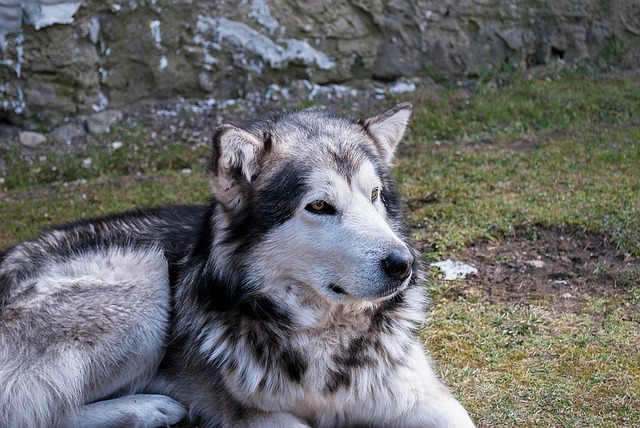
America’s earliest dogs were not domesticated North American wolves, as has been speculated. It’s much more likely that they followed humans over a land bridge that once connected North Asia and the Americas, the study found. You can read more about recent research on human migration into the Americas here. The earliest archaeological evidence for dogs living in North America comes from 10,000 years ago. As humans entered the region 14,000 years ago, it looks like the first wave didn’t bring dogs with them. The first canines to arrive in America were of East Asian descent, but soon evolved into their own group, distinct from both their ancestors and modern dogs. The animals in question are loosely related to Arctic breeds, such as huskies and malamutes, which arrived with later human migrations into North America. [caption id="attachment_8798" align="aligncenter" width="640"] A modern Malamute.[/caption]

“Forced cultural changes”

Humans and dogs coexisted relatively peacefully in both continents for over 9,000 years. But when European colonists arrived, they were gone. “This suggests something catastrophic must have happened, and it’s likely associated with European colonisation,” says Frantz. Clearly, early humans and dogs in the Americas faced many of the same challenges after European contact. University of Illinois Professor of Anthropology, Ripan Malhi, explains: “It is known how Indigenous peoples of the Americas suffered from the genocidal practices of European colonists after contact… What we found is that the dogs of Indigenous peoples experienced an even more devastating history and a near-total loss, possibly as a result of forced cultural changes and disease.”]]>

Categories
Breaking News

Not Western after all: veterinary science originates from Mongolia

Max Planck Institute for the Science of Human History. A team of scholars, led by William Taylor of the Institute, have analysed ancient horse remains from a Mongolian pastoral culture called the Deer Stone-Khirigsuur Culture. Crucially. their findings challenge the traditional view that veterinary care is a Western science.

Who were the people of the Deer Stone-Khirigsuur Culture?

This pastoral culture roamed the steppes of Mongolia and the eastern parts of Eurasia between 1300 and 700 BC. The nomadic tribe carved beautiful standing stones, known as deer stones, and created burial mounds, or khirigsuurs, across the Mongolian Steppe. As peaceful horsemen, they have been linked to some of the oldest evidence for nomadic herding and the keeping of domestic livestock in that part of the world. [caption id="attachment_8781" align="aligncenter" width="500"] Horses congregate near a deer stone site in Bayankhongor, in central Mongolia’s Khangai mountains.
Credit: William Taylor[/caption] They were the first peoples in eastern Eurasia to utilise horses as livestock, and it has been suggested that they were among the first to ride the animals. At roughly the same time as their inhabitancy, bronze and metal mouthpieces for riding spread throughout the region. These would have given riders more nuanced control over the animals, enabling them to use them for new purposes – including warfare. However, using metal to control horses also saw the rise of new oral issues, including painful interactions with a vestigial tooth that develops in some animals, known as a ‘wolf tooth’. A common problem among the horses, ‘wolf tooth’ would have been alleviated by the use of blunt metal instruments. The practice remains in a similar form today. This dentistry care would have allowed the early riders to control their horses, and further use them to advance their own society. Near each deer stone and khirigsuur, stone mounds symbolise the ritual burials of domestic horses. To contextualise the scale of this culture, the number of horses buried can run up into the hundreds, or even thousands. [caption id="attachment_8782" align="aligncenter" width="500"] A depiction of the classic Mongolian style of deer stone. Credit: Kyarrakun, via Wikimedia Commons[/caption]

“Oldest known practitioners of vet care”

A careful study of the skeletal remains found in these burials has exposed never-before-known information about early veterinary dental procedures. The Deer-Stone Khirigsuur people would have removed any baby teeth causing pain in young horses – making them the world’s oldest known practitioners of veterinary dental care. Throughout the study, Taylor worked closely with colleagues from the National Museum of Mongolia. Jamsranjav Bayarsaikhan and Tumurbaatar Tuvshinjargal were able to provide him with deeper insight about the development of horseback riding and how a horse-based pastoral economy facilitates scientific advancement. “We may think of veterinary care as kind of a Western science,” Taylor comments. “But herders in Mongolia today practice relatively sophisticated procedures using very simple equipment. This results of our study show that a careful understanding of horse anatomy and a tradition of care was first developed, not in the sedentary civilizations of China or the Mediterranean, but centuries earlier, among the nomadic people whose livelihood depended on the well-being of their horses.”

Connecting East and West

Nicole Boivin, Director of the Department of Archaeology at the Max Planck Institute for the Science of Human History, concludes: “In many ways, the movements of horses and horse-mounted peoples during the first millennium BCE reshaped the cultural and biological landscapes of Eurasia. “Dr. Taylor’s study shows that veterinary dentistry – developed by Inner Asian herders – may have been a key factor that helped to stimulate the spread of people, ideas, and organisms between East and West.” The research has been published in full here.]]>

Categories
Breaking News

Thousands of Animal Artifacts Entombed with Emperor

Categories
Breaking News

Zanzibar’s Extinct Animals and the Island's Formation

Categories
Breaking News

2600 Year Old Greek Cup May Show Constellations