
Ypresiosirex orthosemos Most hikers would be fairly alarmed to come across a giant wasp, but the ancient species is only slightly larger than its modern cousins according to Archibald. Today’s horntail wood-wasp is considered a significant pest in forests, the young wasps tunnel through tress causing a fungus to grow which they then eat. The fungus produces poisons, while the wasp emits a secretion which weakens the immune system of the tree. This combination eventually causes the tree to die. The discovery has given researchers insight into the modern world and how it began coming together after the dinosaurs became extinct. Many of the trees and plants today’s horntail wood-wasps enjoy were also favored by the old wasp and have been found as fossils in the same forest as the ancient horntails; including trees (hemlock, fir, spruce, pine, spruce, sequoia, hemlock, and cedar) and flowering plants (beech, maple, elm, ash, hickory, ash, elm and poplar). Furthermore, the discovery of Y.Orthosemos indicates to researchers which types of animals and plants can coexist when the climate is slightly warmer. The ancient forest the wasp inhabited grew during a period of Earth’s history when a large portion of the globe was experiencing tropical heat. With the significant elevation of this area of British Columbia, the McAbee forest would have had a climate much like modern-day Vancouver, temperatures preferable to wasps. This means the ancient horntailed wood-wasp lived alongside other animals and insects typically associated with a tropical climate, including a cockroach species which is found only in Fiji today. Y.Orthosemos is just one of the three new wasp species that Archibald and Alexandr Rasnitsyn with the Russian Academy of Sciences recently identified in an article published in the online journal The Canadian Entomologist. The two other new wasps were found at the McAbee forest site as well. In addition, the article also describes three newly discovered sawfly species found in Republic, Washington and in British Columbia. According to Dr. Archibald people often ask him why they should bother caring about what insects flew around 53 million years ago. His answer is simple: The more understanding we gain about the early beginnings of modern-day forest ecosystems and how animals and plants responded to the changes in climate over time, the better prepared we’ll be going forward. The McAbee fossil beds are a designated heritage site and contain many first class specimens for experts and researchers. The Canadian government hopes to provide more opportunities for public exploration and interpretation of the many new discoveries in the area. Image courtesy of Wikimedia Commons user: Stanislaw Kinelski ]]>
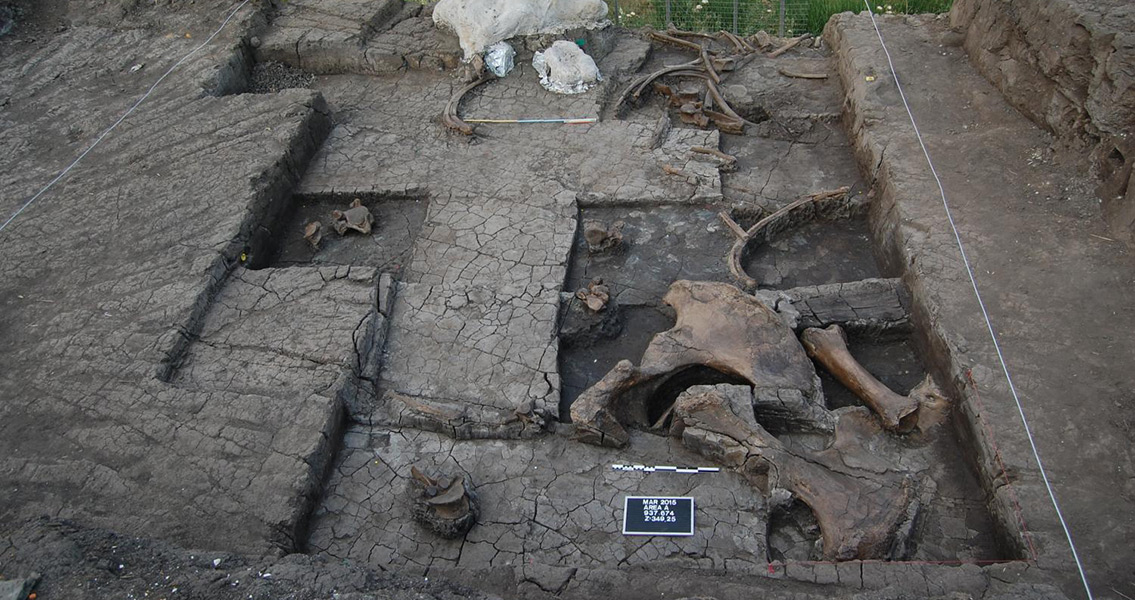
Elephas antiquus, more commonly known as the straight-tusked elephant, a long-extinct species that is thought to be the progenitor of the African elephant. Marathousa 1 was likely to have been a butchering site based on the types of stone artifacts found in close proximity to the remains of the elephant. Additionally, highly distinctive kerf marks were left behind on the bones of the elephant, ostensibly a result of the stone tools as they were used to separate the elephant meat from its bones. So far, early analysis results seem to indicate that the site dates to the Middle Pleistocene, putting it roughly between 300,000 and 600,000 years old. According to Katerina Harvati, a professor with Tübingen University’s Center for Human Evolution and Paleoenvironment, the Greek site is unique due to several of its characteristics. In a press release published by the University, she remarked that the Megalopolis site is the only one in the Balkan region where evidence of an early Paleolithic elephant being butchered had been uncovered. Easily one of the most ancient archaeological sites within the entire country, Marathousa 1 lies within what would have been an epicenter for human migration routes into Europe while also acting as a refuge for human, animal, and plant populations during ice ages. Harvati said that research into the region and its Paleolithic importance has largely gone unnoticed because of Greece’s role in Classical history. Much of the scholarship has revolved around the Hellenistic period and eschewed the Lower Paleolithic as a result. Despite this, the researcher added that Marathousa 1 was and continues to be a high-value site for revealing the secrets behind how humanity dispersed into Europe and how early humans adapted to and behaved within the region as a whole. Professor Havarti, along with her colleagues from both Germany and Greece, hopes to aid in closing the Paleoanthropology research gap that exists in southeastern Europe as a result of this previous focus on the Classical period. Image courtesy of Greek Ministry of Culture ]]>





www.pnas.org ]]>