Categories
Breaking News

History News of the Week: Nazi Loot, B-25s and Prehistoric Ochre

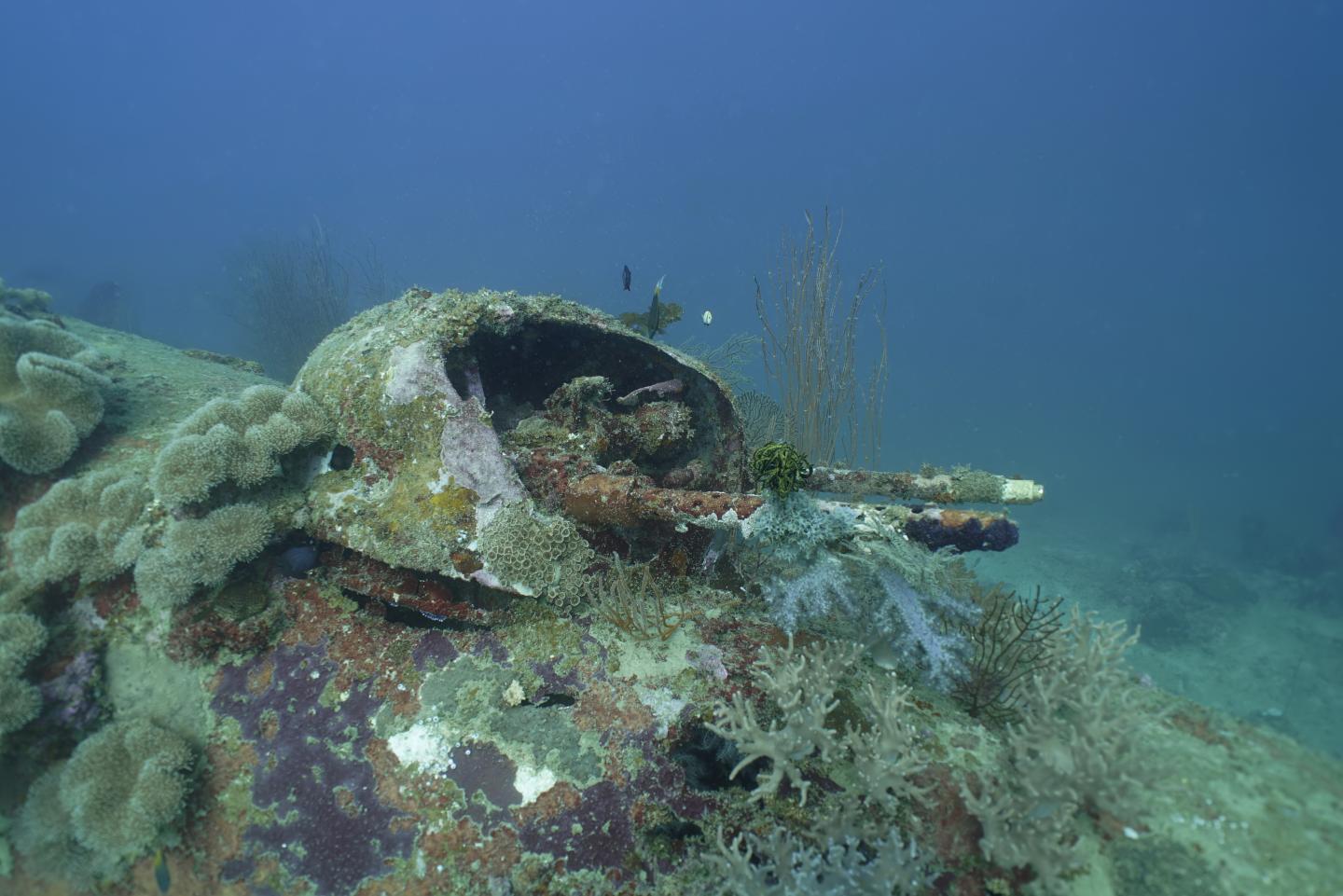
Middle Stone Age Humans used Ochre for Millennia A new study published in the journal PLOS ONE claims that Middle Stone Age humans living in a cave in what is now Ethiopia were using ochre for at least 4,500 years. An iron-rich rock, ochre is a common find at many Middle Stone Age sites. The Porc-Epic cave in Ethiopia contains the largest collection of ochre from the period, weighing 40 kg and believed to date to 40,000 years ago. The authors of the PLOS ONE study conducted a detailed analysis of 3792 pieces of ochre from Porc-Epic, using microscopy and experimental reproduction of grinding techniques to assess how the ochre had been processed and used over a period of 4,500 years. The researchers, led by Daniela Rosso from the University of Barcelona, Spain, found that the inhabitants of the cave persistently and consistently acquired, processed and used the same types of ochre throughout the period. Around 50% of the ochre pieces discovered had been modified by the prehistoric inhabitants, but the team also found that as time went on the inhabitants processed less ochre. The forms of modification also changed, with flaking and scraping becoming more popular while grinding became less so. These gradual changes in processing techniques could be explained by “cultural shifts”, according to the researchers. The authors state that their analysis of ochre treatments suggests a “cohesive behavioral system shared by all community members and consistently transmitted through time.” Two Missing B-25s Documented Two B-25 bombers, believed to be linked to missing US service personnel, have been documented in the waters off Papua New Guinea. The findings are part of Project Recover, a collaboration between marine scientists, archaeologists and volunteers to find US military aircraft and associated MIAs from World War Two. Searching over an area of 10 km2, Project Recover unearthed a B-25 that had been missing for over 70 years, one which is linked with a crew of six MIAs. “People have this mental image of an airplane resting intact on the sea floor, but the reality is that most planes were often already damaged before crashing, or broke up upon impact. And, after soaking in the sea for decades, they are often unrecognisable to the untrained eye, often covered in corals and other sea-life,” said Katy O’Connell, Project Recover’s Executive Director, who is based at the University of Delaware’s College of Earth, Ocean, and Environment. “Our use of advanced technologies, which led to the discovery of the B-25, enables us to accelerate and enhance the discovery and eventual recovery of our missing servicemen.” Former Nazi Loot Goes to Auction 80 years after being looted by the Nazis, an Italian masterpiece is set for auction at Sotheby’s in London, according to the Guardian. Depicting a stunning view of Venice, La Punta della Dogana e san Giorgio Maggiore was painted in 1739 by Michele Marieschi. In 1938 the painting belonged to the Grafs, a Viennese Jewish family who fled Austria after the country was annexed by Nazi Germany. Forced to leave their valued artwork behind, they searched in vain after the war for their lost masterpiece. In 1998, it was revealed that Christie’s knew the whereabouts of the painting, but could not disclose the information due to client confidentiality rules. After years of negotiation a settlement has finally been agreed with the descendants of the Graf family. Although the exact terms have not been disclosed, the painting will have to be sold so the current owners can receive a ‘significant’ sum in compensation, according to the Guardian. Going to auction on 5th July, the picture is expected to fetch somewhere between £500,000 and £700,000. Image courtesy of Project Recover ]]>

Categories
Editorial

The Longest Suicide Note in History

What did the 1983 Labour Party Manifesto say? By 1983 the UK had entered an economic recession. Labour, led by Michael Foot, sought to remedy the situation with an ambitious programme of government investment. The manifesto was explicitly Keynesian in its approach, involving an £11 billion, five year economic plan. It stood in stark opposition to the free market ideology of the Conservative government. The 700 page document was thorough in the plans it detailed. Some key policies included: • Massive investment in industry through a ‘national investment bank’ • Creation of a powerful national oil company to bring the North Sea Oil industry into public ownership • Reversal of the Conservatives’ programme of privatisation, including a renationalisation of industries sold • Withdrawal from the European Economic Community • Britain to take unilateral action to scrap nuclear weapons in order to encourage global nuclear disarmament • All forms of hunting with dogs, such as fox hunting, made illegal • Greater control over bank lending, through the Bank of England • Progressive taxation • Strengthening of the Equal Pay Act Did the 1983 Manifesto really cost Labour the general election? The Conservative party won the 1983 election by a landslide. Some historians claim the 1983 Manifesto was the key reason for Labour’s massive defeat, but a number of other major factors were also at play. Firstly, the Falklands War had come to an end the year before. The conflict provided a massive boost to Thatcher’s popularity, endearing her to the British public, while the victory led to a swell of optimism. The conflict was pivotal in turning around what had initially been a difficult first few years in office. Secondly, Labour was hindered by internal issues and new competition. Divisions in the party saw the creation of a break away party – the SDP (Social Democratic Party). The SDP subsequently formed an alliance with the Liberal party, a move which both weakened Labour and also created a powerful new rival in the election battle. Ultimately, it meant that the votes of those discontented with the Conservative government were split between two parties. Labour went on to lose 60 seats in the election, while the Conservatives gained 58. It was Labour’s worst election performance since 1918, while the Tories secured the biggest majority since that won by Labour in 1945. The Labour Manifesto might have been the longest suicide note in history, but a host of other factors were also at play for the party’s dismal performance in 1983. Image by Marcel Antonisse / Anefo, courtesy of Nationaal Archief ]]>

Categories
Breaking News

Shock discovery that Homo naledi may have lived alongside modern humans

Homo naledi likely lived alongside modern humans, according to a newly published study. First discovered at the Rising Star Cave in South Africa in September 2015, Homo naledi quickly caused a stir in the scientific community. It is believed the creatures may be one of the earliest members of the homo genus, which includes our own species, homo sapiens, and our closest extinct relatives, the Neanderthals (Homo neanderthalensis). Professor Paul Dirks and Associate Professor Eric Roberts from James Cook University have been analysing Homo naledi fossils for the past few years, indeed, they were involved in the first paper describing Homo naledi. By using state-of-the-art techniques, they have now concluded that Homo naledi is between 236,000 and 335,000 years old. “The oldest dated fossils of Homo sapiens in Africa are around 200,000 years old. And now we have a very primitive looking hominid that probably existed at the same time as them. This is the first time one of these primitive hominids has been found in association with more modern humans in Africa,” Professor Dirks said in a press release from James Cook University. Dating was achieved using a combination of the fossil remains and their surrounding sediments. The team has since commenced work on studying a recently discovered second chamber in the cave system, distinct from the one where the initial Homo naledi discovery was made. The dates the team attribute to the fossils have the potential to be hugely significant. “When we first identified the fossils, most of the paleo-anthropologists on site were convinced that they would be a million or two million years old, but we have now shown they are much more recent. It means that a primitive hominid persisted on the landscape in Africa for a very substantial period of time. Well beyond what paleo-anthropologists predicted to be possible”, explained Prof. Dirks. The area around the cave where the Homo naledi fossils were found is littered with prehistoric tools which are typically thought to have been the work of Homo sapiens. The new dating of Homo naledi however, might lead to a rethink on the origins of those tools. “The new dating puts it on the landscape at a time from which we find lots of tools in Africa in the middle stone-age. One of the implications of the new dates is that it’s no longer automatically possible for us to assume that early homo sapiens were making these tools.” Professor Roberts said the team were confident about the new dates. “Much of the initial work on the age range was done here at JCU in our advanced analytic centre. But to get the final date range we used ten different labs and six different techniques which also involved double-blind testing.” Since Homo naledi’s first discovery, a number of figures have been suggested for the age of the remains with each subsequent study seeming to claim the hominid was more recent. A comparative skull study with other members of the Homo genus in December 2015 concluded Homo naledi was around two million years old. In July 2016, another study claimed Homo naledi was only around 900,000 years old. Dirks and Robert’s discovery will likely have far reaching consequences for the study of evolution. “We have many different branches on the family tree and it is only fairly recently that there is only one survivor on the landscape. The new dating of the fossils opens up all sorts of possibilities for an interchange of tool use, cultural activities and behaviours between Homo naledi and homo sapiens,” concluded Dirks. ]]>

Categories
Breaking News

15,000kg Dinosaur Fossil Identified after Being Ignored for Decades

Vouivria damparisensis. Dated to around 160 million years old, V. damparisensis is the earliest recorded fossil from the titanosauriform family, a group of dinosaurs which includes the likes of Brachiosaurus. Analysis of the fossil suggests the specimen died at a young age, weighed around 15,000 kilograms and measured over 15 metres in length. Its neck was spectacularly long and was likely held at a 45 degree angle. Much like other titanosauriforms, the creature also boasted a long tail and four legs of equal length. “Vouivria would have been a herbivore, eating all kinds of vegetation, such as ferns and conifers.” said Dr Philip Mannion, the lead author of the study from the Department of Earth Science and Engineering at Imperial College London, in a press release. “This creature lived in the Late Jurassic, around 160 million years ago, at a time when Europe was a series of islands. We don’t know what this creature died from, but millions of years later it is providing important evidence to help us understand in more detail the evolution of brachiosaurid sauropods and a much bigger group of dinosaurs that they belonged to, called titanosauriforms.” Titanosauriforms were the last surviving group of long necked dinosaurs, only coming to an end with the end-Cretaceous mass extinction event which wiped out the majority of life on earth. The gigantic, diverse group of sauropods originated in the Late Jurassic and included some of the largest creatures to have ever walked the planet. V. damparisensis‘ discovery looks set to greatly aid scientists in understanding the evolution and spread of titanosauriforms across the globe, a subject which has until now proven difficult to shed light on due to a limited fossil record for the earliest members of the family. By incorporating the new species into the fossil timeline, the team have shown that by the Early Cretaceous brachiosaurids were likely restricted to what is now Africa and the USA, and probably extinct in Europe. The discovery also throws into question the previously held belief that brachiosaurids spread as far as South America. Scientists have previously suggested that a sauropod dinosaur called Padillasaurus, whose remains have been found in South America, was a brachisosaurid. The discovery of V. damparisensis however, points to that not being the case. The genus name of the new creature is derived from the old French word for viper – vouivre. In the French-Comte region where the fossil was discovered, ‘la vouivre’ is a legendary winged reptile. The species name damparisensis meanwhile, refers to the village of Damparis where the fossil was first found in 1934. Image courtesy of Imperial College London/Chase Stone]]>