
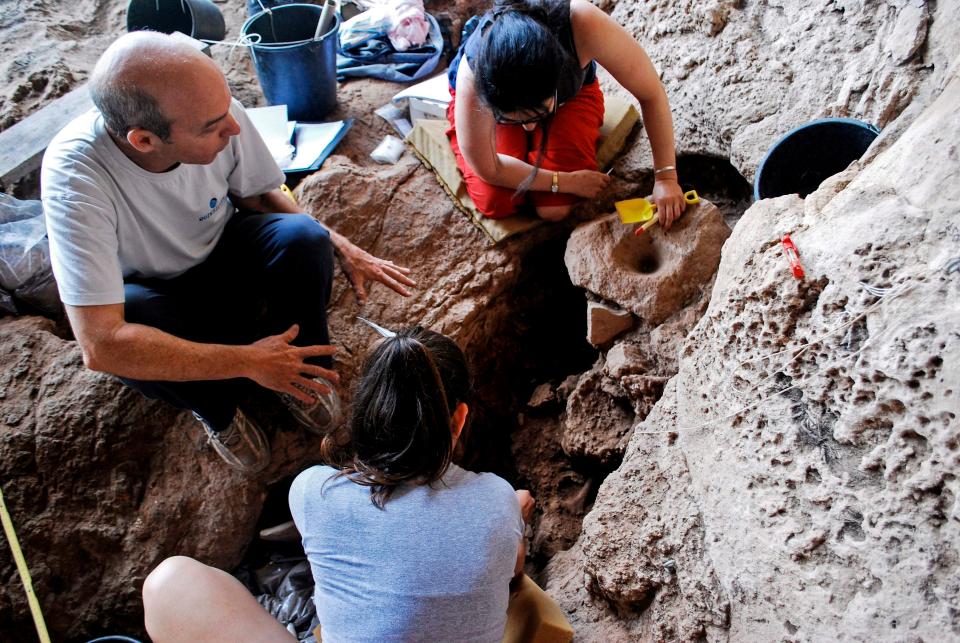
 Archaeologists at the beer-making site in a cave near Raqefet, Israel
Photo credit: AFP[/caption]
Who were the Natufians?
The Natufians were semi-sedentary foraging people, living in the Eastern Mediterranean between the Palaeolithic and the Neolithic periods (after the last Ice Age). As part of their rituals, they collected locally available plants, stored malted seeds and made beer.A vivid and colourful picture of Natufian ways
Prof. Dani Nadel, Zinman Institute of Archaeology, University of Haifa, Israel, was on the excavation team: “The Natufian remains in Raqefet Cave never stop surprising us. “We exposed a Natufian burial area with about 30 individuals; a wealth of small finds such as flint tools, animal bones and ground stone implements, and about 100 stone mortars and cup marks. “Some of the skeletons are well-preserved and provided direct dates and even human DNA, and we have evidence for flower burials and wakes by the graves. “And now, with the production of beer, the Raqefet Cave remains provide a very vivid and colourful picture of Natufian lifeways, their technological capabilities and inventions.” The results of the study indicate that the Natufians exploited over seven types of plants associated with the mortars. That includes wheat or barley, oat, legumes, and bast fibres like flax. They would then pack plant foods in fibre-made containers and store them in boulder mortars. Bedrock mortars would be used to brew wheat and barley based beer, which would then have likely been served in ritual feasts. [caption id="attachment_8893" align="aligncenter" width="500"] This is the site location and artefacts analysed. (A) The location of Raqefet Cave and three additional Natufian sites in Mt. Carmel; (B) field photos of the studied boulder mortars (BM1,2) and the location of BM3 on the cave floor (scale bar and arrow: 20 cm); (C) a functional reconstruction of the mortars: a boulder mortar used to store plants in a basket with a stone slab on top, and a bedrock mortar used for pounding and cooking plants and brewing beer. Photo credit: Dror Maayan; Graphic design credit: Anat Regev-Gisis[/caption]