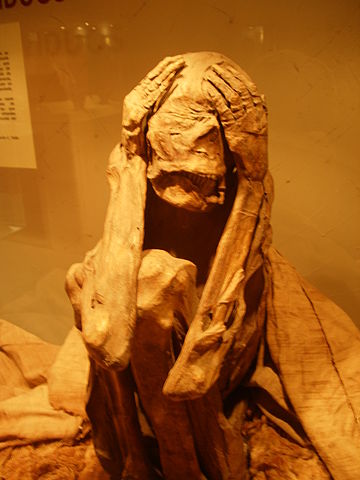
th Century. It was there that the team came across a startling discovery: a mummy from centuries before Inca settlement.
A surprise discovery
Pre-dating the Inca rule, the mummy was made by the Ychsma people, who were native in the region from the 10
th Century, until they were conquered by the Incas five centuries later.

In his statement on behalf of the team, Professor Peter Eeckhout said: “The deceased is still wrapped in the enormous funeral bundle that served as a coffin.”
“Discoveries like this one are exceptionally scarce, and this mummy is incredibly well preserved. Samples were collected for carbon-14 dating, but the area in which it was discovered, and the type of tomb, suggest this individual was buried between 1000 and 1200.”
An untouched chamber
This was just one of thousands of mummies discovered at the site. So far, 300 have been excavated by the team working on the Ychsma Project. However, most of them had suffered from various disturbances, such as looting.
Prior to the arrival of the Inca at Pachacamac the site was looted by Spanish conquistadors. Much of it was left in complete disarray, but one funeral chamber was left intact. When Professor Eeckhout’s team discovered the mummy, it was in such good condition that it could be studied without the need to unwrap it.
Pilgrimage in the Inca Empire
After the arrival of the Incas, the site underwent a period of dramatic change. It was established as a large pilgrimage centre on Peru’s Pacific coast, where the worship of certain deities contributed to an empire-wide collective identity.
It is assumed that worshippers were responsible for leaving a number of other objects found at the site, including Spondylus shells, which symbolise fertility. The research team also found an Inca monument for rituals, as well as a chapel for foreign pilgrims. Inside, they found offerings such as vases, and even some animals. A 17
th Century description of the site from Spanish monk Antonio de la Calancha matches up with the findings.
The results of the project confirm the role of Pachacamac as a site of pre-Columbian pilgrimage under the Inca Empire: ‘Deities and their worship played a major part in the life of Pre-Colombian societies,’ says Professor Eeckhout. ‘The Inca understood this very well, and integrated it into how they wielded their power. By promoting empire-wide worship, they contributed to creating a common sense of identity among the many different peoples that made up the empire. Pachacamac is one of the most striking examples of this.’
Future plans for the Ychsma mummy
Professor Eeckhout and his team now plan to use medical imaging techniques, including x-ray scans, axial tomography and 3D reconstruction, to contextualise and explore their discovery. They will be working in collaboration with Christophe Moulherat from the Musée du Quai Branly, Paris.
By working out the position of the person inside, testing whether they had any diseases and analysing any offerings that may be buried with them, the team will be able to paint a more detailed picture of life for the Ychsma people.
Title image by Thomas Quine]]>
 Action off Cartagena, 28 May 1708. Oil by Samuel Scott.[/caption]
With the help of an underwater autonomous vehicle, the Woods Hole Oceanographic Institution was able to locate and observe the shipwreck for the first time in 2015. The project has been kept secret, says Rob Munier, WHOI’s vice president for marine facilities and operations: “We’ve been holding this under wraps out of respect for the Colombian government.”
New details about the discovery have recently been released with permission from the agencies involved in the search, including the Colombian government.
[caption id="attachment_8677" align="aligncenter" width="500"]
 The wreck was partially sediment-covered, but with the camera images from the lower altitude REMUS missions, the crew was able to see new details, such as ceramics and other artefacts. REMUS image, Woods Hole Oceanographic Institution[/caption]

 Modern Strasbourg. Photo by R Roletschek.[/caption]
Finding a cure
The city’s council was tasked with finding a cure for the curse. Frau Troffea may have been taken off into the mountains, but the remaining afflicted were subject to panicked ideas of treatment.
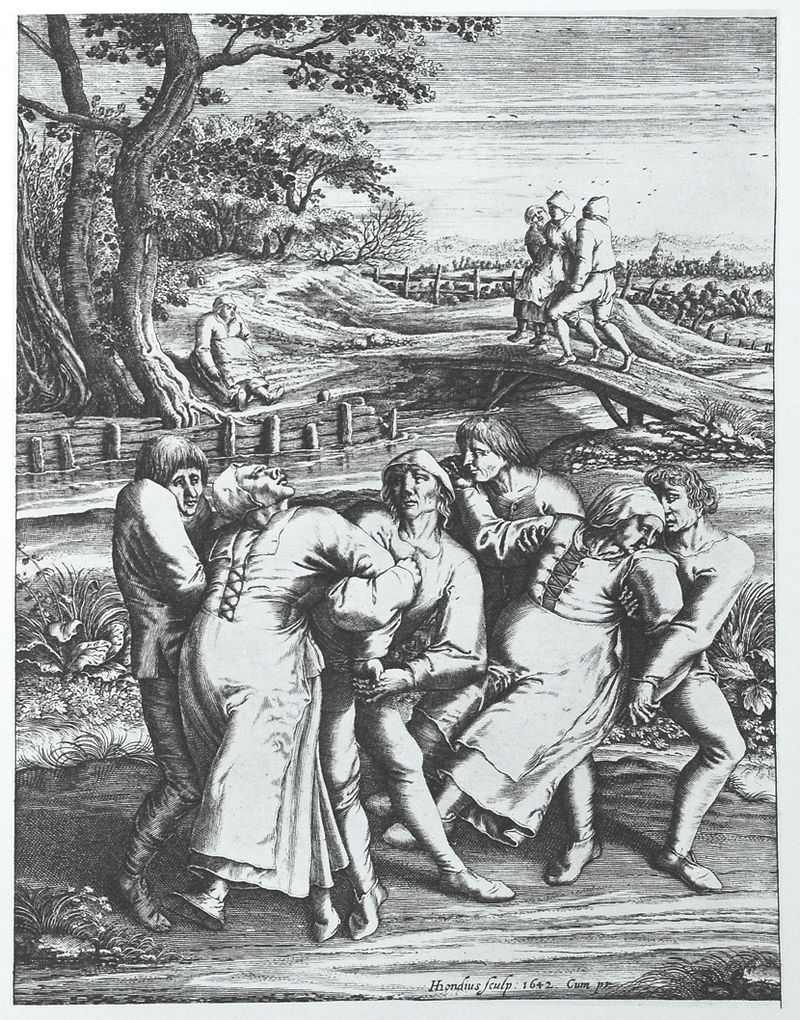
At first, it was thought that the plague came from ‘hot blood,’ and as such, only continued dancing could sweat it out. The council erected a stage, hired musicians and dancers and made sure that the afflicted continued to dance at a fast pace.
Matters worsened. Many of those hired fell subject to the curse, as did petrified onlookers. Within a few days, the council’s theory of forcing the dance to extinguish ‘hot blood’ had been discredited.
For the dancers, medical attentions were irrelevant. They needed the mercy of St. Vitus and support from a neglectful Church. Luckily, the flattering attentions of priests were about to be bestowed upon them.
They were given sacred red shoes and started a pilgrimage to Saverne. It involved a gruelling climb to a remote monastery, which was thick with incense and candle smoke. This extravagant ritual awoke something in their deep-rooted piety. Between holy relics and religious imagery, they had reason to believe the curse would be raised. and the curse was lifted.
Why did the pilgrimage lift the curse?
Dr. John Waller, author of A Time To Dance, A Time To Die, hypothesises that ‘the large number of people who recovered through the power of religious suggestion reveals that even when self-awareness is impaired, our minds can still receive, process and respond to appropriate external stimuli.’
These were a people calling out for attention from the Church. They’d been neglected for years, but in the recent weeks, civic and religious leaders had changed their attitudes toward their flock. Just as neglect has immense psychological potential, so too does religious attention.
Cultural conventions and pathological anxiety
In the decades that followed, Martin Luther’s attractively egalitarian ideals diverted the Christian psyche away from supernaturalism. Outbreaks of choreomania disappeared; but the phenomenon provides a fundamental commentary on group psychosis.
Biologically speaking, 500 years is not a long time. When under pressure, the human brain still causes relatively expected behaviour. A person may appear to have lost control completely, but they still reflect some kind of cultural prescription.
Whether supernatural or not, cultural conventions play a key role in the expression of pathological anxiety. Set in the context of a people who feared St. Vitus, the dancing plague of Strasbourg offers us a fascinating insight into the ways pathological anxiety can play out.]]>