Categories
News

Mutiny Sets Henry Hudson Adrift

Discovery mutinied on 22nd June, 1611. The vessel’s captain, famed explorer Henry Hudson; his teenage son and seven others were all overpowered by the ship’s crew and forced into a small, uncovered boat. Set adrift with few supplies in the harsh conditions, Hudson and the others were never seen again. The only hint to their fate came almost twenty years later, in 1631, when another expedition through the region found the remains of a shelter that could have been erected by Hudson and his eight companions. Hudson, for whom Hudson Bay is named after, was embroiled in an obsessive hunt for a Northwest Passage, a sea route through the North American continent that would connect Europe to the lucrative trading opportunities in Asia. The 55-ton Discovery had set off from London on 17th April, 1610, stopping briefly in Iceland before making its way into the Hudson Bay in August. For this expedition, Hudson had his ship cruised around the southern section of the Hudson Bay, searching for an outlet into the Pacific. Scouring the region and finding nothing, Hudson nevertheless continued his search. When the wintry Arctic conditions struck however, tensions quickly rose among the crew when the ship became trapped in the ice, with its supplies dwindling. Rumours started to spread among the crew that Hudson had started to hoard food, saving it for his favoured crew members while depriving others. He demoted Robert Juet, the ship’s first mate, while also getting into a heated dispute with another officer, Henry Green. Conspiracy began to spread around the ship, with Green and Juet recruiting men to their cause. In June, while the ship prepared to commence its journey back to Europe, the mission a failure, the mutiny took place and Hudson along with his supporters were apprehended and then set adrift. At least, that was the account provided by the surviving crew members. The Discovery eventually made its way back to England, but without Juet and Green. The surviving crew members claimed that the two mutiny leaders had been killed in a battle with Native Americans at some point on the journey home. This of course adds an interesting twist to the tale of the mutiny, raising the possibility that the crew perhaps altered certain elements of the story, or lied about Juet and Green’s fate, in order to shift blame away from themselves. Some of those who made it back were eventually tried for mutiny, but all were ultimately acquitted due to a lack of evidence. Little is known about Hudson’s early life. Likely born sometime late in the sixteenth century, in England, he earned a reputation as a formidable sailor and, ultimately, one of the world’s greatest explorers. How he gained such skill as a seafarer is unknown, with precious few details about his life prior to his first expedition as a ship’s commander in 1607 available. He embarked on four major voyages in his career, including the fateful final one. All were driven by the same aim, of finding a new passage between Europe and Asia, and with countries and businesses fighting to unearth new trade routes, funding for these ambitious expeditions was seldom hard to come by. His first two trips attempted to find a Northeast Passage, the second ultimately blocked by thick ice north of Russia. Giving up on ever finding an eastern route, he soon turned his attention to the North American continent, embarking on his first voyage there in 1609. Although ultimately failing, Hudson inspired a host of later explorers to search North America for the fabled Northwest Passage. His name, meanwhile, can be found on waterways, bridges and even towns across the continent, a mark of the esteem he is held in.]]>

Categories
News

Crew of the Potemkin Surrender

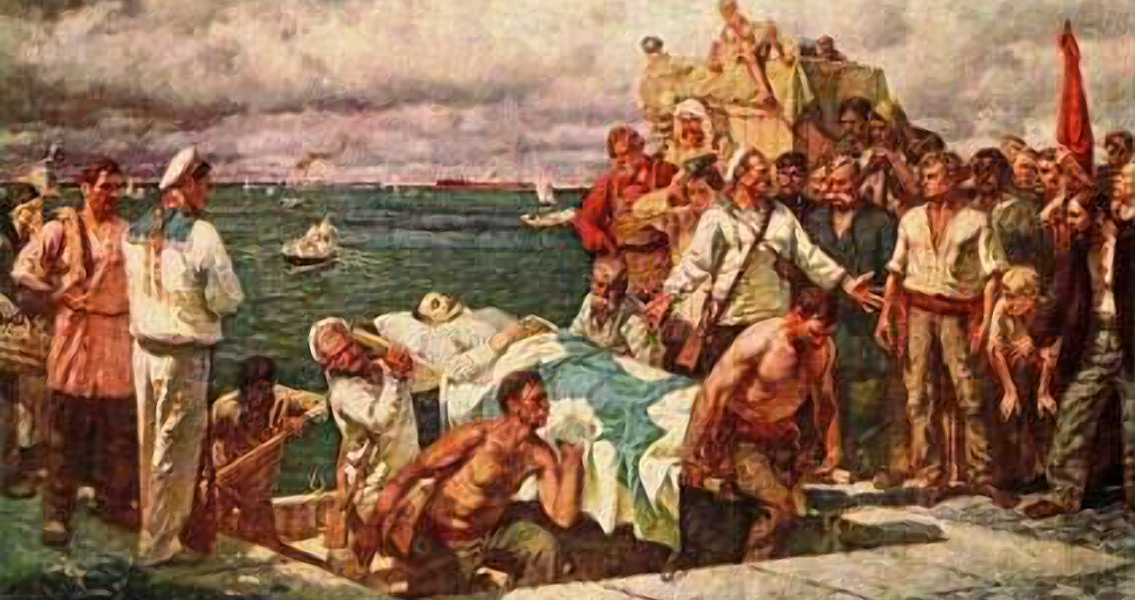
Potemkin surrendered to Romanian authorities at the port of Constantza, on the west coast of the Black Sea. Immortalised in Sergei Eisenstein’s 1925 movie, ‘Battleship Potemkin’, the Potemkin mutiny was one of the most shocking moments of a year of upheaval and unrest in Russia. The striking scenes of Eisenstein’s propaganda film ensured that events on the battleship Potemkin have been remembered more than others from the 1905 revolution as a symptom of the growing conflict between labour and capital which would ultimately split Russia and see the end of the Romanov monarchy. Commissioned in 1903, the Potemkin was one of the newest battleships in Russia’s Black Sea fleet. At sea on 27th June, the ship’s cooks complained that the meat they had been given to prepare was riddled with maggots. The ship’s doctor said that the meat was still fit to use, and instructed the cooks to continue serving it. Hours later a delegation from the crew went to the captain and complained that there were worms in the soup they had been served. Commander Gilarovsky, the ship’s commanding officer, inexplicably flew into a rage which some historians put down to the coarse language used by the crew members, and shot the group’s spokesman, a seaman named Valenchuk. Gilarovsky’s murderous response to the protest inevitably bred more violence. At once the crew members seized the commander and threw him over board. As he struggled in the water he was shot and killed. The refusal of the Potemkin‘s guard to fire on their own ship mates allowed the mutiny to rapidly escalate. A brawl ensued in which sailors were able to seize weapons from the ship’s armory. Several of the ship’s officers and the doctor were shot, while the rest of the officers were imprisoned in one of the Potemkin‘s cabins. A red flag was raised on the ship, and it set sail for Odessa. It was decided that the ship would be governed by a people’s committee, with one of the initial protest’s ringleaders, Matyushenko, elected its leader. At this point protests, riots and unrest were common throughout Russia’s southern cities as the Tsar’s grip on power began to look increasingly fragile. When the Potemkin arrived at Odessa on the 29th June, the unrest in the city quickly escalated as the population tried to deliver food and supplies to the ship’s crew. A violent clash erupted between rioters and government troops which saw huge swathes of the city burnt and over a thousand people killed. Tsar Nicholas II ordered the Russian army to Odessa to suppress the resistance and restore order. They indiscriminately attacked the crowd of protesters, and the Potemkin, powerless to assist the people of Odessa, fled the city. A squadron from the Russian navy was then dispatched to either capture or sink the Potemkin. The ships confronted the Potemkin in the Black Sea, but ultimately refused to open fire out of fear it could trigger mutiny among their own crews. The Potemkin then fled to the Constantza port in Romania to gain vital supplies, but was refused entry. Short on food, and lacking vital supplies to keep the ship running, the crew soon realised they had no choice but to surrender, and on 8th July they handed the ship over to the Romanian authorities. A large chunk of the crew returned to Russia, where they were imprisoned and trialed. Others stayed in Romania, and didn’t return to Russia until after the 1917 Bolshevik Revolution. The mutiny was the culmination of a variety of factors. The February 1905 Bloody Sunday Massacre had shocked the Russian people and galvanised resentment against the Tsarist regime. This led to growing acts of defiance and protest, of which the events on the Potemkin were just one example. In the longer term, Russia’s embarrassing failure in the recent war with Japan, combined with continued terrible conditions for its armed forces, had led to widespread dissatisfaction among all but the highest ranking members of the military. As Eisenstein’s movie about the Potemkin shows, the mutiny was later used by Soviet leaders as a heroic example of the history of the development of communist ideals in the country. Image courtesy of Wikimedia Commons user: HOBOPOCC]]>

Categories
News

The Amistad Mutiny

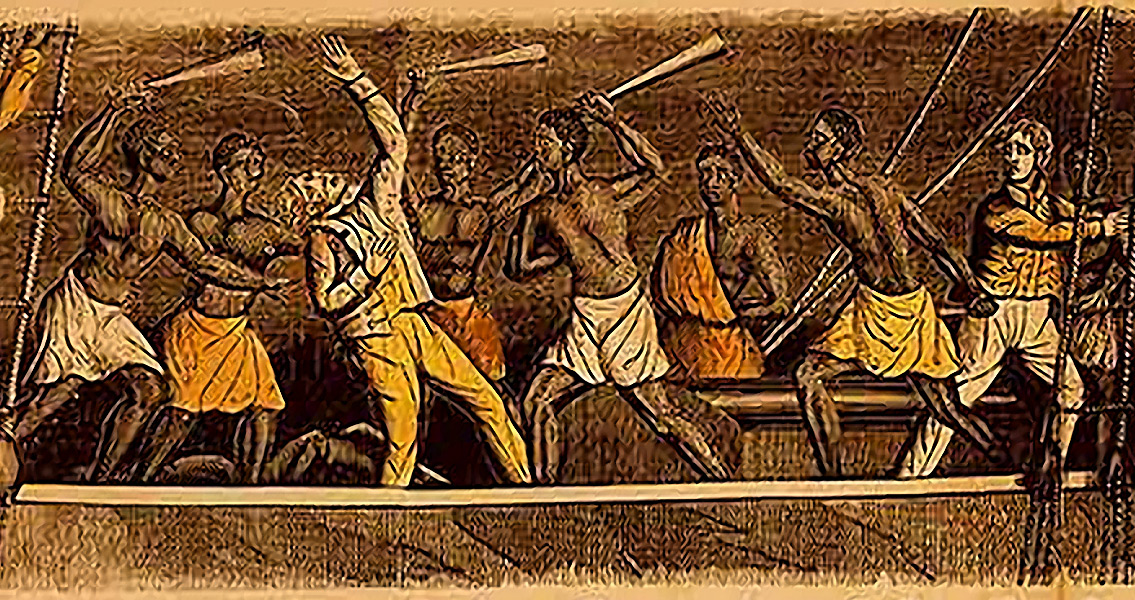
Amistad. The event became the basis for one of the most significant court cases in US history and a defining moment in the development of the abolition movement in the United States. Sometime in April 1839 Clinque, a 26 year old man from Mende in Sierra Leone, was captured alongside hundreds of others from the West African tribes by Spanish slave merchants. With his wife and three children still free and living in Sierra Leone, Clinque and 500 other slaves were taken, chained hand and foot, aboard the Portuguese slave vessel Teçora to the Caribbean. Teçora finished its voyage by entering Cuba under the cover of night. The secretive approach was because of Anglo-Spanish treaties which had made the trade of slaves from Africa a capital crime. Slavery was legal in Cuba however, meaning once smuggled ashore it would be possible to trade the slaves on the Cuban market. Highlighting the horrendous conditions endured by the captives aboard Teçora, a third of the slaves had died by the time the ship reached Havana. Clinque and 53 other slaves, including four children, were bought by two Spaniards: Jose Ruiz and Pedro Montes. The slaves were collected aboard the Amistad, a small schooner built in Baltimore especially for the slave trade. It set sail on a 300 mile journey to transport the slaves from Havana to Puerto Principe, on another part of Cuba. The mutiny started three days into the voyage. Clinque used a nail to pick the locks of his chains and free the other captives. The escapees, armed with machete like weapons they had found in the vessel’s stores, stormed the ship, killing the Amistad‘s captain and cook, and injuring Montes and Ruiz. The lives of the two Spaniards were spared for their navigational skills, and they were tasked with sailing the ship back to Africa. Montes and Ruiz deceived the captives and had the ship sail back and forth along the coast of the Americas. After two months at sea the vessel was spotted by the USS Washington off the coast of Long Island. The difficult voyage had seen around a dozen of the slaves perish. The US Navy ship escorted the Amistad to Connecticut, where Montes and Ruiz were freed and the Africans were imprisoned pending an investigation into the mutiny. Quickly the mutiny escalated into an international issue which engaged directly with the long standing controversies over slavery. A group of evangelists, led by Lewis Tappan, worked to publicise the incident as a means to expose the evils of the slave trade. A key turning point took place when they found two other men from Sierra Leone who could serve as translators for Clinque, allowing his side of the story to be publicised. Increasingly, abolitionists painted and spread a vivid depiction of the horrendous conditions endured by the slaves. They launched a case, arguing that the Africans had been enslaved illegally and had thus broken no laws in trying to escape from bondage. On the other side, Montes and Ruiz sued the slaves, on the basis that they had been deprived of their property. They demanded the return of the slaves, which they fraudulently claimed had been born in Cuba. The Spanish government was eager for the slaves to be returned to Cuba to stand trial for piracy and murder. Tremendous diplomatic pressure was therefore placed on US President Martin Van Buren to find a quick solution to the mutiny which would appease the Spanish demands. An interesting sub-plot to the case was the Spanish awareness that if Mortes and Ruiz were found guilty of having kidnapped the slaves from Africa, Spain’s infringement of the treaty banning the African slave trade would be revealed. This, in turn, would provide the British with justification to intervene in Cuba. An initial trial, in January 1840, ruled that the slaves had been imprisoned illegally. As such, they would not be forced to return to Cuba to stand trial but instead freed and returned to Africa. Shockingly, Van Buren and the Spanish government both intervened in the case, and appealed the verdict to the Supreme Court. In March 1841 the Supreme Court confirmed the original verdict, ruling again that the slaves had been imprisoned illegally. With financial assistance from the abolitionists that had backed their campaign, the Africans from the Amistad set sail for West Africa in November 1841. For the United States, the verdict of the trial was pivotal. It revealed the growing momentum of the abolition movement, and the growing contradictions between US law and the moral principles supposedly embodied in the country’s Declaration of Independence. The event became a public as well as political spectacle, highlighting the divisions between slave owners and abolitionists. The result set an important legal precedent concerning the importance of ‘natural law’ over the property rights of the slave owners and as such, the outcome of the Amistad trial was a crucial step in the process which ultimately culminated in the Thirteenth Amendment in 1865.]]>