Categories
Editorial

“The strangest leader west of North Korea”: the personality cult of Turkmenbashi

Turkmenbashi rises to power Turkmenistan had operated under Russian control for more than a quarter of a century when it became part of the Soviet Union in 1924; so when Communism fell, the country found itself independent for the first time in 100 years. When it came to appointing a new leader, Saparmurat Niyazov was the obvious choice. Having operated as the Communist Party’s puppet governor since 1985, he was already considered by many to be the country’s ruler. Still, an election took place. On 21st June 1992, the Turkmenistani presidential election saw Niyazov chosen as the country’s first elected president. He was the sole candidate.

A post-Soviet cultural vacuum

One of his first acts was to declare himself Türkmenbaşy, or Turkmenbashi. Shortly afterwards, a plebiscite extended his term to 2002. Allegedly, it was to enable him to oversee a decade-long development plan. The proposal achieved a 99.9% approval rate in the vote. However, before the term was complete, Parliament declared him ‘President for Life’. It was no coincidence that parliamentary elections had been held just a few weeks earlier, in which the president had chosen all the candidates.

Extreme mismanagement of the economy

The gas-rich state allowed Turkmenbashi to indulge himself at the expense of a downtrodden population. His National Democratic Party managed the economy disastrously; meaning that 35% of the population lived below the poverty line. The average income, in fact, was less than £30 a month. Housing and fuel were cheap; but healthcare and education were sparse. This didn’t stop him from commissioning Central Asia’s largest mosque, the Spirit of Turkmenbashi, at a reported cost of £60m. On top of the hardships of widespread poverty, the ubiquitous image of the leader became inescapable. And yet, criticising the money lavished on this and other presidential projects – such as eccentric horse race tracks – would be committing the offence of ‘parricide’. In the national criminal code, this was defined as ‘questioning the policy of the president’.

Bizarre policies

Daily life in Turkmenistan became increasingly eccentric. He declared July 10th a public holiday to honour melons. April 27th was Horse Day. As time went on, allegedly drug-fuelled paranoia came to define the President-for-Life’s policies. The arts fell victim to Turkmenbashi’s whims: ballet, circuses and opera were all banned.

An ego goes berserk

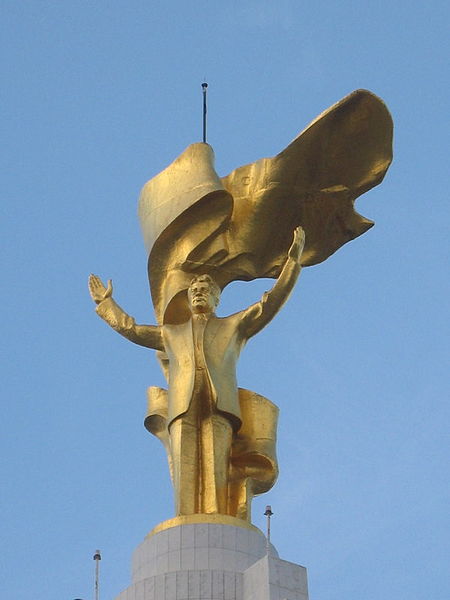
Many of Turkmenistan’s new laws reflected an uncontrollable ego. When he gave up smoking in 1997, so too did his populace (in public places, at least). Doctors took an oath not to Hippocrates, but to Turkmenbashi. The month of January was renamed Turkmenbashi; and a 250 ft gold statue of Turkmenbashi constantly rotated to face the sun. Streets, cities schools, and even the airport were all renamed Turkmenbashi, making the country increasingly difficult to navigate. When a meteorite landed in Turkmenistan in 1998, its given name surprised no one. [caption id="attachment_8752" align="aligncenter" width="450"] Credit: Martijn Munneke via Wikimedia Commons[/caption]

Turkmenbashi, the author

And yet, for all of his self-aggrandising moves, there are few that compete with his book. Like Chairman Mao and Colonel Gaddafi before him, Turkmenbashi penned a philosophical treatise known as Ruhnama, which is Persian for ‘Book of the Soul’. To celebrate finishing it in September 2001, he renamed the month ‘Ruhnama’. A combination of poetry, moral guidelines and revisionist history, it became compulsory reading in all schools. Indeed, an entire day of the schoolchild’s week was spent on Ruhnama. Memorisation was required to graduate, get a state job or receive a driver’s license. Its effect was not limited to the mortal lives of the people. The book lay next to the Quran in mosques, and it was to be kissed by all worshippers on entering the building. Shortly before his death, Turkmenbashi even suggested that reading the Ruhnama was a requirement for entry into heaven. Without much competition (all Soviet-era books were banned), Turkmenbashi awarded himself the Magtymguly International Prize, an accolade honouring the best pro-Turkmen poetry.

Repressing opposition politics

The edict of Ruhnama was so strictly enforced that when former chief mullah Nasurallah Ibadullah resisted, he was punished with a 23-year prison sentence. But of course, extreme punishments became characteristic of Turkmenbashi’s rule. Some were welcomed by certain pockets of society: he would execute Turkmen gangsters and display their dead bodies on national television. Other punishments were more political. In 2002, the country’s former foreign minister, Boris Shikmuradov, wrote an open letter accusing Turkmenbashi of staging an attack on his car so that he could enforce harsh laws. He wrote: “I intend to hand myself in to the National Security Ministry in the hope my arrest will stop the massive arrests and torture of innocent people… I write this while I am free. I can only assume what will happen to me in the near future… We have several times witnessed how people were physically and psychologically tortured.” Shikmuradov was arrested in December that year, confessed to his crimes on national television and was jailed for life. After that, the number of political prisoners in the country rocketed to an estimated 20,000. Many were forced to watch as their relatives were beaten. [caption id="attachment_8753" align="aligncenter" width="334"] Turkmenbashi walks with Vladimir Putin in 2000. Credit: kremlin.ru via Wikimedia Commons[/caption]
The strangest leader west of Pyongyang?

On 21 December 2006, Turkmenbashi died of a heart attack. Since then, his successor has been busy dismantling a personality cult that permeated every aspect of Turkmenistan’s society. As political author Daniel Kalder writes, “Soon Niyazov will be reduced to a footnote of history, a joke to all except the unfortunate five million Turkmens obliged to live under his rule.”]]>

Categories
Breaking News

Construction Work Reveals Russian Spy Room

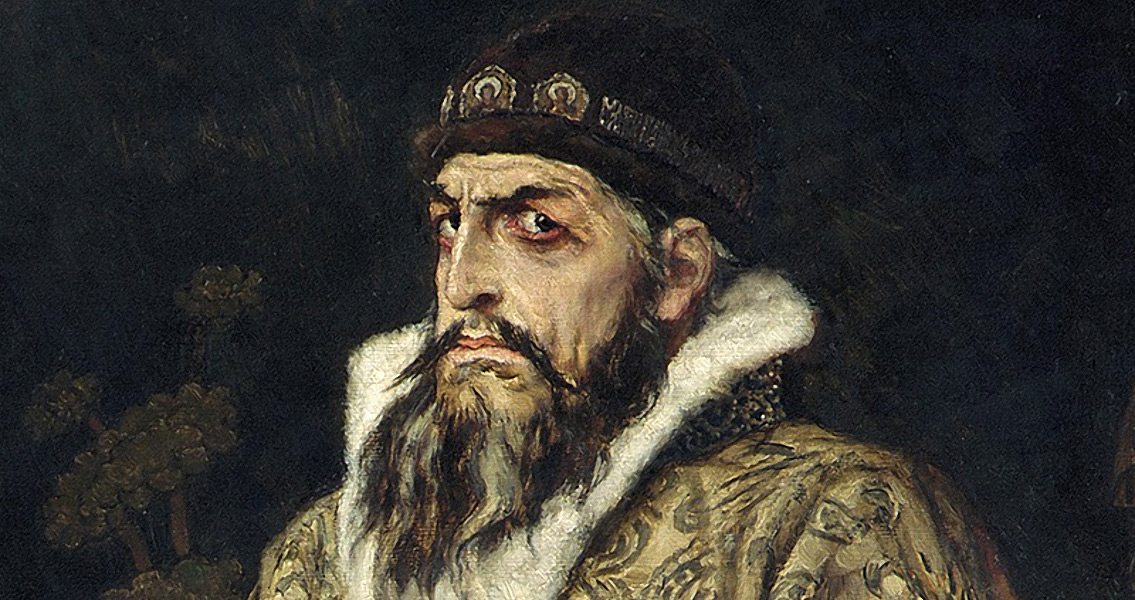
RT’s Ruptly news agency. Ivan IV Vasilyevich, also known as Ivan the Terrible, was the Grand Prince of Moscow between 1533 and 1547. During his reign, Russia conquered several neighboring regions to become a multicontinental and multiethnic state that spanned approximately 4,050,000 square kilometers (1,560,000 square miles). Historic sources offer dissimilar accounts of Ivan’s character. He’s often described as devout and intelligent, and a patron of the arts and trade (he established Russia’s first publishing house), yet he was prone to rages and episodic periods of mental instability that grew more common as he aged. During one such outburst, he reportedly killed his second son and heir Ivan Ivanovich during a heated argument that resulted in Ivan Vasilyevich striking him in the head with a pointed staff. In total, archeologists recovered approximately 150 artifacts dating back to between the sixteenth and nineteenth centuries, the majority of which are eighteenth and nineteenth century ceramics, including fragments of bowls and pots, as well as an intact ceramic cup. Trade sealing marks made of lead, 12 copper coins, nails, and iron knives were also recovered from the room. Experts are currently considering whether the room should be opened up for the public to see or preserved as it is. ]]>

Categories
Editorial

Why Are So Many Flags Red, White and Blue? (Part Two)

first part of this article looked at the history of the flags of the Netherlands, the UK and France; but the prevalence of red, white and blue flags goes way beyond western Europe. On 14th June, 1777, the US flag was born in a resolution by the Marine Committee of the Second Continental Congress. “Resolved, that the flag of the United States be thirteen stripes, alternate red and white; that the union be thirteen stars, white in a blue field representing a new constellation.” The basis of the stars and stripes was born, although additional stars would be added as the USA expanded. An explanation for the decision to make the flag red, white and blue can be found in events a year earlier. The country’s great seal, also coloured red, white and blue, had been designed to reflect the beliefs of the Founding Fathers. It is therefore unsurprising that those same colours found themselves in the flag of the USA. Charles Thomson, Secretary of the Continental Congress, explained the meaning of the colours when he presented the seal to Congress. “White signifies purity and innocence. Red, hardiness & valour, and Blue… signifies vigilance, perseverance & justice.” Significantly, some historians have suggested that the colours were chosen because of their presence in the British flag. Despite having just won the war of independence, the US flag still reflected the heritage of many of the Founding Fathers. On the other side of the world these same colours had also started to be used in Russia, and then elsewhere in Eastern Europe. Again, the process was a combination of specific regional histories, external influences and coincidences. The origins of the Russian flag of horizontal white, blue and red stripes dates back to the seventeenth century. Tsar Peter the Great chose the design for Russia’s merchant ships, inspired by the Dutch design after a visit to the Netherlands. The flag became a poignant symbol for the Russian people, the colours taking on symbolic meanings, and by the late nineteenth century it was the flag of the country despite attempts by the Tsars to impose a black, orange and white tricolor as Russia’s symbol. The 1848 Pan Slavic Congress saw these colours spread throughout Eastern Europe. The meeting, held in Prague between representatives from all Slavic populations, was carried out as an act of defiance against growing German and Hungarian nationalism. Among the meeting’s outcomes was the declaration of red, white and blue as the colours of the Slavic peoples. Some historians say that this decision was inspired by the French flag, the members of the Congress drawing a link between their cause and the French Revolution. Others argue the colours were chosen in reference to the Russian flag, reflecting the belief that Russia could protect and foster Slavic nationalist movements. Whatever the case, following the Congress different nationalist groups such as Slovenians, Slovakians and Croatians started to use the colours on their flags, and they have stayed prominent into the twenty first century. Countless other examples of red, white and blue flags exist, in Chile for instance, or Thailand. Sometimes this can be explained by specific local circumstances – in Chile the blue stands for the sky, the white for the snow capped Andes and the red for the blood of the citizens who fell in the struggle for Independence. In other instances global events were at play – the blue in the Thai flag was added deliberately in 1917 to reflect the flags of its allies in World War One: Britain, France, Russia and the USA. Each of the examples mentioned, from the Netherlands to Chile, have their own story behind the use of red, white and blue in their national flags. Although there are of course some connections between the decisions, there are also examples which can only be explained by chance and circumstance. What is perhaps most striking however, is the multitude of meanings the three colours have come to hold, as history has seen red, white and blue weaved into countless different narratives of cultural identity and association. ]]>

Categories
News

History's Strangest Tax? Peter the Great Puts a Price on Beards

Categories
Breaking News

Ancient Stone Furnaces Discovered Under a Road to Russian Tourist Spot

Siberian Times. “The first finds were made in 1998 and the numerous discoveries came in the following years showing us that the Baikal region was one of the largest metallurgical regions in Asia at the end of first millennium B.C., and early in the first millennium A.D.” Despite the migration processes occurring at the time, these metallurgical technologies not only continued, they were improved upon and passed on to future generations. The earliest known metal used by humans appears to have been gold which is naturally occurring. Small quantities of natural gold have been unearthed in Spanish caves used during the late Paleolithic era (around 40,000 BCE). Silver, tin and copper can also be found in their native form, and allowed for limited metalworking in ancient cultures. ]]>

Categories
News

Conspiracy and Anti-Semitism Lead to Bialystok Pogrom

Categories
Breaking News

Homo Sapiens Inhabited Russian Dig Site

Categories
News

February Revolution – History Changed in Less than a Fortnight

Categories
News

Armenian Reform Plan Lays Path to War and Genocide

Categories
News

Did a Curse Sink the Neva or the Weather?