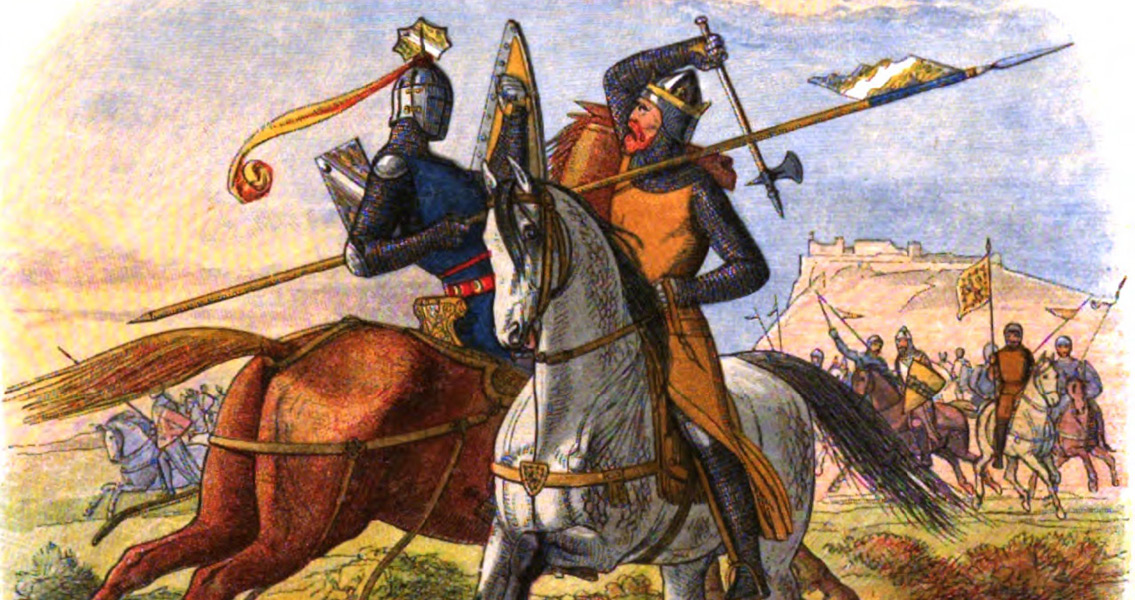
Herald Scotland newspaper: “These stones have been linked to Randolph’s skirmish, though I thought they were more likely to be prehistoric and possibly incorporated into the battle. This year I received funding and I have now obtained a radiocarbon date in association with the foundation of the stone. The date that came up is contemporary with the battle. It raises the very real possibility that the stones were constructed to mark the site of Randolph’s victory on the first day.” It was a highly significant battle in that it prevented the English from reaching Stirling Castle, as well as setting up the Scots for their historic victory over the much larger army of King Edward II on the following day. Like a modern day commemorative plaque, the stones, believed to have come from Castle Rock, would have been placed there as a memorial. Police Scotland, who permitted the investigation, have stated that after this new discovery the stones may be made more visible and accessible to the public. Stirling’s Local Area Commander, Chief Inspector Lynn Ratcliff, told The Herald: “These stones are literally in our front yard. We’ve been aware of them, but we did not know their history or background.” The Battle of Bannockburn, during the First War of Scottish Independence, is considered a milestone in Scottish history. The Scots fortress, Stirling Castle, was occupied at the time by the English, and was under siege by the Scottish forces. The English king put together a formidable army to end the siege and keep the castle. His attempt was a failure and his troops were defeated by the much smaller army led by Robert the Bruce, the King of Scots, in a fierce battle. The Wars of Scottish Independence, fought between Scotland and England, started in 1296 with the English initially successful, having won a series of important victories such as the Battle of Dunbar (1296) as well as the Capture of Berwick (1296). However, when Robert the Bruce took the Scottish throne in 1306, the war was restarted. The Bannockburn battlefield is part of the Historic Battlefields in Scotland and is protected by Historic Scotland under the Historic Environment Act. ]]>

Commentarii de Bello Gallico is Caesar’s own firsthand account of the battles which took place in the Netherlands and is still considered the most important and comprehensive account of the conflict. The six volumes include battle descriptions and war-time intrigues which took place during the nine years he fought the local armies that opposed Roman domination in Gaul – Gaul is generally considered to have included modern day Belgium, France and parts of Switzerland. In the Commentarii de Bello Gallico the Roman invasion of Gaul is portrayed by Caesar as a defensive and preemptive action. Regardless of the personal motivations ascribed by historians, defeating Gaul was important to Rome in a military sense. Conquering Gaul provided Rome the means of securing a defensible natural border (the Rhone river) against its enemies to the north along the Rhine River, preventing ongoing attacks. Meanwhile, in Rome Caesar’s contemporaries had begun labeling him a war criminal, guilty of perpetrating what today would be considered genocide, and many were promoting the idea of charging and trying him for these war crimes. Much of the talk was generated by stories coming back from the battlefield regarding Caesar’s unwillingness to offer refuge to Gaul natives (specifically the Helvetii). Some claims stated that after Caesar turned them away, he followed them back into Gaul, executing soldiers and slaughtering entire villages. The campaigns Caesar led against the Helvetii are described and defended in great detail in the Commentarii de Bello Gallicoaccusations. The Helvetii were actually a coilition of approximately five related Gallic tribes living on the Swiss plateau, hemmed in by the Rhone and Rhine rivers and mountains. Because of the inhospitable landscape and increasing pressure from German forces from the north and east, by the start of the Gallic Wars the Helvetii were completing the planning and provisioning for a mass migration west. After a series of failed negotiations in which Caesar would have allowed the Helvetii to cross the Rhone and Roman territory on their way to the west coast, the tribe made several attempts to cross the Rhone river by force – each time being turned back by the Romans. The Helvetii then changed track and began moving west by negotiating with neighboring tribes and pillaging lands under Roman protection on their way to the river Arar (now named the Saône River). The river Arar is where Caesar eventually caught up to them. In the end and with massive loses on both sides, the Romans were victorious and accepted the Helvetii’s surrender (executing more than 6,000 soldiers who attempted to flee rather than surrender). In the Commentarii de Bello Gallico Caesar refers to a Greek census from that time which reported the Helvetii population as 368,000; only 110,000 survived to return to their homeland. ]]>