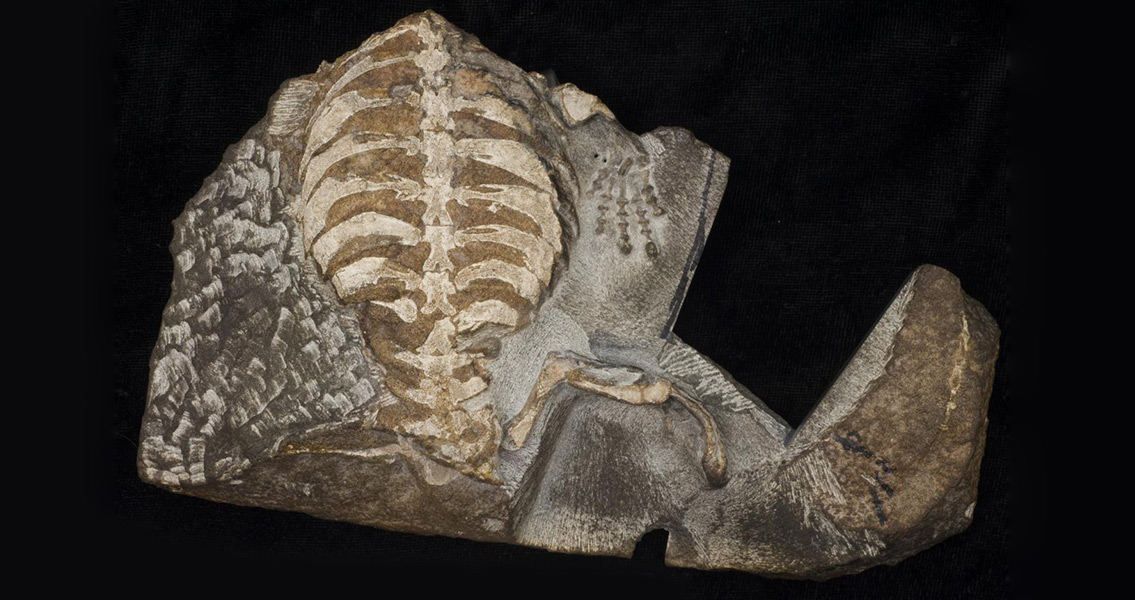
Current Biology claims that this was not always the case. Rather, the authors suggest that broad ribbed proto-shells were actually an adaption to help with burrowing underground. Eight year old Kobus Snyman was walking on his father’s farm in the Western Cape of South Africa when he found the remains of a proto-turtle. The specimen proved to be the missing piece in the puzzle for the group of scientists striving to determine the origin of turtle shells. Measuring about 15 cm in length, the specimen Snyman discovered is in remarkably good condition, comprising a well preserved skeleton with fully articulated feet and hands. It is an example of Eunotosaurus africanus, a partially shelled turtle that lived around 260 million years ago. “Why the turtle shell evolved is a very Dr. Seuss like question and the answer seems pretty obvious – it was for protection.” said lead author of the study, Dr. Tyler Lyson of the Denver Museum of Nature and Science. “But just like the bird feather did not initially evolve for flight – we now have early relatives of birds such as tyrannosaur dinosaurs with feathers that definitely were not flying – the earliest beginnings of the turtle shell was not for protection but rather for digging underground to escape the harsh South African environment where these early proto turtles lived”. Understanding the importance of ribs in turtles was crucial to the team’s results. “We knew from both the fossil record and observing how the turtle shell develops in modern turtles that one of the first major changes towards a shell was the broadening of the ribs.” said Lyson, in a press release. Because ribs are crucial to both respiration and movement, changes in them have a major impact on all four legged animals. When ribs broaden they stiffen the torso, in turn shortening stride length, slowing down the animal and impeding its breathing. “Ribs are generally pretty boring bones. The ribs of whales, snakes, dinosaurs, humans, and pretty much all other animals look the same. Turtles are the one exception, where they are highly modified to form the majority of the shell.” explained Lyson. The breakthrough for the team came with the discovery of several specimens of Eunotosaurus africanus in the Karoo Basin of South Africa. Analysis of the fossils revealed that the broadening of the ribs in this creature had nothing to do with protection, but was rather a means to provide a more stable base when the animal used its front limbs to dig underground. Professor Rubidge from the University of Witwatersrand in South Africa, who was one of the scientists gathering fossils for the study, made it clear how important Snyman’s contribution had been. “I want to thank Kobus Snyman and shake his hand because without Kobus both finding the specimen and taking it to his local museum, the Fransie Pienaar Museum in Prince Albert, this study would not have been possible.” For more information: www.cell.com Image courtesy of Tyler R. Lyson]]>