Categories
Breaking News

Humans Migrated To North America 10,000 Years Earlier Than Thought

PLOS ONE. Until now, the earliest settlement date for North America was estimated at 14,000 years Before Present (BP), based on the earliest reliably dated archaeological sites. The new study has moved that date back to 24,000 years BP, to a period that coincides with the height of the last ice age. The groundbreaking research was carried out by Ariane Burke, a professor in Université de Montréal’s Department of Anthropology, and her doctoral student Lauriane Bourgeon, with the contribution of Dr. Thomas Higham, Deputy Director of Oxford University’s Radiocarbon Accelerator Unit. A controversial site first excavated forty years ago is at the heart of the latest study. The Bluefish Caves, located on the banks of the Bluefish river in northern Yukon near the Alaskan border, were first studied by archaeologist Jacques Cinq-Mars over a ten year period beginning in 1977. Radiocarbon dating of animal bones discovered at the site led the researcher to hypothesize that human settlement in the surrounding region dated back to 30,000 BP. For thirty years Cinq-Mars’ conclusions have remained controversial in the scientific community, primarily due to the lack of other sites of a similar age. In addition, there was no clear evidence that the horse, mammoth, bison and caribou bones found in the Bluefish Caves were the result of human activity there. Bourgeon set out to answer once and for all whether Cing-Mars’ hypothesis was correct. Over the course of two years she examined 36,000 bone fragments taken from the Bluefish Caves and preserved in the Canadian Museum of History in Gatineau. Fifteen bones showed ‘undeniable’ traces of human activity, according to a University of Montreal press release. Another twenty fragments showed probable traces of human activity. “Series of straight, V-shaped lines on the surface of the bones were made by stone tools used to skin animals,” said Burke. “These are indisputable cut-marks created by humans.” The bones were then submitted for radiocarbon dating. The oldest fragment, a horse mandible showing marks likely caused by the tongue being removed by a stone tool, was dated to between 23,000 and 24,000 years BP. “Our discovery confirms previous analyses and demonstrates that this is the earliest known site of human settlement in Canada,” explained Burke in the press release. “It shows that Eastern Beringia was inhabited during the last ice age.” The results support findings made in studies of population genetics that a group of a few thousand individuals lived in isolation in Beringia between 15,000 and 24,000 years ago. “Our discovery confirms the ‘Beringian standstill [or genetic isolation] hypothesis,'” said Burke, “Genetic isolation would have corresponded to geographical isolation. During the Last Glacial Maximum, Beringia was isolated from the rest of North America by glaciers and steppes too inhospitable for human occupation to the West. It was potentially a place of refuge.” It seems, therefore, that the ancient humans inhabiting the Bluefish Caves were among those who, at the end of the last ice age, migrated south and went on to colonise the entire North American continent, along the coast and down to South America. Image courtesy of Université de Montréal ]]>

Categories
Breaking News

Domesticated Chickens Arrived In Africa Much Earlier than Thought

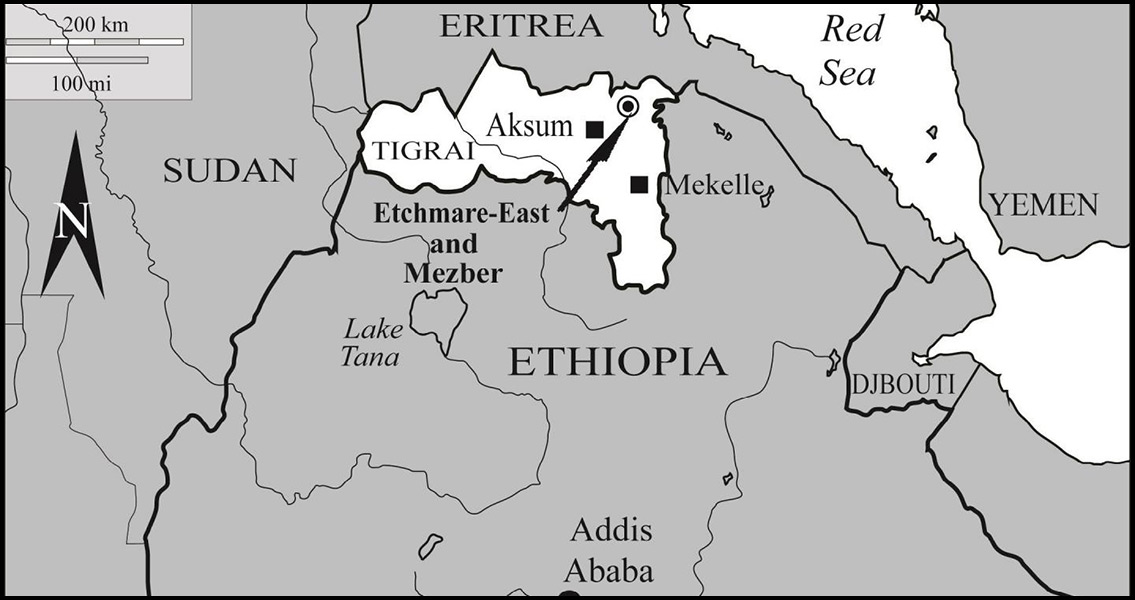
Gallus gallus, a species endemic to sub-Himalayan northern India, southern China and south-east China. First domesticated in the region between 6,000 and 8,000 years ago, the offspring of these chickens have spread across the globe. A team from Washington University in St. Louis radio carbon dated around 30 chicken bones unearthed from the site of an ancient farming village in what is today Ethiopia. Among them was a discarded chicken leg, etched with teeth marks from thousands of years ago. The bones provide physical evidence of the introduction of chickens to Africa. “Our study provides the earliest directly dated evidence for the presence of chickens in Africa and points to the significance of Red Sea and East African trade routes in the introduction of the chicken,” said Helina Woldekiros, lead author of the study and a postdoctoral anthropology researcher in Arts & Sciences at Washington University, in a press release. How the domesticated chicken arrived and then dispersed through Africa has long remained a mystery. Earlier research relied on depictions of chickens in ceramics and paintings, along with bones from other archaeological sites, to conclude that chickens were introduced to Africa through North Africa, Egypt and the Nile Valley about 2,500 years ago. Until now, the earliest actual bone based evidence of chickens in Africa was from the Saite levels at Buto, Egypt, and was dated to between 685 and 525 BCE. The new study, published in the International Journal of Osteoarchaeology, both pushes that date back by centuries and also suggests that the initial introduction could have happened on the east rather than north coast of Africa. “Some of these bones were directly radiocarbon dated to 819-755 B.C., and with charcoal dates of 919-801 B.C. make these the earliest chickens in Africa,” explained Woldekiros. “They predate the earliest known Egyptian chickens by at least 300 years and highlight early exotic faunal exchanges in the Horn of Africa during the early first millennium B.C.” Co-author of the study Catherine D’Andrea, professor of archaeology at Simon Fraser University in Canada, led the excavation team in Ethiopia. The bones used in the study were recovered from the kitchen and living room floors of an ancient farming community known as Mezber: a rural village located in northern Ethiopia about 30 miles from the urban center of the pre-Aksumite civilization. The pre-Aksumites were the first people in the Horn of Africa to form complex, urban-rural trading networks. Interestingly, linguistic studies into the ancient root words for chickens in African languages suggest the birds had arrived through multiple routes: North Africa through the Sahara to West Africa; and from the East African coast to Central Africa. Molecular studies revealing the biodiversity of domesticated African chickens further support this notion of domestic chickens arriving in Africa through multiple routes. Woldekiros said: “It is likely that people brought chickens to Ethiopia and the Horn of Africa repeatedly over a long period of time: over 1,000 years. Our archaeological findings help to explain the genetic diversity of modern Africans chickens resulting from the introduction of diverse chicken lineages coming from early Arabian and South Asian context and later Swahili networks.” Studies like Woldekiros and D’Andrea’s shed new light on ancient migration, exchange and trade; the spread of domesticated animals tracing the paths of ancient connections. Sometimes these trades were unsuccessful of course, with various zooarchaeological studies showing examples where the introduction of a new species to a new part of the world failed. Other times it took repeated introductions of a new species to a region, something which the recently published study points to. “Our study also supports the African Red Sea coast as one possible early route of introduction of chickens to Africa and the Horn,” Woldekiros said. “It fits with ways in which maritime exchange networks were important for global distribution of chicken and other agricultural products. The early dates for chickens at Mezber, combined with their presence in all of the occupation phases at Mezber and in Aksumite contexts 40 B.C.- 600 A.D. in other parts of Ethiopia, demonstrate their long-term success in northern Ethiopia.” Image Courtesy of International Journal of Osteoarchaeology]]>