Nature. ]]>

Nature. ]]>

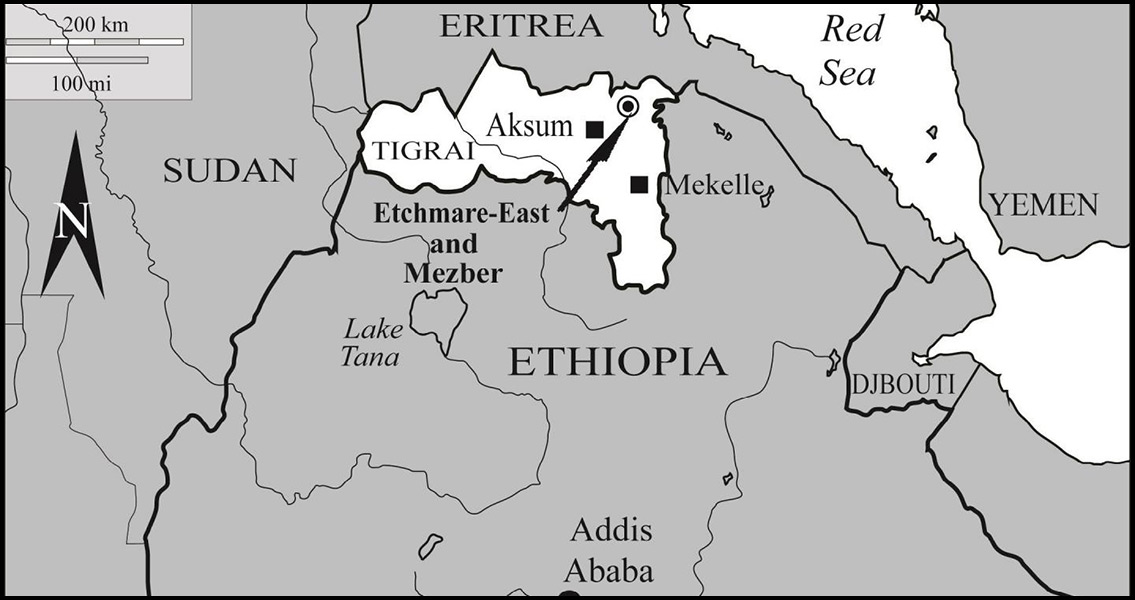
Gallus gallus, a species endemic to sub-Himalayan northern India, southern China and south-east China. First domesticated in the region between 6,000 and 8,000 years ago, the offspring of these chickens have spread across the globe. A team from Washington University in St. Louis radio carbon dated around 30 chicken bones unearthed from the site of an ancient farming village in what is today Ethiopia. Among them was a discarded chicken leg, etched with teeth marks from thousands of years ago. The bones provide physical evidence of the introduction of chickens to Africa. “Our study provides the earliest directly dated evidence for the presence of chickens in Africa and points to the significance of Red Sea and East African trade routes in the introduction of the chicken,” said Helina Woldekiros, lead author of the study and a postdoctoral anthropology researcher in Arts & Sciences at Washington University, in a press release. How the domesticated chicken arrived and then dispersed through Africa has long remained a mystery. Earlier research relied on depictions of chickens in ceramics and paintings, along with bones from other archaeological sites, to conclude that chickens were introduced to Africa through North Africa, Egypt and the Nile Valley about 2,500 years ago. Until now, the earliest actual bone based evidence of chickens in Africa was from the Saite levels at Buto, Egypt, and was dated to between 685 and 525 BCE. The new study, published in the International Journal of Osteoarchaeology, both pushes that date back by centuries and also suggests that the initial introduction could have happened on the east rather than north coast of Africa. “Some of these bones were directly radiocarbon dated to 819-755 B.C., and with charcoal dates of 919-801 B.C. make these the earliest chickens in Africa,” explained Woldekiros. “They predate the earliest known Egyptian chickens by at least 300 years and highlight early exotic faunal exchanges in the Horn of Africa during the early first millennium B.C.” Co-author of the study Catherine D’Andrea, professor of archaeology at Simon Fraser University in Canada, led the excavation team in Ethiopia. The bones used in the study were recovered from the kitchen and living room floors of an ancient farming community known as Mezber: a rural village located in northern Ethiopia about 30 miles from the urban center of the pre-Aksumite civilization. The pre-Aksumites were the first people in the Horn of Africa to form complex, urban-rural trading networks. Interestingly, linguistic studies into the ancient root words for chickens in African languages suggest the birds had arrived through multiple routes: North Africa through the Sahara to West Africa; and from the East African coast to Central Africa. Molecular studies revealing the biodiversity of domesticated African chickens further support this notion of domestic chickens arriving in Africa through multiple routes. Woldekiros said: “It is likely that people brought chickens to Ethiopia and the Horn of Africa repeatedly over a long period of time: over 1,000 years. Our archaeological findings help to explain the genetic diversity of modern Africans chickens resulting from the introduction of diverse chicken lineages coming from early Arabian and South Asian context and later Swahili networks.” Studies like Woldekiros and D’Andrea’s shed new light on ancient migration, exchange and trade; the spread of domesticated animals tracing the paths of ancient connections. Sometimes these trades were unsuccessful of course, with various zooarchaeological studies showing examples where the introduction of a new species to a new part of the world failed. Other times it took repeated introductions of a new species to a region, something which the recently published study points to. “Our study also supports the African Red Sea coast as one possible early route of introduction of chickens to Africa and the Horn,” Woldekiros said. “It fits with ways in which maritime exchange networks were important for global distribution of chicken and other agricultural products. The early dates for chickens at Mezber, combined with their presence in all of the occupation phases at Mezber and in Aksumite contexts 40 B.C.- 600 A.D. in other parts of Ethiopia, demonstrate their long-term success in northern Ethiopia.” Image Courtesy of International Journal of Osteoarchaeology]]>

H. floresiensis may have done in Southeast Asia with the larger-brained H. erectus and H. sapiens. H.naledi was first discovered in 2013, when fossil skeletons of 15, at minimum, individuals (over 1,550 specimens in total) were unearthed in South Africa’s Rising Star Cave system, which is part of the Cradle of Humankind World Heritage Site. There are some signs which indicate the individuals might have been placed in the cave deliberately at the time of their death. The word “naledi” means “star” in the Sotho language, chosen in reference to the cave system where the specimens were found. It’s estimated that adult males stood approximately 150 cm (5 ft.) tall and weighed about 45 kg (100 lbs.), while females were likely somewhat shorter and lighter. These sizes are within the range of sexual dimorphism associated with small-bodied humans. A skeletal analysis suggests H. naledi stood upright and walked on two legs, and his hands appear much better suited for manipulation of objects than earlier humans, with thumb, wrist and palm bones that were more modern, yet his fingers were curved, like those of earlier humans. Homo naledi first impressed researchers with the Rising Star Expedition for being remarkably similar to Australopithecus, given the number of shared features between it and the ape-like species. Ultimately, it was determined the species shared even more features with the Homo group, and thus landed in our genus. These same archaic features also led researchers to believe H. naledi existed around 2 million years ago. Now, paleoanthropologist Mana Dembo with the Simon Fraser University in Burnaby, Canada, and her research team, have provisionally dated H. naledi as having lived less than a million years ago. After analyzing 60,000 potential evolutionary trees to determine which one provided the best fit for the tooth and skull measurements of 21 hominid species, chimpanzees, gorillas and H. naledi, they’ve dated H. naledi based on the rate of development of these features. While the new research affirms H. naledi’s place in our genus, which hominid species he’s most closely related to, whether Homo sapiens, Australopithecus sediba or Homo floresiensis (hobbits), remains uncertain. The team found no indications the bones of H. naledi presented as a variant of Homo erectus, as argued previously. H. erectus originated in Africa around 1.8 million years ago and spread quickly into West Asia. Additional statistical comparisons which would include measurements of trunk and limb bones may help in clarifying these evolutionary relationships. This research can be found in the Journal of Human Evolution. Image courtesy of Lee Roger Berger research team ]]>

Homo erectus, in the desert of the East African country of Eritrea. It’s believed the prints date back approximately 800,000 years, and although their age has yet to be verified, it’s anticipated they will provide a wealth of information about the movements and gait of this extinct species of hominid. Alfredo Coppa, an archaeologist with Sapienza University in Rome, along with his Italian research team and researchers with Eritrea’s National Museum discovered the 26 square meter stone slab that contained the footprints. Today, the region where they were found is in the middle of a desert, but 800,000 years ago the environment was very different. The fossilized footprints, which are practically indistinguishable from our own, were left in the sandy sediments on the shore of a lake, which archaeologists believe was part of the landscape at the time. The shapes of the footprints indicate they filled with water directly after they were formed and before they dried out and were eventually buried. The footprints suggest movement from the north to the south, and amazingly, there were also tracks from an animal similar to a gazelle around them, suggesting perhaps our early ancestors were on a hunting expedition. “Fossilized footprints are extremely rare,” Coppa explained to the Italian publication, The Local, “We need to carry out more digs in the area, which has so far turned up the fossilized remains of five or six different Homo erectus specimens.” Homo erectus (which means “upright man”) lived through most of the Pleistocene epoch which lasted from about 2,588,000 years ago up to 11,700 years ago. The earliest Homo erectus fossils date back 1.9 million years, and there are two schools of thought on how and where they evolved. The first theory has Homo erectus evolving from the Australopithecina, in East Africa, and migrating (around 2 million years ago) as a result of the desertifying conditions which were developing in northern and eastern Africa at the time. H.erectus joined other migrations travelling through the “Saharan Pump” and spread throughout much of Eurasia, getting as far as India, Georgia, Sri Lanka, Indonesia, and China. The second theory is that H.erectus evolved in Eurasia and then migrated to Africa, based largely on evidence which has been discovered at the Dmanisi site in Georgia which shows they inhabited the area around the same time or even slightly before the earliest evidence of H.erectus in Africa. What has been decided is that we, Homo sapiens, evolved from African Homo erectus approximately 200,000 years ago. Even if the footprints are found to be the oldest left by Homo erectus, they aren’t even close to being the oldest prints left by a hominid species; a team of researchers in Tanzania discovered the tracks of our first upright ancestor, Australopithecus, which were 3.8 million years old. ]]>
Proceedings of the National Academy of Sciences. Image courtesy of Nicole Boivin]]>

Evolutionary Anthropology ]]>

Sayimys negevensis – was discovered in Israel’s Negev desert (the species was named for the Negev area where it was discovered) and researchers hope it will shed new light on the dispersal routes of several species, including mammals, between Africa and Eurasia during the Early Miocene which occurred between 23 million and 16 million years ago. The discovery has already highlighted Israel’s unique paleogeographic status as an important piece of the Levantine corridor which connected North Africa with Eurasia. Israel is the one place in the Eastern Mediterranean – from Sinai to Anatolia – where Early Miocene fossil sites have been discovered. The research, published in the open access journal PLOS ONE, describes a distant ancestor of today’s gundi: a small rodent who sports bristles (which resemble a comb) on its hind feet’s two middle toes – not surprisingly the gundi is also referred to as a comb-rat. “It is a pivotal species that bridges the gap between an array of primitive Ctenodactylines and the most derived, Early Miocene and later, gundis,” the authors wrote in the PLOS ONE article. Gundis are the only remaining descendants of the Ctenodactylidae family whose ancestors appeared in Asia around 40 million years ago. The species’ widest distribution and greatest diversification occurred from the Far East to Africa, during the Miocene. Today, they live in groups in the deserts and semi-deserts of North and East Africa. “The fossil sites of Israel are in a unique position to offer data on the early times of the large waves of faunal exchanges that took place around 19 million years ago between Eurasia and Africa,” Dr. Raquel Lopez-Antoñanzas, with the University of Bristol, said in a press release. At the time of the Early Miocene, what’s known as Israel today was still attached to Africa. Almost all of the mammals found in modern Israel originated in Africa. Sayimys negevensis is one of only a few species found in Israel with connections to Eurasia. “The new Israeli species is closer in morphology to nearly coeval species found in Pakistan, therefore demonstrating that mammals were already using the Levantine corridor to travel between Eurasia and Africa in the Early Miocene,” Dr. Rivka Rabinovich, a research co-author with the Institute of Earth Sciences and the National Natural History Collections at the Hebrew University of Jerusalem, said in the press release. The new rodent discovery is part of international research being undertaken by scientists from the Israel Geological Survey, Midwestern University in Glendale, Arizona, the University of Manchester and the University of Connecticut; focusing on the paleogeographic implications involving the fauna of Israel during the Early Miocene. For more information www.journals.plos.org Image courtesy of Rivka Rabinovich]]>


“Ancient Ethiopian genome reveals extensive Eurasian admixture throughout the African continent” Image courtesy of Wikimedia Commons user: Thomas Splettstoesser]]>