Categories
Breaking News

Fossils of a New Ape Species Cause Rethink of Evolution

Pliobates cataloniae, seems to have lived before this split between great and lesser apes occurred. This suggests that either the two branches of apes co-existed or that instead of lesser apes evolving from great ones, it was the other way round, one of the authors of the study, published in Science, told EurekAlert. Sergio Almecija, an anthropologist at George Washington University, added that the species provides a missing chapter to the beginnings of human and ape evolution. This missing chapter fills a void in the fossil record; the reason scientists believed that lesser apes originated from great apes was the lack of lesser ape fossils from the time when great apes first evolved. While the authors of the study lean towards the suggestion that lesser apes contributed to the evolution of great apes, other scientific sources, cited by Science News, counter with the argument that Pliobates cataloniae could be an ancestor of just lesser apes, having nothing to do with great apes. In support of this argument, these critics note that lesser apes are believed to have split from the great ones around 14 million years ago, even though their origins remain shrouded in mystery. To arrive at their conclusions, the research team that analysed the fossils, led by David Alba from the Catalan institute, conducted more than 300 measurements of the 70 bones – of the teeth, the skull, and the lower body. These measurements revealed that the ancient species was closest to the modern ape family of several other ancient and now extinct ape-like species known to science. Alba told Science News that based on the analysis of the Pliobates cataloniae fossils, it could be suggested that the last common ancestor of apes and humans may have been much smaller than previously believed. In fact, P. cataloniae was really tiny: at between four to five kilos, it was as small as the smallest modern gibbons. Its facial characteristics were also very gibbon-like, the researchers note. Yet it also had monkey-like features, such as wide ear openings. The question remains open as to whether the small animal was a descendant of a common ancestor of humans and lesser apes but one thing seems to be more or less clear: its discovery in Spain could turn out to be the first evidence that lesser apes migrated from Africa to Europe, the research team’s leader noted. For more information: Miocene small-bodied ape from Eurasia sheds light on hominoid evolution Image courtesy of Wikimedia Commons user: Matthias Trautsch ]]>

Categories
News

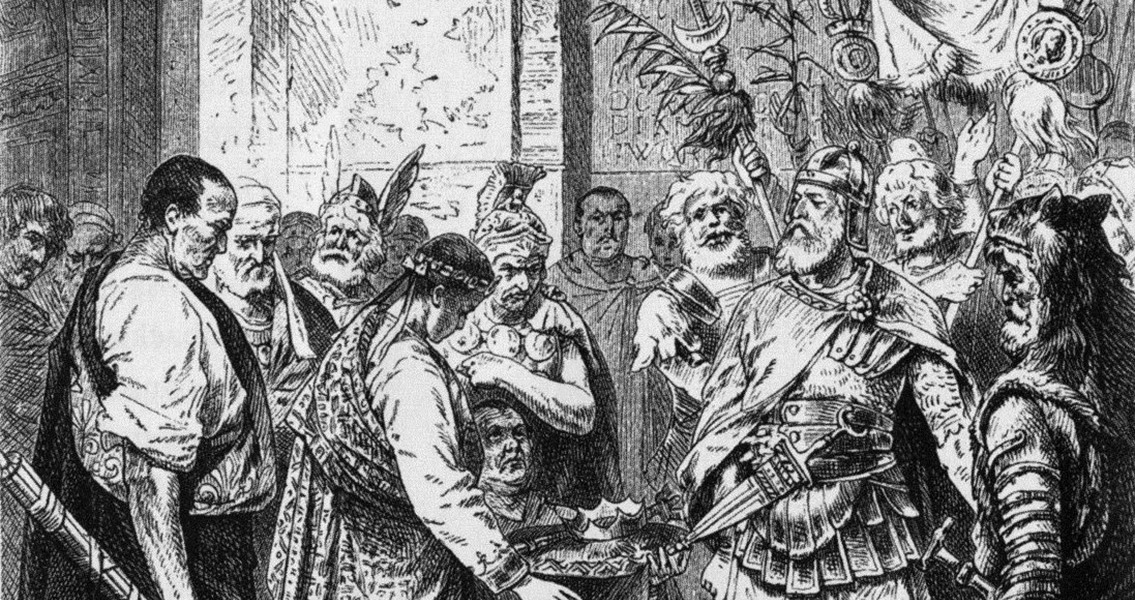
Romulus Augustus Deposed by Odoacer

Categories
Book Reviews

The Study of Ancient History That Set the Path for All Historians

  • The impact of time and nature on the empire
  • The attacks from Christians and Barbarians
  • The use and abuse of materials and resources
  • The domestic quarrels and disputes among the Romans
  • The key is that Gibbon emphasises the interrelation of these causes. The six volumes are not designed to argue one reading of history and to prioritise causes, but to document the multiple facets of a long and complicated process. The Romans ultimately succumbing to barbarian and Christian attacks, is linked to internal quarrels causing citizens to lose their sense of civic virtue and willingness to defend the Empire. Gibbon frequently used citations throughout the work, which are a prototype for contemporary footnoting methodology. They served two functions. Firstly they refer the reader to the sources used. Gibbon was ahead of his time in the amount of primary sources he deployed, as well as his willingness in opening them up to the reader for further investigation. Secondly they allowed Gibbon to expand on a point or debate the modern parallels with a past event, without disrupting the flow of his work. Another important element of this work is the author’s fearlessness in challenging popular doctrine on a subject. Although the works were generally critically well received, chapters fifteen and sixteen of the first volume were highly controversial. Quoting primary sources, Gibbon estimated there were a much smaller number of Christian martyrs during the late Roman period than was traditionally believed. This, combined with his objective analysis on the diverse causes of the Empire’s fall, put him in conflict with the long established narrative of Rome’s decline, supported by the church. Prior to Gibbon, the explanation for the decline of Rome was built around the actions of Christians. Gibbon not only put this into a broader cocktail of causes, he also suggested it was less significant than generally believed. He argued this traditionalist claim was built purely on the study of secondary sources, rather than the primary ones he utilised. This objective analysis is one of the key roles of the historian – to not only question preconceptions, but to also consider how they came about in the first place – highlighting the constant relationship between the past and the present. Gibbon’s explanation of the Decline of the Roman Empire was so strong that it is still the starting point of many modern histories on the subject. Although the prose of the work can seem a little rigid by modern standards, it has become an important artefact in its own right. As well as shedding light on a fascinating period of history, it’s also a key step in the development of the methodology of studying the past.

    Related Books


    The History of the Decline and Fall of the Roman Empire book

    The History of the Decline and Fall of the Roman Empire
    Vol. 1 of 8Vol. 1 of 8
    by Edward Gibbon

    [gap height=”20″]]]>