Categories
Breaking News

'Killed' Pebbles Reveal 12,000 Year Old Burial Practice

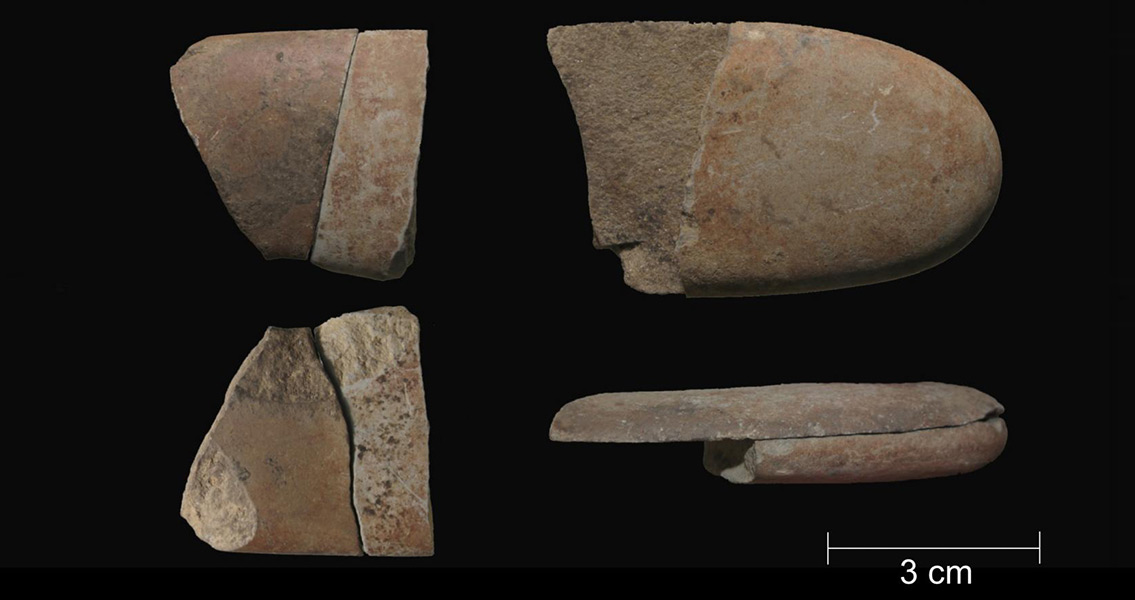
Cambridge Archeological Journal, claims to have found evidence that this symbolic killing was actually practiced up to 5,000 years earlier. Researchers from Université de Montréal, Arizona State University and University of Genoa examined 29 pebbles taken from an Upper Paleolithic burial site in Italy to make their conclusion. They believe that roughly 12,000 years ago the flat, oblong pebbles recovered from Caverna delle Arene Candide on the Mediterranean Sea in Liguria had been brought up from the beach and used as spatulas to apply ochre paste to decorate the dead. Once the decoration had been completed, the pebbles were broken and discarded. Study co-author Julien Riel-Salvatore, an associate professor of anthropology from the UdeM, said the reason for breaking the stones could have been to “kill” them, “discharging them of their symbolic power”. Roughly the size of a hockey rink, the Arene Candide cave is home to a necropolis containing the remains of some twenty adults and children. Situated in a steep cliff some 90 metres above sea level, it’s considered a vital reference site for the Neolithic and Paleolithic periods in the Mediterranean. Although the cave has been known about and subject to excavation since the 1940s, the broken pebbles were always overlooked. “If our interpretation is correct, we’ve pushed back the earliest evidence of intentional fragmentation of objects in a ritual context by up to 5,000 years,” said study lead author Claudine Gravel-Miguel, a PhD candidate at Arizona State’s School of Human Evolution and Social Change, in Tempe. “The next oldest evidence dates to the Neolithic period in Central Europe, about 8,000 years ago. Ours date to somewhere between 11,000 and 13,000 years ago, when people in Liguria were still hunter-gatherers.” Crucially, no matching pieces were found for the pebble fragments analysed by the team. They speculate that this could be because the missing halves were kept as talismans or souvenirs. “They might have signified a link to the deceased, in the same way that people today might share pieces of a friendship trinket, or place an object in the grave of a loved one,” explained Riel-Salvatore. “It’s the same kind of emotional connection.” For five years the team painstakingly excavated the Arene Candide area using trowels and dental tools before carrying out rigorous microscopic analysis on the pebbles they found. For comparison, they also carried out a similar process on pebbles from nearby beaches, to prove that those from Arene Candide had indeed been deliberately broken. “This demonstrates the underappreciated interpretive potential of broken pieces,” the authors write in the conclusion to their study. “Research programs on Paleolithic interments should not limit themselves to the burials themselves, but also explicitly target material recovered from nearby deposits, since, as we have shown here, artifacts as simple as broken rocks can sometimes help us uncover new practices in prehistoric funerary canons.” Broken pebbles are often overlooked during excavations. Riel-Salvatore suggests that this could have led to many vital insights being missed. “Historically, archeologists haven’t really looked at these objects – if they see them at a site, they usually go ‘Oh, there’s an ordinary pebble,’ and then discard it with the rest of the sediment. We need to start paying attention to these things that are often just labeled as rocks. Something that looks like it might be natural might actually have important artifactual meaning.” Image courtesy of Université de Montréal]]>
Categories
News

'Hollywood Gangster' Bugsy Siegel Gunned Down

Categories
News

Blackbeard Killed on the High Seas

Queen Anne’s Revenge. Exactly why the name was chosen is unclear. Some have speculated it was in reference to Queen Anne’s War, the name given to the War of Spanish Succession by those living in the Americas, (a war Blackbeard may have fought in as a privateer) while others suggest it was a reference to Queen Anne, the last Stuart monarch of England who reigned during the Act of Union in 1707 and died in 1714. For two years Hornigold and Blackbeard worked in tandem, their two ships carrying out pirate raids across the high seas, until Hornigold accepted amnesty from the British navy in 1717 and retired from his life of piracy. North Carolina’s Outer Banks had become a haven for outlaws during the late seventeenth century, the shallow sounds and inlets ideal locations for pirate vessels to disappear quickly. In 1718, Virginia Governor Alexander Spottswood grew tired of Blackbeard and other pirates’ continued use of the territory and dispatched a Royal Navy force to North Carolina. Details of the ensuing battle are unclear. As with so much of Blackbeard’s life myth becomes mixed up with fact, but legend has it he endured five musket shots and twenty sword lacerations before finally dying. Blackbeard’s reign of terror came after the main Golden Age of Piracy, when British and French seamen had launched raids on Spanish shipping in the Carribbean and Americas, often with the clandestine approval, if not encouragement, of their own governments. What seems to have made Blackbeard different in terms of how he is remembered is that he was the highest profile pirate at a time after the Spanish War of Succession, when the French, Spanish and British governments all launched a clamp down on piracy. On the one hand, a propaganda campaign was launched against him and other pirates, vilifying them as dangerous, immoral, cold blooded killers. This is an image that has stuck, although it’s interesting to point out that there is no archival evidence of Blackbeard killing somebody who hadn’t tried to kill him first. Ships who gave into the pirate’s demands were merely looted, and then allowed to go on their way. On the other hand, Blackbeard also became something of a Robin Hood figure to the poorest in society, someone who was stealing from the extremely wealthy. Again, this may have some truth, but there is little evidence that he took this to the next step and tried to redistribute this wealth among the poor. Nevertheless, it cemented the iconic image of Blackbeard as a roguish, daring adventurer type figure, carrying out daring raids against the odds on wealthy merchants. Almost three hundred years after his death, historians continue to find new evidence about Blackbeard’s life, as they attempt to find the reality behind the layers of propaganda, legend and myth.]]>

Categories
News

Dillinger Killed in Chicago

Manhattan Melodrama at the Biograph Theatre. A force of twenty FBI agents and police officers positioned themselves outside the building, in preparation for Dillinger’s exit. Sage had agreed to wear a red dress, so the officers would be able to identify her. At 10:40pm, Dillinger and Sage left the cinema. The authorities immediately pounced, ordering Dillinger to surrender, but he bolted. He made it less than a block before being gunned down in a hail of bullets. Official reports claimed the FBI and police had opened fire because Dillinger had pulled a gun. Dillinger died at the scene, close to an alleyway next to the theatre. The response to Dillinger’s death shows the extent of the celebrity status he had garnered, despite the at times brutal nature of his robberies. Souvenir hunters lined up to dab handkerchiefs in his blood at the scene of his shooting, while thousands went to the morgue to see his body. At his funeral, 5,000 people came to witness his burial, despite attempts to keep the date and location a secret. At a time when the United States was gripped by the Great Depression, the fascination with Dillinger can be put down to a roguish, ‘Robin Hood’ type mythology which surrounded him. The banking system was held up as the source of the United State’s economic calamity. Dillinger’s frequent attacks on banks and his rebellious personality turned him into something of an anti-hero for many Americans. Even now, there are some who argue Dillinger was not killed in Chicago on 22nd July. Pointing to inconsistencies in medical records, they claim that someone other than John Dillinger was gunned down outside the theatre. Suspected motives for this supposed cover-up vary, from desperate attempts by the FBI to prove they could catch the man they had declared public enemy number one, to the belief that Dillinger had organised the whole deception himself, so he could retire into obscurity. Image courtesy of Wikimedia Commons user: Wildhartlivie]]>