Categories
Breaking News

'Killed' Pebbles Reveal 12,000 Year Old Burial Practice

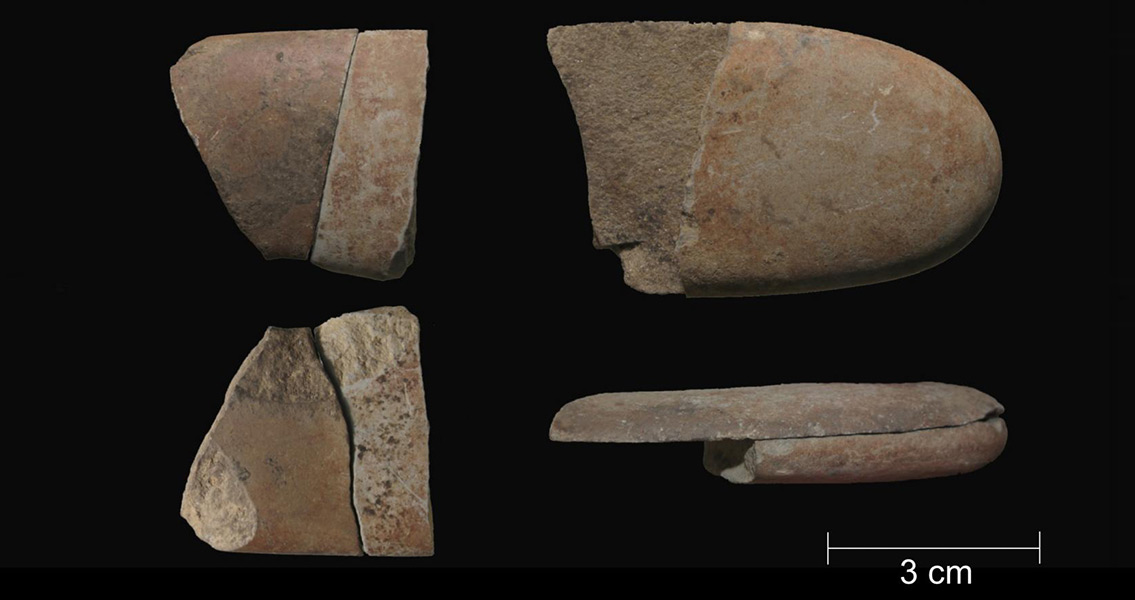
Cambridge Archeological Journal, claims to have found evidence that this symbolic killing was actually practiced up to 5,000 years earlier. Researchers from Université de Montréal, Arizona State University and University of Genoa examined 29 pebbles taken from an Upper Paleolithic burial site in Italy to make their conclusion. They believe that roughly 12,000 years ago the flat, oblong pebbles recovered from Caverna delle Arene Candide on the Mediterranean Sea in Liguria had been brought up from the beach and used as spatulas to apply ochre paste to decorate the dead. Once the decoration had been completed, the pebbles were broken and discarded. Study co-author Julien Riel-Salvatore, an associate professor of anthropology from the UdeM, said the reason for breaking the stones could have been to “kill” them, “discharging them of their symbolic power”. Roughly the size of a hockey rink, the Arene Candide cave is home to a necropolis containing the remains of some twenty adults and children. Situated in a steep cliff some 90 metres above sea level, it’s considered a vital reference site for the Neolithic and Paleolithic periods in the Mediterranean. Although the cave has been known about and subject to excavation since the 1940s, the broken pebbles were always overlooked. “If our interpretation is correct, we’ve pushed back the earliest evidence of intentional fragmentation of objects in a ritual context by up to 5,000 years,” said study lead author Claudine Gravel-Miguel, a PhD candidate at Arizona State’s School of Human Evolution and Social Change, in Tempe. “The next oldest evidence dates to the Neolithic period in Central Europe, about 8,000 years ago. Ours date to somewhere between 11,000 and 13,000 years ago, when people in Liguria were still hunter-gatherers.” Crucially, no matching pieces were found for the pebble fragments analysed by the team. They speculate that this could be because the missing halves were kept as talismans or souvenirs. “They might have signified a link to the deceased, in the same way that people today might share pieces of a friendship trinket, or place an object in the grave of a loved one,” explained Riel-Salvatore. “It’s the same kind of emotional connection.” For five years the team painstakingly excavated the Arene Candide area using trowels and dental tools before carrying out rigorous microscopic analysis on the pebbles they found. For comparison, they also carried out a similar process on pebbles from nearby beaches, to prove that those from Arene Candide had indeed been deliberately broken. “This demonstrates the underappreciated interpretive potential of broken pieces,” the authors write in the conclusion to their study. “Research programs on Paleolithic interments should not limit themselves to the burials themselves, but also explicitly target material recovered from nearby deposits, since, as we have shown here, artifacts as simple as broken rocks can sometimes help us uncover new practices in prehistoric funerary canons.” Broken pebbles are often overlooked during excavations. Riel-Salvatore suggests that this could have led to many vital insights being missed. “Historically, archeologists haven’t really looked at these objects – if they see them at a site, they usually go ‘Oh, there’s an ordinary pebble,’ and then discard it with the rest of the sediment. We need to start paying attention to these things that are often just labeled as rocks. Something that looks like it might be natural might actually have important artifactual meaning.” Image courtesy of Université de Montréal]]>
Categories
Breaking News

Mutilated Skeletal Remains Dating to Roman Era Found in UK

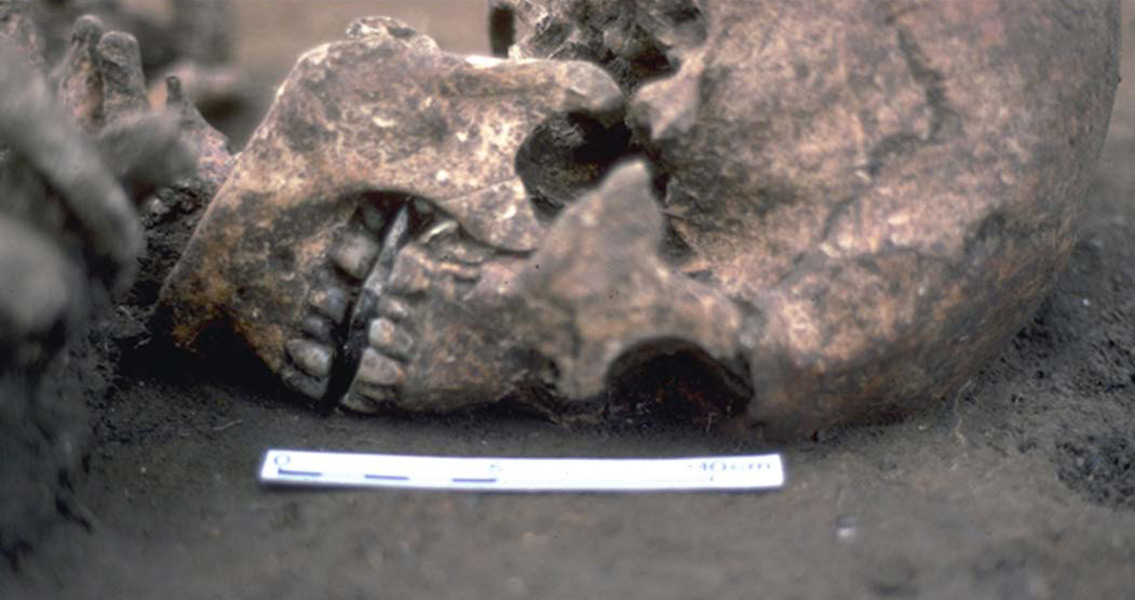
The Guardian. Archaeologists that studied the burial say that the man could have been buried in such a manner to prevent him from rising from the dead and terrorizing the living. Discovered near the river Nene at Stanwick, the original site dates to either the third or fourth century, when the region would have been dominated by small farming communities. Originally discovered in 1991, it was only recently that research methods had progressed to the point where specialist archaeologists and other experts from Historic England were able to uncover the complex mysteries of the burial. The mutilation in question is thought to have been unique among Romano-British remains, according to human skeletal biologist Simon Mays, who worked with Historic England to study the burial. Never before has such a practice been identified in the archaeological record, Mays added, remarking that the position of the body would have been consistent with an individual who was either a threat to a community – or just seen as distressingly, perhaps dangerously, odd. It’s difficult to pinpoint the age of the man when he died thanks to the lack of precision in modern methods. However, scientists feel that, based on the evidence they have gathered, the man is likely to have been at least in his thirties when he died – and that the fact that his tongue was severed could have been the result of a self-inflicted wound due to poor mental health. Another more sinister theory is that the loss of his tongue might have been meted out as punishment for some crime. There are ancient Germanic laws that prescribed the removal of the tongue as a punishment for malicious slander or bearing false witness, Mays said. There’s no known Roman laws to that effect, but researchers are looking into the possibility as the knowledge modern historians have about Romano-British practices are not nearly as complete as they could be. May said that the team latched on to the idea of the man’s tongue being amputated by looking at other Romano-British burials where missing body parts were replaced by foreign objects at appropriate anatomical locations. There’s around less than a dozen such identified instances, the majority of which are decapitations where a pot or a stone was placed in the grave in lieu of a head, the burial expert explained. With the stone found in the front part of the mouth, where the tongue would have been, the researchers felt it was a safe bet to conclude it had been placed there to take the place of a missing tongue. Corroborating evidence regarding the loss of the man’s tongue prior to his death came in the form of traces of bacterial infection in the bones of the mouth typical of the type of infection one would have received in the third or fourth century after having their tongue removed. Image courtesy of Historic England]]>

Categories
Breaking News

Unusual Burial Discovered at the Settlement that Doesn’t Exist

Lincolnshire Live: “What makes this a really interesting burial is the fact that they have been buried on their front. But there’s something else that really makes it special. You see how narrow it is in the grave. It’s about 25cm between the shoulders, it’s really crammed together.” The incredible discovery featured in an episode of Digging for Britain, presented by Anthropologist Professor Alice Roberts. Professor Roberts described the burial of a Christian person in this fashion as “bizarre”, adding, “What we can say for definite is it was buried after the body had started to decompose. The limbs have started to fall away from the rest of the body, but great care has been made to try to put the body back.” Dr. Willmott is quoted by Lincolnshire Live as saying: “A great deal of care has been taken in this burial. So this could be an individual who perhaps has died away from the site and been brought here to be interred here specially. There are stories of the bodies of kings being moved. And of course saints and holy people. So there could be something like that going on here, which suggests Little Carlton was a place of great importance.” The unusual skeleton was just the first of many rare and intriguing finds, including writing tools, approximately 300 clothing pins, a large number of coins dating to the seventh and eighth centuries called Sceattas, a lead tablet with the faint, but still legible word Cudberg (an Anglo-Saxon woman’s name) on it, and glassware that suggested the inhabitants traded with the European mainland. Another rare find in Britain, an iron manacle, was also found, suggesting the site was the location of a slave-trade operation or slaves were owned by the occupants. Additionally, a pair of tweezers commonly used to turn book pages were recovered and may have been used by Christian monks as they read religious manuscripts. Today the site is completely surrounded by dry land, however, it’s believed that in the past the site would have been surrounded by water, and that it was probably occupied by either a trading post or monastery within the Anglo-Saxon Kingdom of Lindsey. The settlement also produced woven textiles that were exported to northern Europe, while German pottery and wine were imported from the mainland. Bizarrely, there is no record of the settlement ever existing. It’s believed that it was abandoned when the Viking raids in England started in the later part of the eighth century, and there was no trace of it ever being there by the time the Domesday Book (a survey of England and areas in Wales) was completed in 1086. Images of the burial can be found at Lincolnshire Live ]]>

Categories
Breaking News

Remains of 13th Century 'Siberian Robin Hood' Discovered

the Siberian Times: “At the moment we have a birch bark quiver, two bone plates with elaborate ornaments, iron arrowheads, wooden arrow shafts, birch bark linings for a saddle, the remains of ribbons, likely silk, and what is left of a leather strap. Initially we thought that the bone plates were details of the bow, but they turned out to be the decorations of the quiver.” The warrior is believed to be Mongolian, although no other quivers like the one at the burial site have ever been found. The shape of the arrow heads suggest the man was a warrior, although they could also have been used for hunting. Archeologists are hopeful they’ll receive permission to examine the sarcophagus next year. In the meantime, steps have been taken to preserve the site, and work will continue to find the deceased archer’s bow. Vasily Oinoshev, the director of the Agency for Cultural and Historical Heritage of the Altai Republic, says in the Siberian Times: “The quiver is a very interesting one. It has separate ‘pockets’ for different types of arrows. This quiver is a great find, it is very well preserved. It will be important to examine it more thoroughly to understand its construction,” adding, “Sadly we cannot go and excavate the grave immediately. We need to have a special permission for work. Excavations are allowed in the period from 1 April to 1 November. So as soon as we get all the permits we will go to work on this grave. “ “We are doing all we can to ensure the safety of the grave in winter and to ensure the security of other archaeological objects. I have many questions to how these items were found. The story was that the locals found the grave in a hole in a cliff and took some items from there. But I am not completely sure they have not unearthed it. We need to check all this thoroughly.” Mongolians conquered the region of Altai in the twelfth century, and the area stayed under Mongolian control into the fourteenth and fifteenth centuries, yet finds from this time are rare in Altai. ]]>

Categories
Breaking News

Shackled and Buried: New Etruscan Grave Site Raises Dark Questions

Seeker, researchers say that the mysterious man had died wearing the shackles and had been interred with a shroud around his body. University of Milan archaeology professor Giorgio Baratti, one of the scientists involved in the excavation, added that the remains of what might have been a wooden object were found under the nape of the man’s neck and may have been connected to the collar. There may have been more to the man’s shackles, as an iron ring was found near the remains of his left hand. The object was likely part of a connecting apparatus from the head to the feet, made possible through the use of leather thongs, rope or some other organic material that has not survived the ravages of time. The end result of the device would have been to limit the man’s mobility even further. Professor Baratti suspects the deceased individual had committed some definitive crime in order to be fitted with such a distinctive device. The man may have also been a slave, as Populonia was both a maritime settlement and in close proximity to local iron mines. Between 500 and 300 BCE, the region was a popular Mediterranean destination for the processing of iron ore, much of it coming from the nearby island of Elba. There was little in the grave that could be used to pinpoint its age. However, based on the fact that there was a burial directly above this one that had been definitively dated to the fourth century BCE, Baratti felt comfortable in placing the shackled man’s time of death in the fifth century BCE, with at least a century passing between one burial and the other. The new findings raise some dark questions about the Etruscans, who have been characterized as rather benign in their contributions to early civilizations. Rising to power by around 900 BCE, the Etruscans were the primary power on the Italian peninsula for around half a millennium, only to be absorbed into Roman culture by around 300 BCE. While there is little known for sure about the Etruscans, the research data we do have paints a picture of a carefree people interested in commerce, metalworking, agriculture and art. Credited with pioneering wine-making, road-building, and writing, the Etruscans don’t seem to have been the type of people to bury a still-shackled man. However, Baratti said that there was plenty of cruelty within the Etruscan civilization. He pointed out several instances of what looked like the victims of ritual human sacrifices at other Etruscan archaeological digs throughout Tuscany. ]]>

Categories
Breaking News

Alcoholic Brew Found in Iron Age Burial Plot Recreated

Categories
Breaking News

Ancient Chinese Burial Yields Massive Cannabis Cache

National Geographic, the remains of a 35-year-old man with Caucasoid features were found in the Turpan Basin of northwest China. The man had been laid to rest on a wooden bed, his head resting on a reed pillow, and covered in thirteen cannabis plants, each of which were nearly three feet in length. The plants themselves were found to be in remarkably well-preserved condition; the burial is likely to have occurred anywhere from 2,400 to 2,800 years in the past, based on radiocarbon dating. At that period of time Turpan would have been a well-known stop on the Silk Road thanks to its status as a desert oasis. The people inhabiting the region, known as the Subeixi – or the Gushi Kingdom – were active from 2,000 to 3,000 years in the past; the burial was found among nearly 250 others in Turpan’s Jiayi cemetery, which is closely associated with the Subeixi. This new discovery is the first of its kind to feature the recovery of complete cannabis plants. Additionally, it is the first recorded instance of these plants being used, in essence, as a sort of human “burial shroud”, as the plants were laid across the chest of the deceased man at a diagonal. However, this is not the only evidence of cannabis being associated with Turpan burials, as a grave from nearby Yanghai cemetery, thought to have been dug contemporaneously with the Jiayi cemetery grave, featured nearly two pounds of seeds and powdered leaves from the plant. Meanwhile, archaeological research into regions of Asia to the west of the Gushi Kingdom has also yielded burials where cannabis seeds played a role. Several Scythian burials dating to the first millennium BCE in southern Siberia included the plant, among them the grave of a woman who might have been suffering from breast cancer. Some researchers have suggested that she may have been using cannabis partly to provide some relief from the pain of her condition. Determining the origin of the plants included in the Turpan burial has proven to be problematic, as it is the first instance of intact plants being included in a grave. With cannabis finds in the region prior to this in the form of parts of the plant, it’s unknown whether the cannabis found in the Jiayi burial had been obtained through trade or if it had been grown locally. Because the plants were discovered laid flat on the body of the deceased, researchers believe they were fresh at the time of the burial, making it more likely the cannabis had been grown locally and harvested specifically as part of a funerary rite. Additional evidence supporting this claim includes the state of the plants themselves. The plants – all of them female – had nearly all been pruned of their flowering heads. Those that were intact were nearly ripe and some even contained still-developing fruit. This has raised the suggestion that, according to the cannabis growing season, the burial must have occurred in the later days of summer if the plants had been collected locally. The research study associated with the find, recently published in the journal Economic Botany, is available online at http://link.springer.com/article/10.1007/s12231-016-9351-1?view=classic ]]>

Categories
Breaking News

Never Seen Before Headless Burials Discovered in Siberia

Siberian Times: “Burials without heads are quite common. Usually it is because of war. There was a widespread practice in which bowls were made of the heads of defeated enemies.” As he describes it, eating from the enemy’s skull was the ultimate victory celebration. “But this is obviously a different case,” he added. In other burials, the heads were not placed in the same grave as the body. Also unusual, if these were the remains of enemies, was the care taken to ensure the deceased received the rituals associated with an honored death, such as being well dressed. When burying their own, as opposed to war enemies, the Pazyryks typically took great care to not distort the bodies of the diseased. Additionally, tombs containing headless children have never been seen before now. The archeologists have considered whether grave-robbers, in the act of stealing the ornaments buried with the bodies, might have severed the heads on purpose and then placed them by the knees for some unknown reason. However, the skeletons had not been disturbed, as one would expect after such an act. The discovery has resulted in more questions than answers, Dr. Konstantinov admitted in the Siberian Times, adding, “We have no similar cases, so we need to investigate this one very thoroughly. We will continue the research of these skeletons. We need to determine their gender and (approximate) age. It is also important to study the traces on their cervical vertebrae to understand how and when the heads were cut off or separated in some other way. We hope to get the first results in December or January.” Photos of the burial can be found here: siberiantimes.com ]]>

Categories
Breaking News

Mass Graves Show Cahokia Was Not Male Dominated

American Antiquity, the focus of the new study is Mound 72: a massive burial site discovered in 1967 by archaeologist Melvin Fowler. The impressive Mound 72 held five mass graves, the smallest containing only twenty bodies, the biggest over fifty. Dozens of other bodies were buried individually or in groups there, some directly over the mass graves. By the end of his study, Fowler had identified 270 bodies in the mound. Some of them had been placed in cedar litters, leading Fowler and his team to conclude they had been people of high status during life. Later studies determined that all of the bodies had been interred between 1000 CE and 1200 CE. Cahokia was at its peak during this period, with historians claiming the city’s population was as high as 20,000 during the eleventh century. “Mound 72 burials are some of the most significant burials ever excavated in North America from this time period,” said ISAS (Illinois State Archaeological Survey) director Thomas Emerson, who conducted the most recent study with physical anthropologist Kristin Hedman and skeletal analysts Eve Hargrave of ISAS, Dawn Cobb of the Illinois State Museum Society, and Andrew Thompson of the University of Cincinnati College of Medicine. “Fowler’s and others’ interpretation of these mounds became the model that everybody across the east was looking at in terms of understanding status and gender roles and symbolism among Native American groups in this time.” Fowler’s remarkable discovery, and subsequent interpretation of Mound 72, were hugely influential. However, Emerson and colleagues have found that some of the original conclusions were based on inaccurate or incomplete information. According to them, a key misunderstanding relates to the beaded burial, where two bodies were buried on top of each other on a partial bed of beads. Several other bodies, interred at the same time, were buried around the centrally placed pair. For Fowler, this unique burial was interpreted as two high status males surrounded by their servants. The pattern of the beads around the bodies was thought to resemble a bird’s head. In many Native American traditions birds are associated with warriors and supernatural beings, something which led Fowler to conclude the beaded burial represented mythical warrior chiefs. This interpretation came to be taken as evidence that Cahokia was a male dominated hierarchy, but the new analyses by Emerson and his team have thrown this conclusion into doubt. Firstly, they found that there were in fact 12 bodies involved in the beaded burial, not just six as previously reported. Most dramatically, the team concluded that the two bodies at the centre of the burial were a male and a female, not two males. Further study by the team revealed other inconsistencies. There were other male and female pairs in or near the burial. There was also evidence of the bones of disarticulated bodies being gathered up and placed for burial next to these important couples. The team even found the remains of a child. “We had been checking to make sure that the individuals we were looking at matched how they had been described,” said Hedman. “And in re-examining the beaded burial, we discovered that the central burial included females. This was unexpected.” “The fact that these high-status burials included women changes the meaning of the beaded burial feature,” Emerson explained. “Now, we realize, we don’t have a system in which males are these dominant figures and females are playing bit parts. And so, what we have at Cahokia is very much a nobility. It’s not a male nobility. It’s males and females, and their relationships are very important.” It’s a conclusion which fundamentally changes the image of Cahokia society, showing it to be class based rather than split along gender lines. For Emerson, this wasn’t a surprise based on his experience at other Cahokia sites. “For me, having dug temples at Cahokia and analyzed a lot of that material, the symbolism is all about life renewal, fertility, agriculture,” he said. “Most of the stone figurines found there are female. The symbols showing up on the pots have to do with water and the underworld. And so now Mound 72 fits into a more consistent story with what we know about the rest of the symbolism and religion at Cahokia.” The scientist believes the misinterpretation of Mound 72 is an example of archaeologists projecting the practices of other North American indigenous cultures onto the Cahokia, and subsequently missing much of what made the civilisation unique. “When the Spanish and the French came into the southeast as early as the 1500s, they identified these kinds of societies in which both males and females have rank,” he said. “Really, the division here is not gender; it’s class.” Emerson said “People who saw the warrior symbolism in the beaded burial were actually looking at societies hundreds of years later in the southeast, where warrior symbolism dominated, and projecting it back to Cahokia and saying: ‘Well, that’s what this must be… And we’re saying: ‘No, it’s not.'” Graphic by Julie McMahon]]>