Categories
Breaking News

Vasa-Like Warship Discovered in Sweden

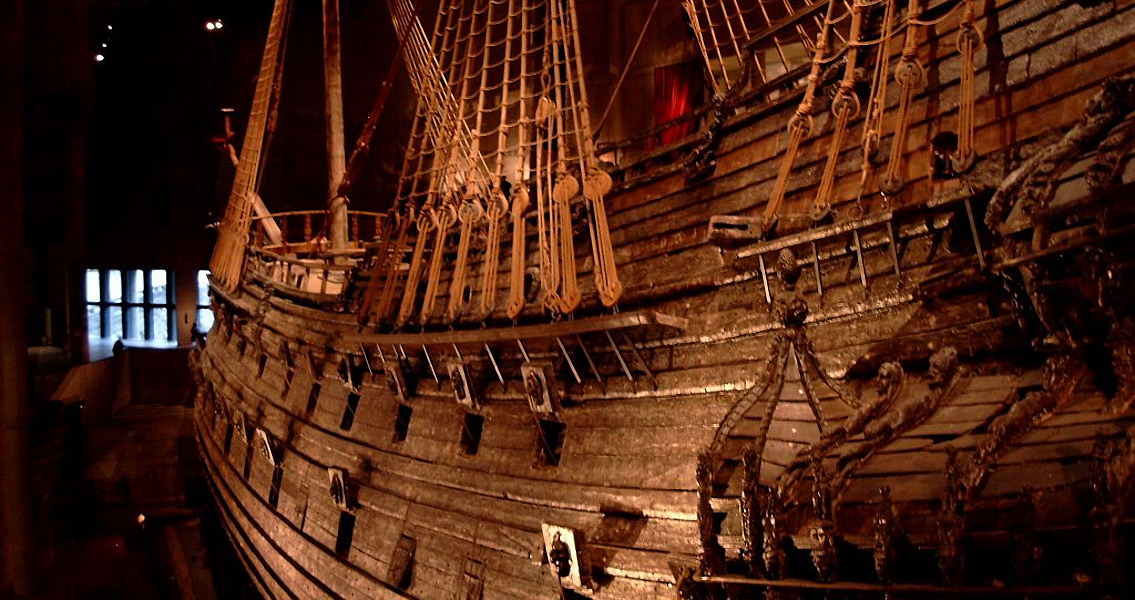
The Local, the ship is approximately 45 meters long and carried 68 or 70 cannon. Launched in 1682, it was the first ship ever built in Karlskrona, eventually ending up back where it started in 1713. A curator with the Swedish National Maritime Museums, Jim Hansson, explained in the article that the warship may have been sunk deliberately in order to utilize its cannon to defend the city during the King’s campaign against Russia, a campaign which would eventually lead to the ruin of the Swedish Empire, causing Karl XII to flee to the Ottoman Empire. The newly discovered ship is remarkably similar in size and age to the warship Vasa. The only ship from the seventeenth century to ever be salvaged practically fully intact, the 64-gun Vasa, which sank on her maiden voyage in 1628 and was salvaged in the 1960s, is on display at the world-famous Vasa Museum in Stockholm, Sweden. Opened in 1990, the Vasa Museum is reportedly Scandinavia’s most visited museum, with over 1.3 million visitors in 2016. The Vasa foundered after sailing approximately 1,300 meters into her maiden voyage. Built on the orders of Sweden’s King Gustavus Adolphus at the naval yard in Stockholm, she was armed mainly with bronze cannon which were cast specifically for the ship. Richly decorated, after completion, the Vasa was among the most powerfully armed ships in the world. However, she was also dangerously top-heavy and unstable, and yet despite her lack of stability the ship was ordered to sea. During the recovery process in 1961, thousands of objects and artifacts, along with the remains of fifteen people at a minimum, were discovered by marine archaeologists inside and around the ship’s hull, including weapons, clothing, cannon, coins, tools, cutlery and six of the ten original sails. These items, as well as the ship herself have provided researchers with invaluable information regarding naval warfare, shipbuilding and everyday life in Sweden in the early seventeenth century. The Blekinge, however, is far from being in good condition. A part of the ship seems to have been flattened when the stone pier at Karlskrona shipyard was constructed, although it’s possible the lower sections are better preserved. “Part of her is embedded in deep layers of sediment. We believe there could be a relatively in-tact level of deck under it. The ship’s not at all as well preserved as the Vasa, but the part which lies outside of the pier could be better preserved,” Hansson explained in the article. It’s likely that further research will be conducted on the shipwreck, given its historical significance as the first ship built at the Karlskrona shipyard, where a naval base is still located. The shipyard was established around 1680, at practically the same time as the city. It was a necessary facility due to heavy losses suffered by the Swedish navy in 1659. Areas of the city, consisting primarily of the Naval Port, have been declared a UNESCO World Heritage Site. ]]>
Categories
Breaking News

Brazilian Dinosaur Discovered Six Decades Ago Comes Out of the Closet

Austroposeidon magnificus. Diogenes de Almeida Campos, the Museum director, is quoted as saying in Phys.org that six decades does sound on the slow side for studying such a big find. He went on to explain that in the 1950s Price and his colleagues were pioneers in the field of paleontology for Brazil and that a vertebra of this size needed to be studied. Campos continued, saying that a lack of money had held back research, as well as a shortage of staff qualified to take up the task. Today there are still only ten dinosaur experts in the entire country of Brazil. Campos told Phys.org: “We were waiting for the staff…, for a laboratory that started from nothing to mature. We made a first effort with students about eight years ago and it didn’t succeed.” It was one of Campos’ students, Kamila Bandeira, who made the mysterious creature the subject of her doctoral thesis, and put the pieces of the puzzle together. A majority of dinosaur discoveries occur in the desert or largely barren areas, like the southwest region of the USA, the south of Mongolia or Argentina, because they’re easier to find. The fossilized bones belonging to the biggest dinosaur ever discovered, around 40 meters (130 feet) long, were discovered in 2014 in Argentina. Like so many other discoveries, Austroposeidon magnificus was found by chance, by construction workers building a road near Sao Paulo. Researchers believe the small number of bones recovered at the site points to the creature’s unceremonious end. Campos told GMA News Online, “When these animals die, it’s… a huge new source of meat. So all the hunters, the carnivores ate this creature. The first thing they ate is the head, because the brain must be tasty. They also broke the long bones to get at the marrow… After, came smaller animals and nothing was left over. Anything that did remain the beetles and the spiders and the ants finished, and when there was just bones, the bacteria came. Finally, the remains sank into the lagoon.” There may yet be many more such discoveries waiting in Brazil’s thick flora. “Pay attention when roads are built, when wells are dug,” Campos tells GMA, “You could have a dinosaur in your backyard and not realize!” ]]>

Categories
Breaking News

Outhouses Uncovered in Philadelphia Flush with Artifacts

Huffington Post as coming from a tavern which occupied the location on Chestnut Street, including red earthenware which was made from known local potters. Another particularly impressive piece that the team found and reassembled is a delftware punch bowl, believed to be English. Delftware (also known as Delft pottery or Delft Blue) is white and blue pottery that was made in and around the town of Delft, in the Netherlands, during the sixteenth century. The bowl is embellished with a picture of the Tryphena, a brigantine ship that carried the colonists’ petition contesting the Stamp Act to Liverpool from Philadelphia in 1765. Philadelphia, Pennsylvania, was the location of the First and Second Continental Congress, a meeting of delegates from all thirteen colonies. Soon after the Second Convention, which began meeting in 1775, it was declared that the American Revolutionary War had started. The Second Congress oversaw the colonial war efforts, and moved slowly towards independence from England by adopting the U.S. Declaration of Independence on the 4th of July, 1776. By directing strategy, raising armies, appointing diplomats and writing formal treaties, like the Olive Branch Petition, the Congress performed as a de facto national governmental body of what in the future would become the United States. The recovered items are an eclectic mix; a large assortment of seashells linked to a local button shop, 1,400 fruit pits (mostly cherries) in one vault suggesting a nearby baking operation (no pie pans though), 750 individual pieces of printers’ type associated with the city’s budding press industry, two whole raccoons, 66 birds, wig curlers, and a curiously large amount of alcoholic bottles, along with an abundance of items from private residences, and of course the usual collection of garbage. Some pieces from the collection are expected to be on display inside the Museum of the American Revolution when it opens in 2017. ]]>