Categories
Breaking News

Frightening Megalodon and Great White Shark Relative Described

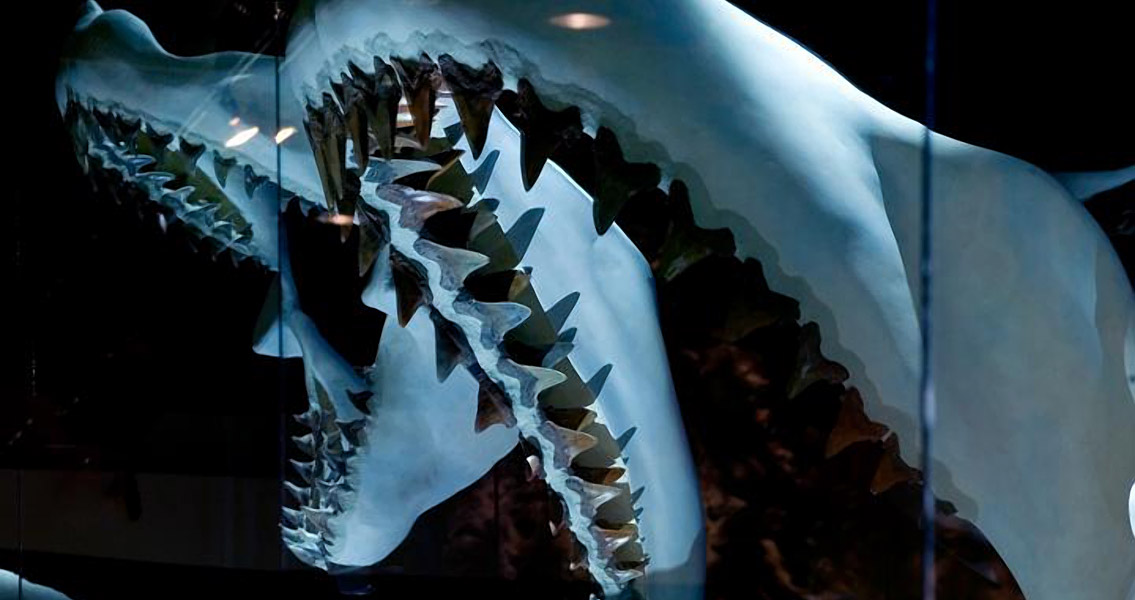
Megalolamna paradoxodon, lived during the early Miocene epoch, some 20 million years ago. The long extinct creature belongs to a shark group called Lamniformes, which includes the modern day great white and mako sharks. Terrifying fossilised teeth, measuring up to 4.5 centimetres (1.8 inches) long, were the basis of the discovery. Megalolamna paradoxodon’s teeth have been found in California and North Carolina in the United States, as well as in Peru and Japan. Substantially smaller than members of the ‘megatoothed’ lineage, Megalolamna paradoxodon was still a formidable creature. At a minimum it was comparable in size to a modern great white shark, around four metres (thirteen feet) long. Living in the same oceans as the megatoothed sharks, Megalolamna paradoxodon likely feasted on small and medium sized fish, grasping its prey with its front teeth and slicing the unfortunate victim with its rear teeth. Megalolamna paradoxodon is a member of the Otodontidae family of sharks. Kenshu Shimada, a paleobiologist at DePaul University and research associate at the Sternberg Museum in Kansas, who led the study, said in a press release that the newly discovered fossilised shark is a “close cousin” of the megatoothed lineage that includes megalodon. The prehistoric shark’s name reflects ambiguities over its identification. Although certain dental features point to the otodontid affinity, superficially the teeth look close to those of a modern day salmon shark from the lamna genus – only much bigger. It is for this reason it has the name Megalolamna. Paradoxodon means paradoxical teeth. This is in reference to the fact the shark appears unexpectedly in the geologic record, with an as yet inexplicable 45 million year gap from when Megalolamna split with its apparent closest relative: Otodus. “It’s quite remarkable that such a large lamniform shark with such a global distribution had evaded recognition until now, especially because there are numerous Miocene localities where fossil shark teeth are well sampled,” said Shimada. Through their work on Megalolamna paradoxodon the team have also concluded that members of the megatoothed lineage, such as megalodon, should be reclassified from their traditional place in the Carcharocles genus to the Otodus genus. “The idea that megalodon and its close allies should be placed in Otodus is not new, but our study is the first of its kind that logically demonstrates the taxonomic proposition,” The Odotus lineage without megatoothed sharks would not constitute a full lineage, something scientists call ‘non-monophyletic’. By including megatoothed sharks however, Odotus becomes a monophyletic group, a complete lineage. This lineage is considered the next of kin to Megalolamna paradoxodon. The study has been published in the latest issue of the journal Historical Biology. Shimada, the lead author, worked alongside Richard Chandler, North Carolina State University; Otto Lok Tao Lam, The University of Hong Kong; Takeshi Tanaka, Japan; and David Ward, The Natural History Museum, London; to describe the prehistoric shark. For more information: tandfonline.com Image courtesy of Kenshu Shimada]]>

Categories
Breaking News

Giant Sharks Weren't Driven Extinct By Climate Change

Carcharocles megalodon was the largest shark in the history of the planet, the fossil record suggesting body lengths of up to 18 metres (59 feet). By way of comparison, the giant great white shark which starred in the movie Jaws was meant to be just seven metres (25 feet) long. Although fossilised teeth of the monster sharks have been found in Africa, North America, South America, India, Australia, Japan, and Europe, little else is known about them. In particular, why these terrifying creatures went extinct has long been a mystery. In a recently published study, researchers from the University of Zurich suggest that megalodon died out because the diversity of its prey decreased, and new predators arrived on the scene as competitors. The team’s conclusion is based on an innovative study of the giant shark’s geographical distribution over time. Led by Catalina Pimiento from the Paleontological Institute and Museum of the University of Zurich, the team of researchers examined 200 megalodon records in museum collections and databases from across the globe. Their results have recently been published in the Journal of Biogeography. The data allowed Pimiento’s team to chart the range and abundance of the giant sharks. During the early Miocene, lasting until roughly 16 million years ago, megalodon were mainly found in the warm waters of the Northern Hemisphere, off the coasts of Europe and North America, as well as in the Indian Ocean. Later, they penetrated further into the seas around Australia, South America and Asia. The population of the species peaked during the middle Miocene, while they acheived their widest geographic dispersion during the late Miocene. Around five million years ago megalodon entered a state of continuous decline, seemingly coinciding with the beginnings of the Pliocene glacial period. Until now, most explanations for megalodon’s extinction have been directly connected to this period of climate change. The fossil record has led most researchers to conclude that the giant sharks lived in warm waters. As the temperature of the oceans started to decrease, its hypothesised they would have become uninhabitable for megalodon, and the species slowly died off. Another suggestion is that the freezing waters forced Megalodon’s prey to migrate, starving the giant sharks. The University of Zurich study throws serious doubt on this climate change explanation. “We were not able to ascertain any direct link between the extinction of C. megalodon and the global fluctuations in temperatures during this time.” explained Pimiento in a press release. “Changing climatic conditions do not appear to have had any influence on the population density and range of the giant sharks,” Evolutionary narratives of other species showed the greatest connection with the development of the monster sharks, according to the new study. At a time when a multitude of smaller marine mammals were disappearing, the megalodon range also decreased. Similarly, the arrival of other major predators, such as the ancestors of the killer whale and the great white shark, also coincided with a decline in the megalodon population, suggesting the new species provided too much competition for the increasingly scarce prey. Image ©Jeff Gage / Florida Museum of Natural History]]>

Categories
Breaking News

Megalodon Teeth Appear in North Carolina