Categories
Breaking News

New Theory on Origin of Scythians Put Forward

According to a university press release, anthropologists conducted comparative analysis of non-metric cranial trait frequencies in the remains of Scythians found in the northern Black Sea region. These non-metric traits were then compared to those gathered from Central Asian and Eastern European remains dating to the Bronze Age to look for commonalities. These so-called “cranial series” are groups of skulls found from either one burial or several burials spaced closely together, and from either one archaeological culture or one ethnic group. Non-metric, varying cranial traits can reflect minor anatomical variations in the human skull. These variations take the form of irregular skull sutures and processes or additional and irregular holes, and are consistent among those with similar genetics. When compared to data gathered from molecular genetic markers, these non-metric cranial traits tell a similar tale in determining the genetic distances between populations. Many researchers have begun to use these cranial trait comparisons as an alternative to direct DNA research, which can be much more expensive and not necessarily always appropriate. There are two major hypotheses regarding the origin of the Scythians. One claims the Scythians came from Central Asia as invaders, resulting in local Indo-European populations being assimilated by them. The other claims that the ancient people were descended from the “Timber-Grave culture” of the Srubnaya people who lived between the Dneiper and Ural Mountains during the Late Bronze Age. According to lead author Alla Movesyan, the results of the study provide evidence for both of these theories. In other words, both hypotheses are partly correct: the Scythian gene pool was formed from descendants of the Srubnaya from the Late Bronze Age, but these descendants migrated from Central Asia and mingled with the Indo-Europeans living in the northern Black Sea region. This revelation could be a blow to Eurasian mythmakers who have enjoyed claiming the Scythians were predecessors of the Slavs. While there was undoubtedly some genetic intermingling thanks to geographic proximity, Movsesyan claims that the idea of Slavs being direct descendants of the Scythians is simply no longer supported by any scientific data. The new research study, published in The American Journal of Physical Anthropology, can be found here]]>
Categories
Breaking News

Archaeologists Discover 2,400 Year Old Golden Bongs

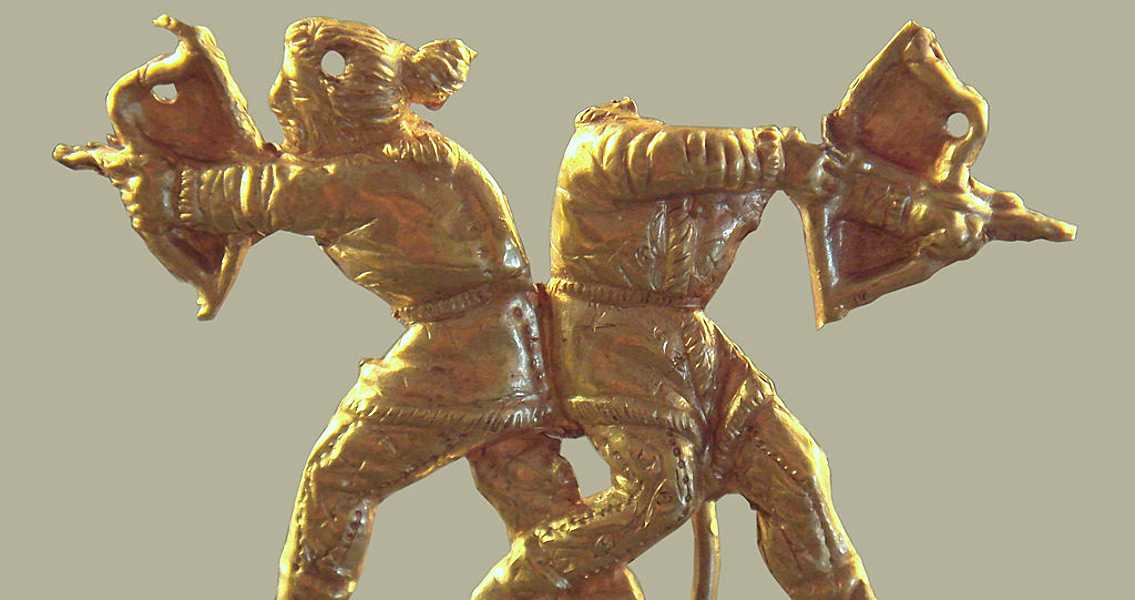
New Historian last week, archaeologists have speculated that some of the artefacts in the site may be of Greek origin. Now, another use has been found for some of the golden objects excavated from this dig. The two bucket-shaped cups were found upside-down and covered with intricate carvings on the outside that depicted creatures from mythology; on one, winged griffons are seen attacking both a stag and a horse while another carving showcases an older man engaged in combat with a larger group of younger warriors. The interior of both cups were coated with a black residue that proved to be a mix of opium and cannabis after it was analyzed by forensics experts. The chamber where the golden bongs were discovered had been cleverly concealed beneath a layer of clay and stored within a chamber lined with broad, flat stones. In the end, nearly seven pounds of golden artifacts were excavated including two neck rings, a finger ring, a bracelet, and a collection of three cups in addition to the two cannabis cups. While the site was initially uncovered in 2013, the decision was made to keep the discovery a secret in order to discourage looters. Archaeologists say that there was already evidence that the burial mound had been scoured by looters sometime in the indeterminate past, prompting the secrecy and initially leading them to believe that any valuable artifacts had long since vanished. The site itself is known as a kurgan, one of the few pieces of permanent construction left behind by the Scythians; the largely itinerant civilisation constructed these burial mounds across their territory, which stretched from the Black Sea in the west to as far as Mongolia to the east over the close to a thousand years that the nomadic people ruled the region. Andrei Belinski, the archaeologist that led the excavation team that took over following the discovery of the site, says that the historical value of the find is noteworthy, especially since the bongs are in such excellent condition and the carvings on the cannabis cups harbor such minute details. “I’ve never seen such a detailed representation of the clothing and weaponry of the Scythians,” the archaeologist remarked, adding that “it’s so detailed you can see how the clothing was sewn.” Hopes are high that the cups, and the remainder of the gold uncovered from the kurgan, will help shed additional light on Scythian culture. It has long been thought that the Scythians used cannabis and opium in ceremonial or religious rites. Herodotus, the Greek historian living in the fifth century BCE, described Scythians as smoking a type of plant that affected the cognition of Scythian warriors prior to entering battle. Archaeologists believe the two golden cups uncovered in the Caucasus were likely the possessions of a tribal chief. ]]>