
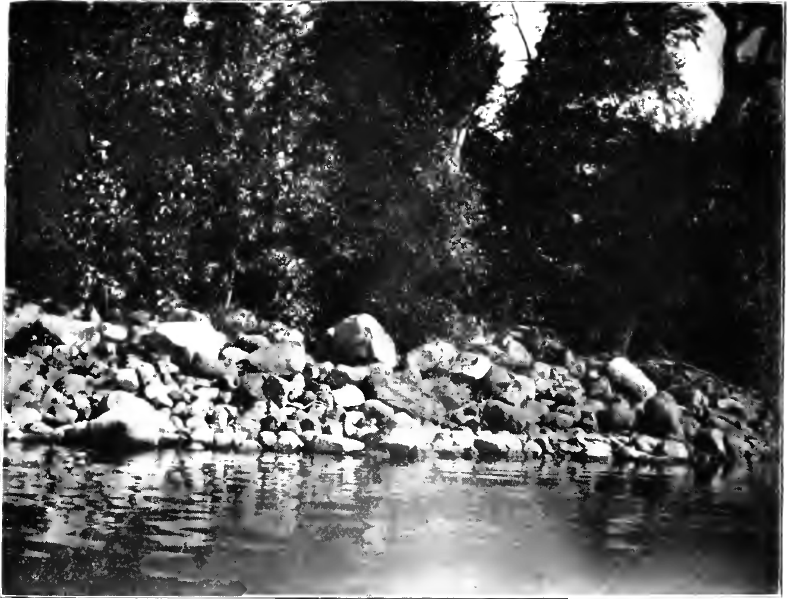
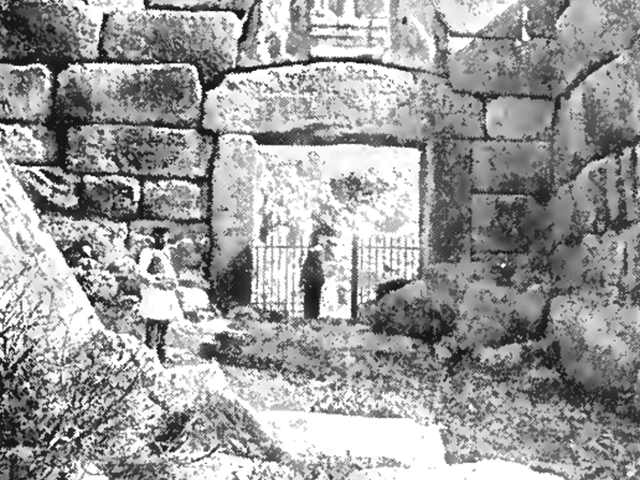
th century BC. Under the project, ancient engineers drained marshlands using drainage control systems and diverted six streams and rivers from the basin to two mammoth canals in the Kopais basin. This transformed the Kopais basin into one of the most fertile plains in Greece. The canals were also reinforced with Cyclopean revetments that helped in supporting roads as well. Archaeologists believe that approximately 2,000,000 cubic meters of earth was required to be moved in order to build the embankments and dykes and as much as 250,000 cubic meters of stone was used to carve the face of the embankments. The Citadel of Glas was believed to be the main administrative center for this project. It was protected by a huge stone wall that was 5.5 – 5.8 meters thick. This wall ran for about 3kms, featured 4 gates and three central enclosures. According to Maggidis, there were certain peculiarities in the Citadel of Glas. He said that one of the biggest oddities was that only 1/3rd of the area seemed to be occupied by buildings and structures, although it did not make sense for the space outside the central enclosure to be completely void of structures. Maggidis believes that the Citadel of Glas was much more than a simple fort to administer the drainage of the Kopais lake. He states that this was what prompted him to explore the Citadel further. As a result of his uncertainties, Maggidis and his colleagues performed a geophysical survey of the citadel with the help of a GPR, satellite imagery, a Fluxgate gradiometer and electrical resistivity. The group mainly focused on areas that were left unexplored. And the results were amazing to say the least. Maggidis states that the tests proved that the Citadel wasn’t void of structures, but was full of buildings that had many uses, including extensive residential quarters, well built complexes, terraces, a cistern and staircases. The picture that emerged was that of a fortified town. Maggidis believes that this discovery finally took them one step further to uncovering the mysteries that the Citadel had to offer. Even though the findings are still at their nascent level, a detailed report that showcases the discoveries made in the Citadel of Glas shall be published in the Popular Archaeology Magazine in September. ]]>
th century that man fully managed to exploit the natural source of mineral water. The Selters soon became popular all over the world and it began being sold all across the world – right from Florence and St. Petersburg to New York and London. It was called as the Selters Liquid Treasure back then and was always delivered in uniquely designed clay jugs. The high quality water and refined tastes soon made Selters synonymous with the finest mineral water in the world. In fact, Selters was the prototype of the word famous Seltzer soda water. Experts believe that although not unexpected, it is still extremely rare to be able to find a fully corked bottle of Selters from the period in reference. Bednarz stated that the bottle definitely contained some liquid and he also seemed sure that it was definitely not sea water. Although this ancient Seltzers bottle is expected to contain the original Selters water, Bednarz also stated that he wouldn’t eliminate the possibility of the bottle being full of wine. He says that excellent shape in which Seltzer bottles were designed made them handy for storing other liquids as well, once the water was finished. Bednarz states that the advantage of corked bottles were that they could be used, reused and corked whenever required. He also stated that the group planned on checking the contents of the bottle. Hopefully, we should finally get an answer in a few days whether the bottle contained the purest form of mineral water or an old world wine, both of which sound to be a delicious prospect. ]]>

th May 585 BC and it was understood to be an omen that the gods wanted the fighting to stop. Another excavation site in the region that deserves to be mentioned is in Kusaklu Tumulus. A team headed by Dr. Stefania Mazzoni has been working at the site since the year 2008 and it is believed that the Hittite civilization as well as the city of Zippalandawas once existed in the region. As a part of these excavations a 2000 year old Roman bath that was said to be used to heal people from their wounds has been discovered. Traces of the Roman, Sejluk, Byzantine and Ottoman eras have also been found in the region. With so much of history yet to be uncovered from a single city, archaeologists remain hopeful of unearthing many more wonders of the ancient world in the next few months. It has already been proved that the area was home to numerous civilizations that date all the way back to the Roman era. Archaeologists remain hopeful of managing to unearth many more old world structures and secrets as time passes by. ]]>
th century. This carving showed hillside houses that consisted of 3 windows on the second floor and doorways on the ground floor. In fact, such designs are used in many villages even today, with the ground floor being used as a storage area and a stable. The temple was believed to be extremely important to the kingdom of Urartu. According to reports, the Urartu King Rusa 1 ripped off his crown and killed himself when the Assyrians looted the revered temple in the year 714 BC. One ancient account that was translated by Marc Van De Mieroop implied that the king tore off his clothes, ripped off his headband, pulled at his hair and threw himself flat on the face. Historians had found countless references to this ancient temple, but its existence and its location had remained a mystery till date. However, with the discovery of these column bases, it is now believed that the location of the historic Iron Age temple can be narrowed down considerably. ]]>
th – 7th century CE, and it literally indicates that the northern parts of the Atacama Desert were inhabited by civilizations and farming communities much before the Tiwanaku civilization came into Peru. The discovery was made during the Tambo Project, a project that has been carried out by the Institute of Archaeology since the year 2008. These burials were found in the Tambo river delta which is located in the northern parts of the Atacama Desert. According to Jozef Szykilski, the leader of the project, the graves were dug into the sand and without the presence of any stone structures, they were almost impossible to locate. As a result, they did not fall prey to robbers and managed to remain safe across centuries. Professor Szykulski also mentions that the burials were made by people about whom almost nothing is known. He believes that the items found in graves also indicate that the people had a clear cut social division as well. Archaeologists have discovered numerous artifacts, headgear made from llama wool, bodies wrapped in mats, bodies wrapped in cotton burial shrouds as well as bodies wrapped in nets. Archaeologists also mentioned that they found some arrows tipped with obsidian heads, bows and quivers. This in itself becomes an extremely rare find, because bows are considered to be rare in Peru. Another interesting discovery was the discovery of a llama. This proved that the animal was brought to the Tambo delta much earlier than was previously believed. Archaeologists have also discovered maces that contained copper or stone finials in a number of male graves. Professor Szykulski believes that these objects along with the bows were used to denote power. This also offers evidence that the culture of this long lost civilization had a stratified society where the elite were allowed to take power with them into their afterlife. Other goods found at the burial sites include objects made from tumbaga and copper, jewelry items, reed withes that were attached to the ears of the dead and protruded all the way to the surface and weaving tools. Archaeologists believe that these reed withes acted as ritualistic communication tools that allowed the living to communicate with the dead. Polish archaeologists had previously discovered the Tiwanaku civilization tombs in the Tambo river delta and dated them back to the 7th – 10th century CE. This makes the new discoveries even more sensational as civilization was not expected to have reached the area before the Tiwanaku. The presence of ceramic vessels, weapons and tools also denote that the society was quite advanced. Archaeological work continues to be carried out and the study area covers a span of almost 20000 sq. kms. With the scheduled work expected to continue for a few more years, we can certainly expect many more details about this previously unknown culture to emerge.]]>
nd July 1937 when her plane vanished from over the Pacific Ocean as she attempted to fly her plane around the world at the equator. Hope of finally finding proof of Amelia’s fate emerged as a handful of pictures of the Electra, Amelia’s twin engine Lockheed grabbed attention. These photos were taken in Miami, the 4th stop in Amelia’s journey around the globe. What makes them unique is that they show a distinctive patch of metal which was installed to replace the navigational window. According to the reports of the researchers working at the International Group for Historic Aircraft Recovery (TIGHAR), the metal sheeting perfectly matches a piece of aluminium which was recovered from the island of Nikumaroro, an uninhabited island lying in the Pacific Ocean between Hawaii and Australia. Researchers state that they have been investigating the fateful flight taken by Amelia for years and a major breakthrough finally seems to have arrived. According to Ric Gillespie, the executive director at TIGHAR, if the photo enhancements manage to establish that the rivet patterns on the repair job match the piece of aluminium that was found on the Nikumaroro island, then it can be conclusively linked that the island was connected with Amelia’s disappearance in some way or the other. This discovery would finally prove that Amelia and Fred Noonan (Amelia’s navigator) had not succumbed in the Pacific Ocean because they ran out of fuel. In fact, if forensics can match the piece of aluminium to Amelia’s plane, it may be conclusive enough to state that Amelia was forced to land on the Nikumaroro island and live the rest of her life as a castaway before she finally succumbed to her death on an island located about 350 miles to the southeast of Howland Island. The researchers from TIGHAR have termed the sheet of aluminium as 2-2-V-1 and have made it the subject of extremely intense investigations ever since its discovery in Nikumaroro. This sheet is 10” wide and about 23” long. It has been made from a product that was introduced in the year 1933 by Alcoa Aluminium and was known as 24ST Alclad. However, the researchers at TIGHAR failed to fit the 2-2-V01 sheet anywhere on a Lockheed Electra even though it seems as if Amelia’s plane was skinned with this very material. Gillespie mentions that a series of researches were conducted in the month of March at the National Museum of the United States Air Force to try and match the sheet of aluminium to a Lockheed Electra. However, the researchers believed that the research and the sheet were inconclusive when it failed to fit into the original or the repaired parts of Amelia Earhart’s Electra. The investigation was said to have been renewed when Jeffery Nevile, an air mechanic and a TIGHAR researcher found that one particular part of Amelia’s aircraft wasn’t designed or built by Lockheed. In fact, it was a patch that was installed in Miami. Why this patch was used to replace the navigational window remains unknown. Another mysterious fact is that even though exhaustive evidence can be found of what Amelia Earhart did while she stayed in Miami for 80 days, not a single mention of replacing the window with a customized patch can be found anywhere.]]>