Categories
Editorial

Nazi Germany and its curious treatment of lesbians

Memorial “to the gay and lesbian victims of National Socialism” in Cologne: The inscription on the left side of the monument (to the viewer’s right from the angle depicted) reads “Totgeschlagen – Totgeschwiegen” (“Struck Dead – Hushed Up”). Credit: Jörg Lenk via Wikimedia Commons[/caption]

Female oppression as a cause for the tolerance of lesbians?

Some have argued that lesbians weren’t as harshly persecuted as gay men, simply because female sexuality wasn’t taken seriously. Others have said that the regime’s policy of pronatalism, which encouraged reproduction and the nuclear family, didn’t face as much of a threat from lesbians as it did gay men. Further still, the Nazis believed women were inferior to men and thus dependent on them. Under this theory, a lesbian would still rely on the men in her community, and is hardly a threat to male dominance. The Nazis also dismissed lesbianism as they believed lesbians could still occupy a German woman’s primary role: to mother as many German babies as possible. Sexuality, they believed, did not interfere with a woman serving the Nazi state as a wife and mother. There is another prominent narrative, which has gained attention over the past year. Samuel Clowes Huneke from Stanford University posits that Nazi officials didn’t see lesbians as a strong political threat, due to the fact that women were barred from politics and public life. “In light of both the fearsome persecution of homosexual men and scholarship that places it in the context of National Socialist pronatalism, the regime’s seeming lack of interest in female homosexuality is startling, for in other respects the government placed considerable burdens on women,” says Huneke.  

Four couples betrayed

Specialising in homosexuality in the Third Reich, Huneke has examined 4 cases of investigation by the Kriminalpolizei, or the German criminal police. Discovered at the Landesarchiv Berlin in 2015, the files shed light on the investigation of 8 women. They show us signed statements from witnesses and the women themselves. In all 4 of the cases, the women were accused by a person they knew and trusted: whether that was a neighbour, co-worker or even a parent. “That these eight women were denounced to the Berlin criminal police in the early 1940s is striking on its own, given the archival silence when it comes to female homosexuality,” Huneke says. Astonishingly, there is no evidence that any of the 8 women were punished as a result. All 4 cases tell us that the women could not be prosecuted for same-sex relations under the criminal code, in the way that gay men would have been. Huneke was fascinated: “To scholars accustomed to seeing in the Nazi state a jungle of overlapping jurisdictions, personal initiative and law based solely on the Führer’s wish, this is a curious portrait of the Nazi justice system, one marked by an unexpected concern for the strict interpretation of statute.” One case stands out as particularly peculiar. Margot Liu née Holzmann was a Jewish lesbian living in Berlin. In 1941, she married a male Chinese waiter and received Chinese citizenship, which protected her from being deported to a concentration camp. However, when her husband discovered she was in a lesbian relationship, he filed for divorce and reported her to the police. Curiously, the police did not intervene. Moreover, they insisted, in multiple documents, that she was protected because of her Chinese citizenship – despite being a German Jewish lesbian. At this point, it is worth noting that in all 4 of these cases, including Margot Holzmann, we are looking at the judgment of one single officer. That particular officer may have just been less inclined to pursue homophobic policy than other officers. However, the rules were very closely followed, which has led some historians to consider this to be an indication of relative tolerance for lesbians.  

“Open – but not enviable – lives”

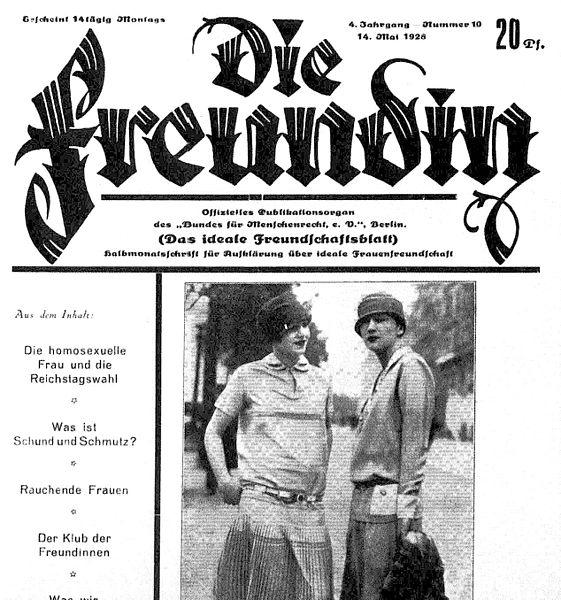
The files show that the 8 women had led relatively open – though certainly not enviable – lives as lesbians before being denounced to the authorities. Ordinary German citizens would have been aware of their female friends, co-workers and acquaintances in same-sex relationships, but were less likely to report them to the police. A patronising understanding of female sexuality comes into play: “Gender is perhaps why lesbians weren’t persecuted in the same ways… [but] these files throw into sharper relief the duplicity of tolerance that has characterised societies’ views of female sexuality for centuries,” says Huneke. By no means was life as a lesbian in Nazi Germany easy, though. In 1928, for example, the police banned popular lesbian journals such as Die Freundin (Girlfriend) based on the Protection of Youth from Obscene Publications Act.   [caption id="attachment_8709" align="aligncenter" width="561"] Credit: Bund für Menschenrecht/Wikimedia Commons[/caption] Many conservatives are documented as demanding the enactment of criminal statutes against lesbian sexual acts. Pamphlets with messages against homosexuals, feminists, Republicans and Jews were everywhere, usually bringing with them the ideas of a conspiracy from marginalised peoples to destroy Germany. These pamphlets denounced the movement for women’s rights, saying that feminism was nothing more than a seduction into lesbianism. Culturally, it seems there was a war against lesbians; and yet there appears to be at least some level of tolerance when it came to prosecution.  
Tolerance and the nature of dictatorships

The case of lesbian life in Nazi Germany is considered to demonstrate that dictatorships often rely not purely on overt oppression; but on limited tolerance of certain groups. Huneke calls it the ‘divide-and-conquer approach’. “One of the most important takeaways from this research, to my mind, is to break the popular idea that authoritarian governments maintain their power only through repression.” Moreover, Huneke says: “the experiences of lesbians in Nazi Germany can help shed light not only on how gender operates in multivalent ways, but also the complex negotiation of both repression and toleration on which authoritarian regimes depend.”]]>

Categories
Editorial

"Hope Will Never Be Silent" – The Life of Harvey Milk

Categories
Editorial

'Viral' Photo Points to Changing Attitudes on Homosexuality

Obergefell vs. Hodges that state level bans on same-sex marriage were unconstitutional. In Europe, the 2015 Europride – a pan-European international event dedicated to LGBT pride on the continent – was held in Riga, Latvia, marking the first time in the annual event’s twenty-three year history that it was held in a former communist country on the EU’s eastern border. Just last week a photo of a tearful teenage boy by renowned “Humans of New York” photographer Brandon Stanton, captioned “I’m homosexual and I’m afraid about what my future will be and that people won’t like me”, went viral, resulting in an international outpouring of support for the teenage boy. The post even grabbed the attention of Hilary Clinton. Undoubtedly there are still places in the world where Lesbian, Gay, Bi-sexual and Transgender people face persecution, from both their fellow citizens and their own governments. The image, and the response to it, highlight the continued concerns and anxieties for LGBT people, but also how much attitudes have changed in a comparatively short space of time. A look at the history of perceptions of homosexuality in Britain and the USA can provide clear examples of just how drastically ideas have changed, at least politically and legally, over the last seventy years. Just 130 years ago, in 1885, the Labouchere Amendment was passed in Britain which created the offence of gross indecency. This made all sex acts between men illegal, the law clearly targeted at criminalising homosexuality. A decade later Oscar Wilde, author of ‘The Picture of Dorian Grey’, was prosecuted under indecency laws and sentenced to two years imprisonment. The judge at the trial stated that he thought the punishment he’d administered, the harshest he legally could, was inadequate for Wilde’s ‘crime’. In 1952, Alan Turing, the key figure in the cryptoanalytic work at Bletchley Park which cracked the Enigma codes, and a pioneering engineer in the development of the computer, was brought to trial on charges of having a sexual relationship with a man. Turing made no attempt to deny or defend his actions, instead making clear that he felt that there had been nothing wrong in his actions. Inevitably found guilty, Turing opted to receive sterilising injections for a year instead of facing a lengthy prison sentence. After the Second World War had ended, Turing worked at the secretive intelligence agency, GCHQ, (Government Communications Headquarters). Following the revelations about his sexuality however, Turing lost his security clearance to work at GCHQ, highlighting Cold War fears that homosexuals presented a security risk. A similar pattern occurred in the USA. Throughout the 1940s and 1950s countless reports were published arguing that homosexuality was a serious threat to society. The 1950 Senate Commissioned report “Employment of Homosexuals and Other Sex Perverts in Government”, argued that homosexuality was a mental illness which constituted a national security risk. Most shockingly, this report openly admitted that the federal government had covertly monitored its employees sexual persuasion in the early years of the Cold War. Highlighting just how seriously these views on sexuality could affect people’s lives, some 4,380 gay men and women had been discharged from the military, and 500 fired from their jobs in the US government in the years leading up to the publication of the report. In April 1953, President Dwight D. Eisenhower signed a bill prohibiting homosexuals from working in the federal government or for any of its contractors. Britain only decriminalised homosexuality in 1967, through the Sexual Offences Act. Even then, homosexual relationships were still burdened with strict restrictions when compared to heterosexual relationships. It would be decades for example, until the same age of consent was applied to homosexual relationships as heterosexual. In the USA reform started in 1962, when the state of Illinois decrimininalised same sex relationships. From there a gradual process started, as other states slowly implemented similar reforms. It wasn’t until 2003 that the Supreme Court struck down the sodomy laws in the fourteen states that still had them. Of course, throughout this period and before, in both the UK and the USA, there were a plethora of campaigners working tirelessly to win acceptance for LGBT rights and to push for legal reforms, laying the groundwork for the increased acceptance we can see today, most explicitly in the response to Stanton’s photograph. It is of course vital to celebrate and acknowledge these campaigners endeavors. Attitudes to homosexuality have had varied histories around the world. In the case of the USA and UK however, the legal, political and social acceptance of homosexuality just seventy years ago was almost unrecognisable to what it is today. Image courtesy of Wikimedia Commons user: Nikodem Nijaki ]]>