Categories
Breaking News

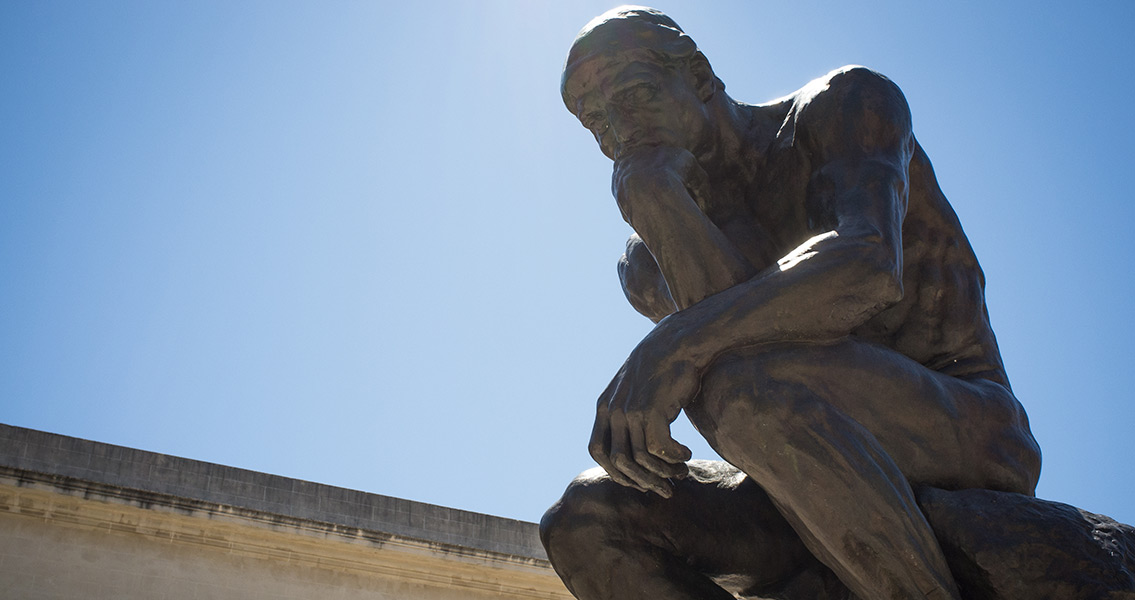
Newly Discovered Sculpture Looks Like Rodin’s “Thinker”

The Times of Israel, dig leader Gilad Itach remarked that the figurine was discovered on the very final day of excavations, just prior to modern construction efforts commencing at the site. The pot itself is relatively characteristic of the period, Itach stated, but the statue that was added after it had been created is unique, as there have never been any discoveries of such a figurine in previous digs. Archaeologists say that the sculpture features an incredible attention to detail for its age. The arms and legs, as well as the face, seem to have been added on to the neck of the jug which was used as the base for the formation of the upper torso of the figure. Along with the figure, which measures seven inches in height, a large number of other items were found as well. Sheep and donkey bones were discovered at the dig site, in addition to an ax head, arrowheads and daggers. The items were likely used as burial goods, Itach explained, probably for the grave of one of the Canaanites who inhabited the region during the Middle Bronze Age. It would have been customary to provide a large number of funeral goods for prominent members of the community, the researcher remarked, as beliefs were that the objects individuals were interred with would have traveled with them to the next world. To Itach’s knowledge, this is the first burial to feature such a wide assortment of objects, especially the remarkable pottery find. The resemblance to “The Thinker” is quite uncanny. The face of the figure rests on one of its hands as it sits on the pot, looking as if it is lost in thought. There’s no way of telling whether the potter who created the jug added the figure or if a second craftsman did so, Itach added. The Yehud dig site yielded more than just the unique set of burial goods. Several other artifacts were discovered that date even older than the Middle Bronze Age, including a shattered earthenware butter churn and the remains of what might have been an ancient well dating to the Chalcolithic period, around 6,000 years in the past. Meanwhile, an earlier archaeological dig in Yehud in close proximity to the location of the statue revealed a massive necropolis dating to the Bronze Age containing nearly 100 pit graves. The remains of men, women and children were found within, complete with grave goods that included jewelry, animal bones, scarabs, pins, daggers and pots. Researchers say that the location saw continued use as a cemetery for several centuries afterwards as well. Images of the newly discovered artifact can be found here: here ]]>
Categories
Breaking News

Shrine of St. Olaf, Norway’s Patron Saint, Discovered

Live Science, researchers from the Norwegian Institute for Cultural Heritage Research (NIKU) say that they have found the remains of the church where the Norwegian king’s body was taken in 1031, when he was raised to sainthood and became known as Saint Olaf. The former Viking raider was baptized into the Roman Catholic faith in 1013, shortly before embarking on a quest to unite the disparate kingdoms of Norway under a single ruler – a task he accomplished in 1016. Olaf ruled as king until 1028, when he was deposed and forced to flee to Russia. In 1030 he attempted to retake the throne, only to be killed in battle at Trondheim, where he was buried. The following year, after rumors had spread how the dead king had been associated with the performance of many local miracles, his body was exhumed. Upon discovering that Olaf was in a state that satisfied the church’s requirements for miraculous preservation, the English Bishop Grimkell declared Olaf a saint, having him reinterred in St. Clement’s Church. While the earthly remains of St. Olaf no longer reside on the site – they were relocated to the site of Trondheim’s Nidaros Cathedral at a later date – NIKU researchers now believe they have found the stone foundation of the original St. Clement’s Church. Additionally, a small rectangular stone platform was uncovered at the east end of the building, which archaeologists surmise as the base of the altar of the church – the very same alter that would have been constructed over the grave of Saint Olaf. Anna Petersén, the site’s excavation director, remarked that the church has a unique place in the intersection of Norwegian politics, culture, and religion. Put in a historical perspective, a large proportion of the Norwegian national identity has its roots in the canonization of Olaf Haraldsson, and the recently discovered church is literally the place where that process began. In life, King Olaf was arguably Christian in name only, as while he had been baptized to the Catholic faith his rule is categorized historically as harsh enough to warrant him becoming deposed in 1028. A former Viking raider, Haraldsson spent time in England, where he pledged his sword to King Ethelred to fight against the Danes, a common enemy – King Canute of the Danes was instrumental in providing support to the Norwegian nobles that overthrew their heavy-handed monarch a little over a decade into his reign. While Bishop Grimkell declared the dead king a saint in 1031, he was not officially recognized as such by the Roman Catholic Church until 1164, when he was canonized by Pope Alexander III. Despite his problematic reign, Saint Olaf is seen as a figure of Norwegian independence. The Norwegian coat of arms features a representation of Saint Olaf in the form of the ax held by a crowned rampant lion on a red field. ]]>

Categories
Breaking News

Skeleton Proves an 800-Year-Old Viking Saga

Categories
Breaking News

Hiker finds 1,200 Year Old Viking Sword in Norway

Categories
Breaking News

DNA Retrieved From Viking Skeletons in Norway Suggest Women Were Vikings, Too