Categories
Breaking News

New Species of Flying Dinosaur Discovered in Patagonia

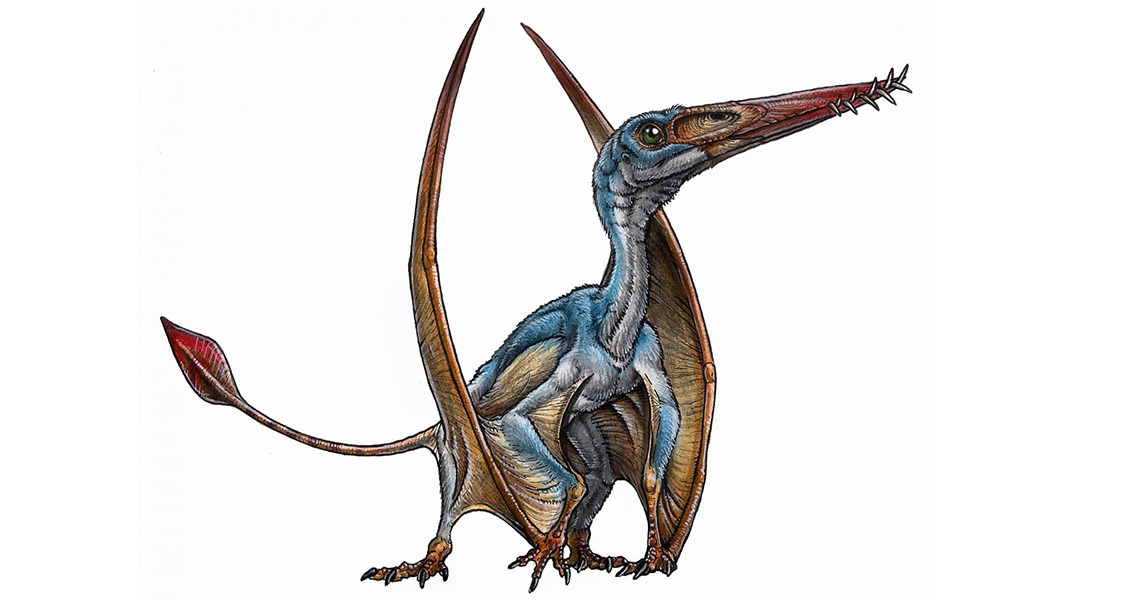
Allkauren koi by the researchers behind the discovery. Preserved in remarkably good condition, the skull remains have revealed new information about the evolution of the braincase of pterodactyloids, a major suborder of Pterosaurs. The name Pterosaur comes from the Greek for ‘wing lizards’. These spectacular creatures dominated the skies during the Jurassic and Cretaceous periods, and included the largest vertebrate ever known to fly: Quetzalcoatlus from the late Cretaceous period. Members of the long extinct group were incredibly diverse, ranging from the size of a sparrow to the size of an airplane. Intriguingly however, Pterosaurs evolved flight separately from bats and birds; they are not closely related to either creature. The group had extraordinary adaptations enabling them to take to the skies: pneumatic bones drastically reducing their weight and an elongated digit supporting a wing membrane. The neuroanatomy of Pterosaurs has remained shrouded in mystery however, the consequence of a paucity of three dimensionally preserved remains. It is this that has afforded the latest discovery such importance, giving new insight into the intermediate forms of Pterosaurs. The study describing Allkauren koi, published in the journal PeerJ, provides new information about the origin, tempo and mode of evolution in the Pterosaur group. Allkauren koi has been named from the language of the Tehuelche, the group of indigenous peoples of Patagonia. ‘All’ comes from the Tehuelche word for ‘brain’, while ‘kauren’ is their word for ‘ancient’. It joins the over 150 other species of Pterosaur discovered so far. The remains, including the amazingly preserved, uncrushed braincase, were discovered in northern central Chubut Province, Patagonia Argentina. Through computer tomography, the researchers have been able to study the creature’s cranial anatomy, observing in three dimensions the cranial endocast and the inner ear. From this starting point a comprehensive phylogenetic analysis of the Pterosaur group was performed, one which “fills an important gap”, according to the study. “Allkaruen, from the middle lower Jurassic limit, shows an intermediate state in the brain evolution of pterosaurs and their adaptations to the aerial environment”, said Dr. Diego Poll, a member of the research team, in a PeerJ press release. “As a result, this research makes an important contribution to the understanding of the evolution of all of pterosaurs.” ]]>
Categories
Breaking News

New Titanosaurian Dinosaur Discovered in Patagonia

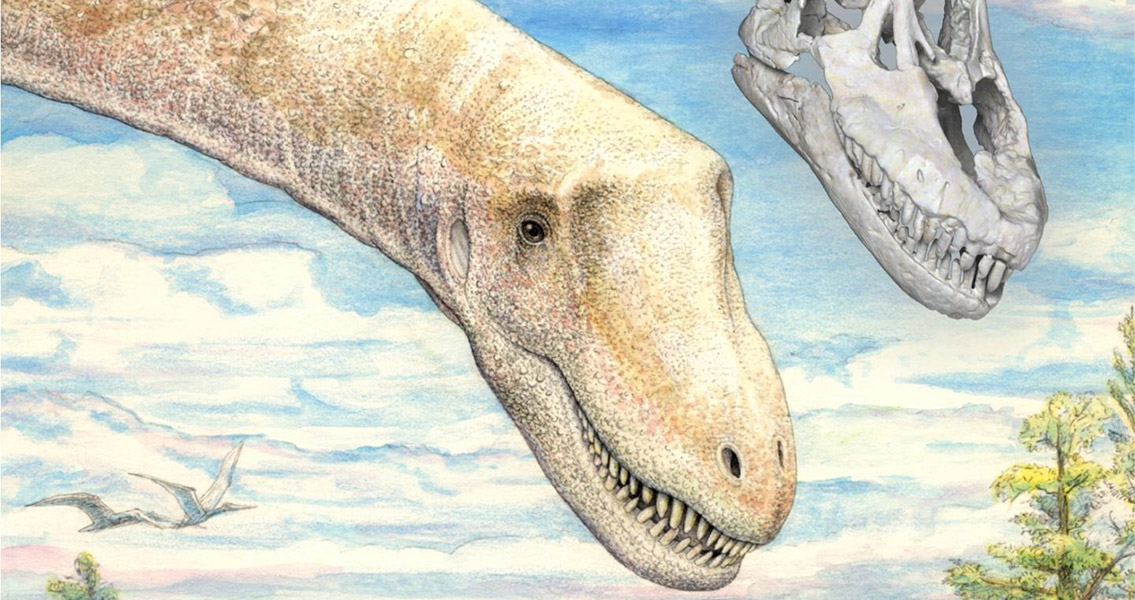
Sarmientosaurus Musacchioi. Based on a partial neck fossil and a complete skull discovered in Patagonia, it’s been determined to be a new Titanosaurian dinosaur – a kind of sauropod which ranged in size from that of a cow to the size of a large sperm whale. They were plant-eaters which had long tails and necks and might have been the most common of the large herbivores that roamed the landmasses of the Southern Hemisphere in the Cretaceous period. Despite their numbers, the skulls of these dinosaurs are exceedingly rare and critical to determining specific facts related to their biology. Only four semi-complete complete skulls out of the more than 60 known Titanosaurs have been found. Researchers associated with the latest discovery utilized computerized (CT) imaging to closely examine the anatomically primitive, well-preserved neck and skull fossils from Sarmientosaurus. Researchers discovered the Sarmientosaurus brain was small compared to its huge body, a typical trait of sauropods. But they also discovered evidence of higher sensory capabilities than almost all of the other sauropods. This suggests that Sarmientosaurus had bigger eyeballs and better vision, in addition to an inner ear which might have been better tuned for hearing airborne sounds at a low-frequency compared to other Titanosaurs. Additionally, the organ in the inner ear which affects balance suggests this dinosaur might have routinely held its head in such a manner that the snout faced downward. “Discoveries like Sarmientosaurus happen once in a lifetime,” study leader Rubén Martínez told PLOS One, “That’s why we studied the fossils so thoroughly, to learn as much about this amazing animal as we could.” There have been numerous dinosaur discoveries in Argentinian Patagonia, a few of the most outstanding have been: * Giganotosaurus Carolinii, discovered in 1993 and considered to be the world’s largest carnivore (13.5 m in length, 4.6 m tall at its hip, and 9,500 kg in weight. * Argentinosaurus Huinculensisis, the biggest herbivore found to date. (larger even than Carolinii). * Andesaurus Delgadoi was found in 1987, under several meters of water in Lake Exequiel Ramos Mejía. The discovery happened when the lake fell to its lowest recorded level due to a drought. Delgadoi was named after its discoverer, Alejandro Delgado. * Rebbachisaurus Tessonei is the most complete dinosaur specimen discovered in South America, and was found in 1988. Also a sauropod, this herbivorous dinosaur weighed around 10,000 kilos and measured 17 meters long. * Gasparinisaura Cincosaltensis, a herbivorous dinosaur which stands out for its small size, 1.50 meters, as well as it’s supposed graceful quick movement. Sarmientosaurus Musacchioi was named for the town of Sarmiento which is located in Chubut Province, close to the discovery site. The study has been published in PLOS ONE, an open-access scientific journal. Rubén Martínez, with UNPSJB, is the author of the study. Image courtesy of Mark A. Klingler, Carnegie Museum of Natural History and WitmerLab, Ohio University]]>