
Journal of Urban History. “The fragmentation of disciplines produces points of view that are difficult to reconcile but it also generates a plural vision, almost kaleidoscopic, on Spanish urban history. We believe this is a good time to make an overall assessment.” After Spain’s stagnation in the seventeenth century, the country began to experience demographic growth in the early eighteenth century. “Cities were trade nodes and grew on the basis of the development of colonial empires,” Diaz and Araujo explain. Interestingly, these early modern cities had a significantly lower level of life expectancy than rural areas. Most large cities suffered from negative natural population growth; this trend could only be offset by sustained mass immigration to urban areas. The Spanish monarchy started to focus on the urban population’s material needs, particularly food markets. Urbanisation, therefore, is clearly not a modern phenomenon. Past municipal governments also sought to solve problems caused by a growing urban population. These urban projects, however, were very fickle. “Escalating conflict between the French and British empires, from the Seven Years War, absorbed the budget of the Spanish monarchy and slowed down or did not permit authorities to carry out large urban projects or simply limited them to wealthier neighborhoods,” Diaz and Araujo noted. Another key period which Diaz and Araujo draw attention to is the Spanish Civil War. The destruction wrought by the Spanish Civil War in the 1930s left a devastated country and more than 800,000 dead. Following the war, famine and shortages – in particular of building materials – ravaged cities and delayed reconstruction work for decades. Between 1950 and 1980, Spain had the highest rates of urban growth in Europe, peaking at 3.23 percent per year in the 1960s. This remarkable urbanisation created a serious housing problem. In the absence of public housing, the rental market dominated – the percentage of private ownership of houses in Madrid and Barcelona fell to 6%. In response to this crisis, the Spanish government adopted policies to encourage private dwelling ownership, considered to be important for social stability. By 1970, the percentage of people owning their home had risen to 64%, by 1980 this figure was 73%. Urban growth, however, sowed the seeds of Spain’s housing bubble which burst in spectacular fashion following the 2008 economic crash. During the economic boom Spain experienced between 1995 and 2008, GDP grew at 4 percent annually and national income increased 60 percent over the same period. The driving force behind this growth was the construction of four million households: eight hundred thousand units were built from 2005 to 2007, which, Diaz and Araujo note, was the same amount as France, Germany, and the United Kingdom – which had five times the Spanish population – built as a whole. Diaz and Araujo trace nearly 300 years of Spain’s urban development and decline. Their work provides a spectacular overview of the major trends and events in Spain’s history and links it with developments in urban history. For more information: www.juh.sagepub.com Image courtesy of Wikimedia Commons user: Fallschirmjäger]]>
Jewish History. In the aftermath of the Revolution, new secular Jewish spaces began to emerge after the liberalisation policies of Tsar Nicholas II had slackened restrictions on the press and public gatherings. This new Jewish public sphere – comprised of the Yiddish press, coffeehouses and theatres – created an ‘ethno-linguistic’ community amongst Warsaw’s Jews, providing new collective bonds for the community. This new Jewish community provided a sense of order for new migrants to Warsaw, a place which could be very worrying. “The disorder, confusion, and possible dangers of urban life—from unfamiliar streetscapes to charlatans who preyed on those who were vulnerable—disoriented newcomers and other city residents, particularly women and children,” Auerbach notes. It is clear that scholarship has taken a clear shift in how Warsaw’s Jewish community is examined. The modern Jewish politics which arose in early-twentieth-century Warsaw was a reaction to a crisis of modernity and urbanisation. Jewish politics did not grow out of internal Jewish developments; they were a response to outside factors. “By shifting the focus away from ideologues, elite decision makers, and cultural figures and toward the broader public,” Auerbach notes, “[new research] complements and challenges the foundational historiography of modern Jewish politics in eastern Europe.” New cultural institutions expanded the Jewish public sphere and were instrumental in bringing Jews into political modernity. Coffeeshops, the press and theatres provided secular arenas where ideas could be shared and debated and Jews could form new bonds. “These spaces curbed the sense of isolation experienced by newcomers,” Auerbach concludes. For more information: www.link.springer.com Image courtesy of Wikimedia Commons user: Alex Bakharev ]]>
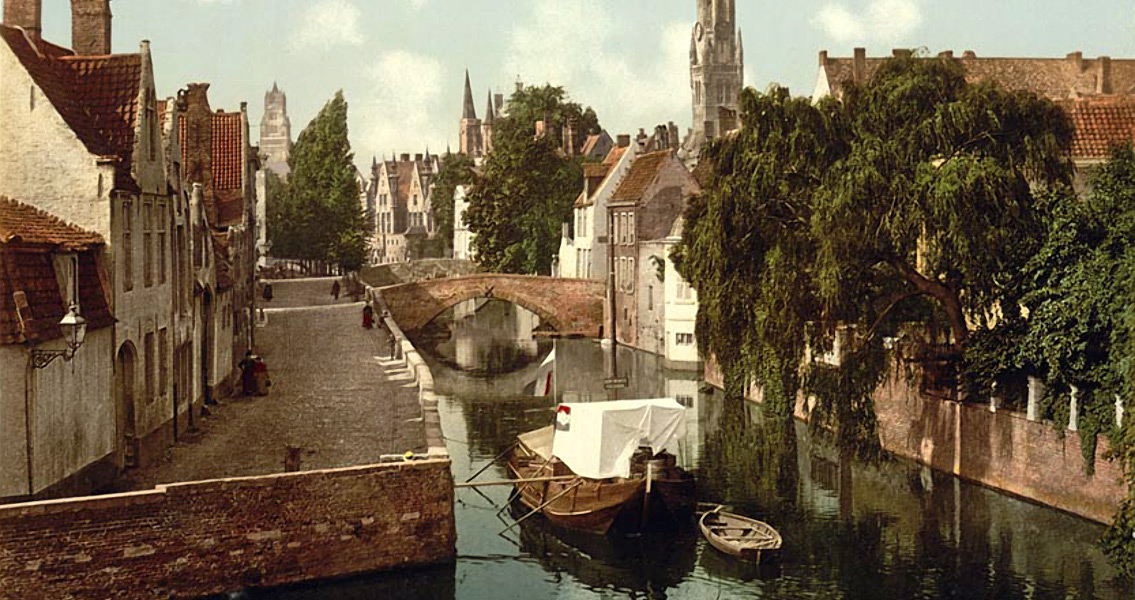
Past and Present, one of the most prestigious historical journals in the English-speaking world. “Indeed, the elites of Ghent, Bruges and Ypres, the three leading cities of the county [of Flanders], had begun to acquire rural estates as early as the second half of the thirteenth century, and members of the urban middle classes soon followed their example.” Since the early twentieth century, historians have assumed that urban elites who bought rural properties gave up their previous lifestyle. In what is called the ‘betrayal of the bourgeoisie,’ leading merchant families abandoned commerce entirely, preferring to pursue noble status rather than profit. Buylaert, however, suggests that this is a fundamentally flawed assumption. Acquiring rural estates, Buylaert argues, did not mean a withdrawal from the urban economy, or from commercial activities in general. Urban merchants “used their rural properties as pledges for contracts to buy or sell industrial goods that were made in or marketed through cities,” Buylaert explained. “Land was also a hedge against market fluctuations, a way of diversifying the investment portfolio.” Far from abandoning their lucrative commercial ways, therefore, these urban merchants used their rural holdings to further their mercantile aims. But what about the nobles seen in the streets of Bruges? Buylaert states that the ennoblement of city-dwellers must be seen in a context of a reciprocal urbanisation. For a long time before the first city elites were accepted into their ranks, Flemish nobles were striving to adapt to the increasing dominance of large cities; this urban growth through the medieval period held particular risks in Flanders, one of the heartlands of European feudalism. By the late thirteenth century, Ghent, Bruges and Ypres had become the economic, demographic and military powerhouses in the county of Flanders. The cities had gained so much power, in fact, that they started to dominate the political decision-making processes. “In response to the power of these cities,” Buylaert argues, “Flemish nobles… invested in urban life and the urban economy, thereby assuring the preservation of their social and political position. It was this investment that, in turn, allowed city elites to enter their ranks as seigniorial lords.” Buylaert has revealed a remarkable piece of social history by examining a rather curious incident in the history of Bruges. By exploring why a group of Flemish nobles were seen in an urban environment – somewhere they supposedly should not have been – Buylaert has re-evaluated how we should look at the medieval nobility. It appears that the elite of society were not apart from the rest of the population and their membership was, at least to an extent, porous. For more information: www.past.oxfordjournals.org Image courtesy of Wikimedia Commons user: Dzlinker]]>