

here Image courtesy of Suzanne Pilaar Birch]]>

here Image courtesy of UPV/EHU]]>
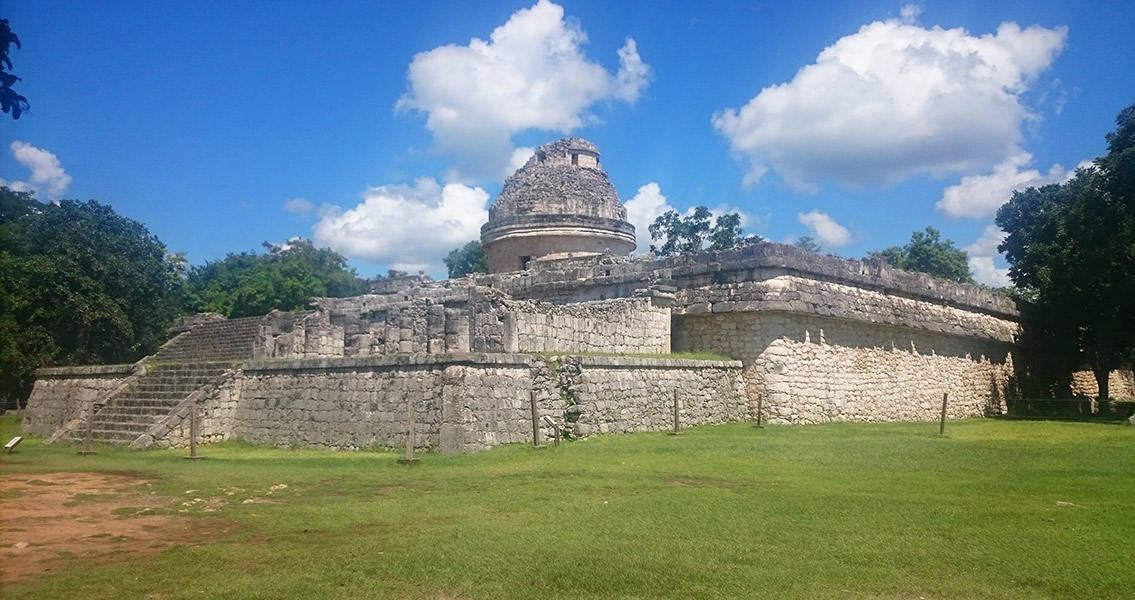
Excelsior, a Mexico City-based newspaper, Quintal Suaste remarked that the building would have seen the exclusive use of the elite of Maya civilization, most notably the community’s astronomer-priests. Like other Maya buildings that were built to match the path of the sun, this observatory has doors within it that align with both the rising and setting sun on the date of the spring and autumnal equinoxes. Additionally, when the midday sun strikes the semicircular building it casts no shadow – another intentional design element of the structure. Meanwhile, the southern edge of the observatory has been shown to align with the northernmost position that Venus reaches in the night sky. After the sun and the moon, the planet is the brightest observable object in the sky; Venus held a special place among Acanceh’s astronomer-priests. According to Quintal Suaste, the Maya had the ability to track the planet through its 584-day cycle thanks to the observatory. Direct evidence of this behavior was corroborated by the text within three codices discovered at the site. These findings were able to further support the idea that Venus was an integral cultural icon amongst the Maya, according to Orlando Casares Contreras, another researcher that also spoke to Excelsior. The Central American civilization was vast, stretching from southern Mexico to Honduras during its peak. Venus had a special place in Maya theology and in their mythological pantheon, known as Noh Ek, or “The Great Star”, among the faithful. Venus was also known as Xux Ek, “the Wasp Star”, according to some texts. There are some indications that Venus might have been known by a specific name depending on where it appeared in the sky during its cycle, as it would appear as a morning star during part of its cycle and an evening star during another part of its cycle. Image courtesy of Wikimedia Commons user: Luigiflas]]>
here Image courtesy of Wikimedia Commons user Peter Wadsworth]]>
MOLA website]]>
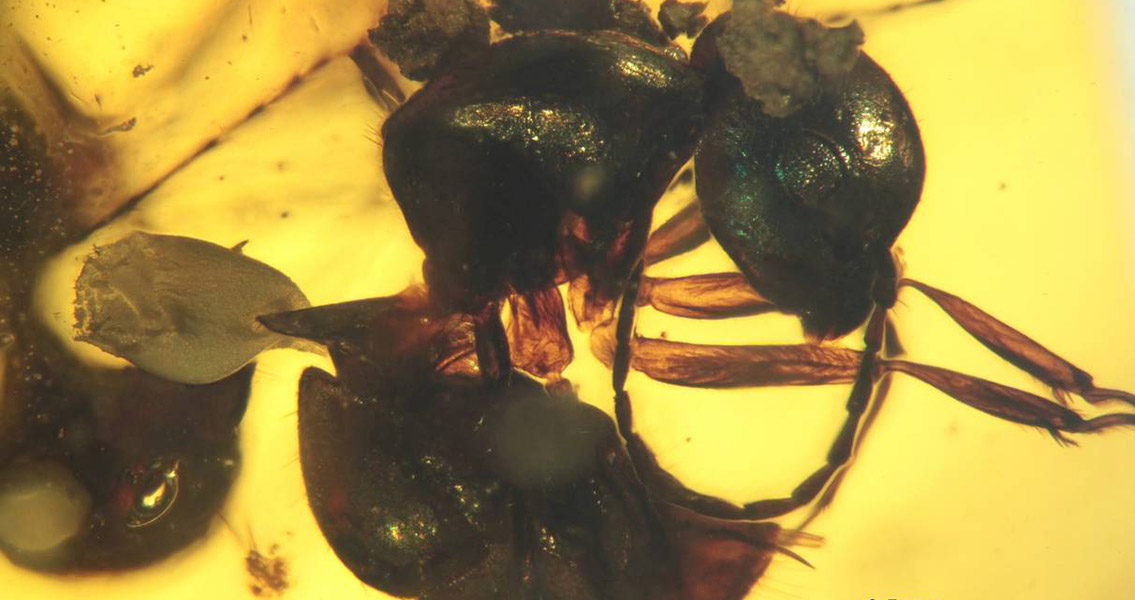
Ceratomyrmex ellenbergeri, is thought to have used its horn and mandibles to trap prey relatively large for its size. C. ellenbergeri, which belongs to the Formicidae stem-group, seems to be an exception to the idea of social evolution in Cretaceous ant species. The bladelike horizontal movement of the species’ mandibles are unique, resembling the Haidomyrmecine ants of the same time period which have long puzzled evolutionary biologists when it comes to classifying their ecology; both these species bear little in common with other large-mandible solitary hunter ant species such as modern trap-jaw ants. According to a press release from the Chinese Academy of Sciences, a new research paper spearheaded by Dr. Wang Bo from the academy’s Nanjing Institute of Geology and Paleontology found that C. ellenbergeri’s remarkable cephalic horn represents a hitherto unseen genetic modification among both ants discovered in the fossil record and the known ant species of today. This shows that the morphology of exaggerated trap-jaws such as in the Haidomymrmecines occurred early in the Formicidae stem group. The implications of the discovery include suggestions that at the very least some of the earliest Cretaceous stem-group ants differentiated themselves by being solitary socialist predators instead of eusocial insects. Additionally, the research study states that soon after ants started forming social bonds during the Early Cretaceous, there was at least one lineage in the form of Haidomyrmecini that grew to become effective at capturing prey – something that would not be seen in ant morphology again until well after the end of the Mesozoic, as evidence of these morphological specializations in the fossil record disappear for millions of years. The highly exaggerated features of the fossilized C. ellenbergeri specimen also show how early Cretaceous ants developed the ability to carry large-bodied prey, despite the fact that smaller prey would have presumably been easier to capture. In the end, the research data indicates that the earliest ants of the Cretaceous had ecological traits that were much more diversified and complex than previously thought. The research study, recently published in the journal Current Biology, can be found online here]]>

The News Minute, the new find was made during an excavation spearheaded by the Archaeological Survey of India. A team of ASI experts say that the village is situated on the ruins of an ancient settlement that would have been on a major highway, one that played an important role in international trade. This roadway featured highly advanced engineering for the time, including a complex sewage and drainage system to collect and re-direct rain and water runoff. Composed of pipe lines created from baked clay, these sewage drains were said to be analogous with those used by the Indus Valley civilization in northwest India and modern-day Pakistan. The Indus Valley civilization is also known as the Harappan civilization – so named for Harappa, the former Punjab province dig site where evidence of the civilization was first discovered in the 1920s. The civilization itself was active during the Bronze Age, roughly between 3000 BCE and 1300 BCE; at its peak, it may have had a population of close to five million. The civilization is well-known for its sophisticated urban planning techniques. In this case, ASI experts say that the settlement in Keezhadi Pallai Sandhaipudur was a minimum of 2,500 years old, meaning it’s both in the wrong time and the wrong place to be part of the Harappan civilization. Instead, this would place it squarely in the Pandiya Dynasty, one of three Tamil dynasties that reigned in southern India from around 600 BCE. The Pandiyan Empire survived, in several different forms, until around the end of the sixteenth century CE; such a drainage system bearing a striking resemblance to ones used by a much older civilization typically found much farther north makes the case for the civil engineers of the Tamil dynasty learning much from their Indus Valley forebears. According to an ASI interview with K Amaranth Ramakrishna, the superintendent of the ASI-sanctioned dig, the fact that the drainage system was found intact is quite rare – shedding more light on this period of Tamil history. Keezhadi village bore strong signs of urban civilization, Ramakrishna added, stronger signs than were discovered in the ancient capital of Kaveri Poompattinam, located where the modern-day Tamil Nadu port city of Poompuhar exists today. There were several different styles of signets discovered during the dig. Other items uncovered by the team of ASI researchers included arrows, weapons made from both copper and iron, an assortment of rare ornaments and a so-called “scribbling nail” as well, which may have been used as a stylus or other type of instrument for making marks on a writing surface. Ramakrishna said that the signets could have been sent along by traders with their products as a way to identify the origin of the goods. The ASI began their excavations at the village on the 18th of January of this year. The dig is ongoing and plans are in place to continue investigating the site until around September of 2016. Image courtesy of Wikimedia Commons user: PlaneMad ]]>
