Categories
Breaking News

DNA Tests Quash King Albert I Death Conspiracy Theory

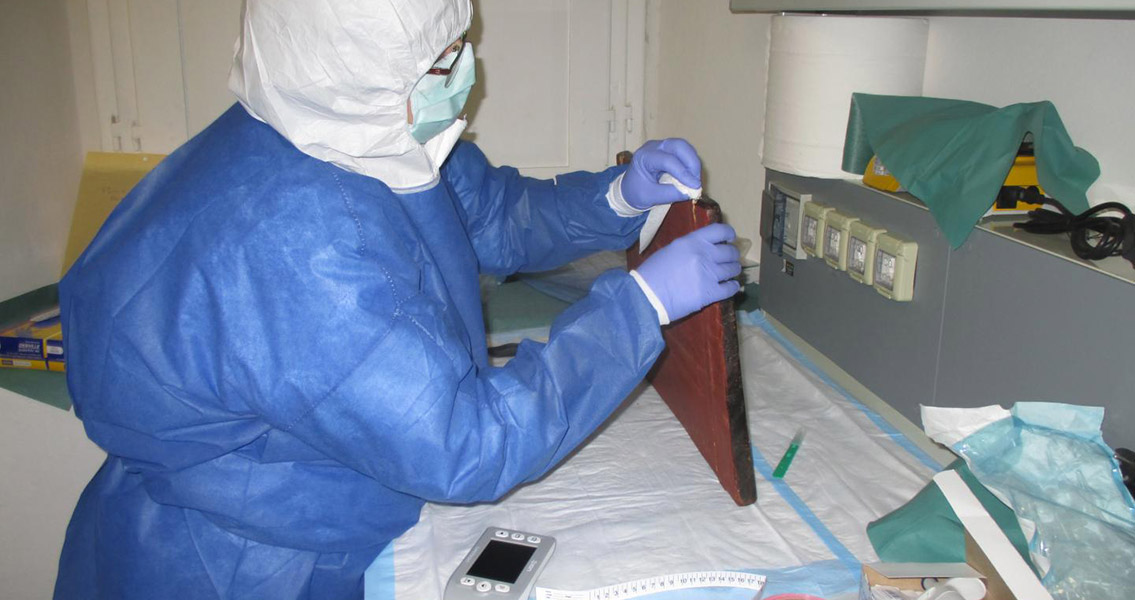
Royalty, bought one such relic: blood stained tree leaves, determined to find out once and for all if they were truly covered in the monarch’s blood. In 2014, Professor Dieter Deforce from the University of Gent carried out tests confirming the blood was human. From there, Larmuseau and his team commenced DNA analysis to confirm whether the blood did indeed belong to King Albert I. “King Simeon II of Saxe-Coburg and Gotha, the last tsar and former prime minister of Bulgaria who is related to Albert I on his father’s side, and Anna Maria Freifrau von Haxthausen, a German baroness who is related to Albert I on her mother’s side, were willing to cooperate. They gave up DNA samples that we compared with the DNA of the trails of blood. We found that the blood is indeed that of Albert I.” said Larmuseau, in a press release from KU Leuven. “The authenticity of the trails of blood confirms the official account of the death of Albert I. The story that the dead body of the king has never been in Marche-les-Dames or was only placed there at night has now become very improbable. Furthermore, the results show that conducting a perfect legal investigation at the time was impossible right from the start, because souvenir hunters had disturbed the scene.” Larmuseau continued. Born in April 1875, King Albert succeeded to the throne in 1909. His popularity came from his refusal to allow German troops free passage through Belgium in 1914, and his personal leadership of the Belgian army during the First World War. Following the armistice, his reign was considered crucial in securing Belgium’s post war recovery. For more information: www.fsigenetics.com Image courtesy of © KU Leuven – Maarten Larmuseau ]]>

Categories
Breaking News

Groundbreaking New Study Launched into Da Vinci's DNA

Journal of Human Evolution. The Project’s team comprises anthropologists, art historians, genealogists and microbiologists from a host of leading Universities in Europe and North America, as well as specialists from the J. Craig Venter Institute of California, the institution responsible for mapping the human genome. A comprehensive image of Da Vinci’s life could be produced by the time the study is completed. In particular, analysis of the remains could allow insights into his lifestyle; his state of health, diet, personal habits and even the places he lived and stayed in. Brunetto Chiarelli of the International Institute for Humankind Studies and editor of the Journal of Human Evolution, underlined just how revelatory the team’s research could be. “Matching Leonardo’s DNA to that of his family presents puzzles that are minutely specific to their history and circumstances, but the tools the investigators use are generic and broadly applicable.” Chiarelli said, in a press release from the journal. “We stand to gain not only greater historical knowledge of Leonardo but possibly a reconstruction of his genetic profile, which could provide insights into other individuals with remarkable qualities.” For the art world in general, the techniques being explored and developed by the team could have a revolutionary impact, capable of detecting multi-million dollar forgeries. One of their aims is to see if Da Vinci’s DNA can be extracted from his artworks. For instance, members of the team are in discussion with the Florentine laboratory currently restoring Da Vinci’s ‘Adoration of the Magi’ about the possibility of removing dust from the painting and studying it for signs of Da Vinci’s DNA. If it turns out an artist’s DNA can be extracted from artwork, it would prove a game changer in verifying a piece’s authenticity. The researchers aim to finish their ambitious project by 2019, to coincide with the 500th anniversary of Da Vinci’s death. Recent multi-disciplinary anthropological studies have provided remarkable insights into the lives of Richard III and the Spanish author Cervantes. The new study has the potential to do the same for Leonardo Da Vinci. For more information: The Leonardo Project: Special Issue]]>

Categories
Breaking News

Kennewick Man a Native American, DNA Research Says

www.nature.com Image courtesy of Wikimedia Commons user: LavaBaron]]>