Categories
Breaking News

New Carbon Dating May Tie Early Humans to Hobbits' Extinction

Homo floresiensis – the “hobbit” species – was discovered, have been carbon dated to approximately 46,000 years ago. Because the upper premolar and lower molar are somewhat younger than any of the known hobbit remains, this new information seems to support the theory that humans were involved in the demise of H. floresiensis. Discovered at Liang Bua in 2003, the remains of H. floresiensis, widely believed to be in the genus Homo, suggest they would have been around 3.5 feet (1.1 m) tall. Nine partial skeletons from nine individuals, including a single complete skull, have been discovered. Recent re-dating efforts in the cave moved the hobbits’ extinction back to approximately 50,000 years ago, when early humans were known to already be living in South-East Asia, according to the study co-authored by geochronologist Richard Roberts and archeologist Thomas Sutikna, both with the University of Wollongong, Australia. “It’s a smoking gun for modern human interaction, but we haven’t yet found the bullet,” Roberts told Nature, which published the research. Although the team is confident the teeth are from H. sapiens, partly because they’re larger than those of H. floresiensis; a paleoanthropologist from University College London, María Martinón-Torres, believes that the premolar appears slightly more primitive. To conclusively prove the teeth are human, she believes they should be compared to a wide range of H. sapiens and H. erectus remains. There is other evidence which puts humans on Flores Island immediately after H. floresiensis disappeared, supporting the possibility that humans contributed to the hobbits’ extinction by out-competing them for limited resources on the island. Animals which may have been a food source for early human hunter–gatherers, including giant storks (Leptoptilos robustus), miniature elephants; known as stegodons (Stegodon florensis insularis), and vultures (Trigonoceps), all vanish from the sediment layers in the cave after approximately 46,000 years ago. During this same time period, freshwater mollusk shells start to show up. These shellfish are commonly found at other early human sites across Africa and Eurasia. Stone tools constructed using chert, a material which is also regularly seen at other early human sites, and evidence of fire hearths are further examples of findings more recent than the Liang Bua hobbit remains. “What we don’t yet know is whether there was at least a short overlap in the populations, thus raising the question once again of the possible role of modern humans in the extinction of floresiensis”, paleoanthropologist Chris Stringer with the Natural History Museum in London told Nature, adding that if humans and hobbits had overlapped, interbreeding is also a possibility. Meanwhile, the research team intends to return to Liang Bua in order to explore cave deposits from 46,000 to 50,000 years old. The discovery of the teeth was revealed at the European Society for the study of Human Evolution in Madrid’s annual meeting. ]]>
Categories
Breaking News

'Hobbit' Ancestor Found in Indonesia

Homo floresiensis, a mysterious, pygmy like human species, were first found on the island of Flores, Indonesia, in 2003. The unusual creatures have been nicknamed hobbits, in reference to their similarities to the characters from J.R.R Tolkien’s popular fantasy books. The first specimen, discovered in the Liang Bua cave on Flores, was surrounded by stone tools and animal remains. Thirty years old at the time of death, the female H.floresiensis would have been about 3.5 foot (1.06 metres) tall. Subsequent discoveries of jaw and skeletal remains from eight similarly diminuitive individuals led scientists to conclude in a 2009 study that the initial discovery had not been an anomaly. Exactly when H.floresiensis actually lived is far from clear, but a 2005 paper in Nature suggested they could have been around as far back as 95,000 years ago until as recently as 12,000 years ago. Now, remains of hominins that were roughly the same size as H.floresiensis but ten times older, have been excavated from Mata Menge, a site in open grasslands 70 km east of Liang Bua, Indonesia. Several isolated hominin teeth, as well as a fragment of lower jaw, were found in a layer of sandstone which had been deposited around 700,000 years ago next to a lakeside stream. The findings are reported in the journal Nature. “We have unearthed fossils from at least three individuals, including two children, along with stone tools that are almost identical to those made by the much younger Homo floresiensis,” said Dr. Adam Brumm from Griffiths University, who was involved in the excavations. Along with colleagues from the Geology Museum and Geological Survey Institute in Bandung, Indonesia, Dr. Brumm has been carrying out excavation work at Mata Menge since 2004. “There is a striking similarity in size and form between the Mata Menge hominins and the Liang Bua hobbit, which is surprising given the former are at least several hundred millennia older.” Dr. Brumm explained in a press release from Griffiths University. “This suggests the Mata Menge individuals belonged to a population of ancient hobbit-like hominins that gave rise to Homo floresiensis. They may even have been a very early form of hobbits, which would mean this species existed for far longer than anyone had anticipated.” Since the initial discovery in 2003, scientists have struggled to explain where H.floresiensis fit into the human family tree. Although broadly agreed that the ‘hobbits’ evolved from an archaic branch of hominins that existed prior to the emergence of our own species in Africa some 200,000 years ago, exactly which hominin group spawned them has divided opinion. One hypothesis is that H.floresiensis descended from Asian Homo erectus, also known as Java man, an early hominin that reached the island of Java 1.5 million years ago. The hypothesis suggests that a group of these ‘Java men’, which were similar in size to a modern human, somehow became stranded on Flores and gradually reduced in body size. The other hypothesis is that H.floresiensis came from an even more ancient ancestor, such as Homo habilis, or perhaps even an ape like hominin forerunner. The Mata Menge discoveries seem to add considerable support to the first theory. “While only a handful of fossils has been found at Mata Menge so far, characteristic features of the teeth strongly imply an ancestral relationship with Homo erectus,” Dr. Brumm said. “This lends weight to the theory that the hobbit was a dwarfed version of the famous Java Man, which somehow got marooned on the island. The fact that they were found with fossils of extinct pygmy elephants (Stegodon) and giant rats also supports the idea of an isolated group of Homo erectus undergoing a dramatic evolutionary change owing to the Island Rule.” These conclusions are far from conclusive of course. Brumm and colleagues are hopeful however, that more skeletal remains will be excavated from Mata Menge, which could provide further insights into H.floresiensis‘ history. “Mata Menge is a goldmine,” said Dr Brumm. “I expect that further excavations at this site will eventually yield a hominin skull, which will finally allow us to put a face and a name to the hobbit’s ancestor. Then we will know how this experiment in human evolution got started”.]]>

Categories
Breaking News

New Research Suggests Humans Drove Hobbits to Extinction

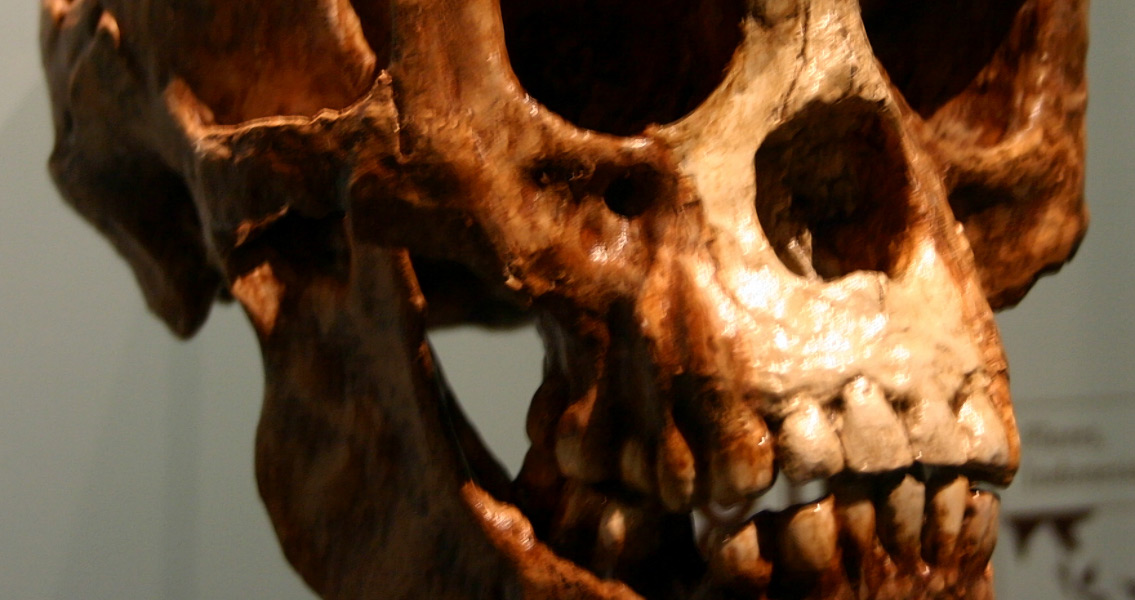
Homo floresiensis, aka the ‘Hobbit’ people, were first discovered on the island of Flores in Indonesia and ever since researchers have wondered how they were able to co-exist with early humans when no other group had. The answer? They didn’t. New excavations and dating have concluded that the Hobbit people died away 50,000 years ago, tens of thousands of years earlier than previous testing indicated. In fact, the new data suggests that instead of living alongside them, modern humans may have driven H.floresiensis to extinction. In hindsight though, the error is clear to see. The first Hobbit fossils were considered too precious and fragile to undergo radiocarbon analysis. In lieu of testing the bones, researchers gathered charcoal found nearby under the assumption it had accumulated at the same time as the fossils. The charcoal was tested and dated to 11,000 years old. Modern humans spread throughout Australia and Asia around 50,000 years ago. “Somehow these tiny people had survived on this island 30,000 years after modern humans arrived”, Richard Roberts, with the University of Wollongong, told Nature “We were scratching our heads. It couldn’t add up.” Previous research shows the Neanderthals disappeared shortly after the arrival of modern humans in Africa and Europe. So the team continued excavations in Liang Bua (the limestone cave where the original fossils were found), primarily to search for more remains, and to gain a better understanding of the enormous cave and its geology. Freshly excavated rock and dirt (removed from the same layer of sediment as the Hobbit bones) was tested using several different methods and the results showed the samples were 100,000 to 60,000 years old. Tom Higham, with the University of Oxford, UK, considers the recent dating results compelling, telling Nature “These results are tantalizingly close to the earliest evidence for modern humans in the region, which might suggest a causal link to the subsequent disappearance of H. floresiensis.” Homo floresiensis (which translates as Flores Man) would have been around 3.5 feet (1.1 meters) tall. A total of nine partial skeletons were recovered in 2003, and included one with a complete skull, which is referred to as “LB1”. It’s been determined that LB1 is the skeleton of a 30-year-old female (nicknamed the Little Lady of Flores or “Flo”). Her height has been estimated to be 3 feet and 6 inches (1.06 meters). There has been intense and continuous research since their first discovery just to determine whether or not the Hobbit people represent a species separate from modern humans. Some experts have posited that the historical H. floresiensis could be connected to the Ebu Gogo myths which were prevalent on the island of Flores. Although the new research answers the co-existence question, others remain. For example; what is the Hobbit people’s evolutionary connection to other primitive humans and did they mate with modern humans? It’s also been noted that Liang Bua’s unusual geology would have made it easy for researchers to make the mistake of connecting the charcoal remains to the Hobbit remains over ten years ago. Image courtesy of Wikimedia Commons user Avandergeer]]>