Categories
Breaking News

Scientists Making Progress in Creation of Woolly Mammoth Hybrid Embryo

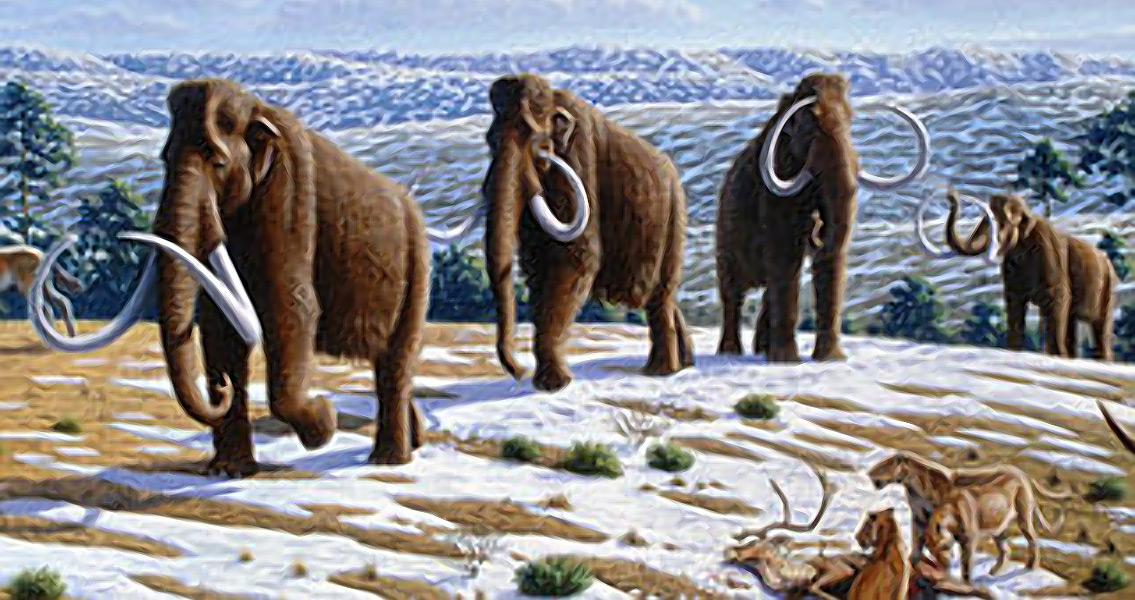
The Guardian. “Actually, it would be more like an elephant with a number of mammoth traits. We’re not there yet, but it could happen in a couple of years.” Already dubbed a “mammophant”, the animal would have numerous mammoth traits such as small ears, shaggy hair and blood that allows the animal to tolerate freezing temperatures. The existence of an actual mammophant however, is still years beyond the creation of an embryo. Future plans, which could take more than a decade to realize, are to grow the embryo in an artificial womb in a lab. The scientists believe their modifications can help the endangered Asian elephant, and help battle global warming by reducing the rate at which Arctic permafrost is thawing. As the permafrost thaws, the process of microbes consuming the organic material beneath it releases huge amounts of the greenhouse gas methane into the atmosphere. When herds of mammoths wandered the Arctic, they suppressed forest growth which in turn prevented the melting of permafrost. “They keep the tundra from thawing by punching through snow and allowing cold air to come in,” Church explained in the article, “In the summer they knock down trees and help the grass grow.” There are critics of the team’s work who consider the revival of extinct creatures to be filled with unpredictable consequences, such as the impact such an introduction would have on elephants and other animals. Regardless of the ethical considerations the team of scientists continues their work. They successfully grew a mouse embryo inside an artificial womb for 10 days, half of its 20-day gestation period. An elephant calf‘s gestation period is 660 days, making growing one a much more difficult feat. Professor Church recently spoke about his team’s progress trying to recreate the long-extinct mammoth’s genetic blueprint over the past two years at the annual meeting of the American Association for the Advancement of Science (AAAS) in Boston. ]]>

Categories
News

Booker T. Washington Receives Honorary Degree

Categories
Breaking News

Cooking May Not be Solely Human Trait

www.rspb.royalsocietypublishing.org Image courtesy of Wikimedia Commons user: Massimo Peruffo]]>

Categories
News

Human Skin or Sheepskin?

th century. The library at Harvard holds over 15 million books but librarians still have no clue as to how many in that collection are actually bound by human skin. The books in question include “Des destinées de l’ame…,”  by Arsène Houssaye;  A book about French philosophy, a book on medieval law (Spanish) dating back to the 17th century and a collection of Roman poetry . Although the book on Spanish medieval law contains suggestive inscriptions at the back of the book, they have turned out to be inaccurate. Laboratory tests on proteins found in the binding have concluded that it is sheepskin, rather than human. There is no distinct difference these books when compared to other books, and without an inscription that states what material makes up the covers there is no real clue as to what the material of the covers consist of. The books do not really resemble human flesh and skin bindings are only recognizable to someone who is an expert; the discolored look similar to books that have been around for many years makes these books look fairly normal.  The law book includes an inscription that suggests that it was done in honor of a dear friend rather than something fiendish. “the bynding of this booke is all that remains of my dear friende Jonas Wright, who was flayed alive by the Wavuma on the Fourth Day of August, 1632. King Mbesa did give me the book, it being one of poore Jonas chiefe possessions, together with ample of his skin to bynd it. Requiescat in pace.” Lawrence S Thompson, states that the practice of anthropodermic bibliopegy i.e. binding books in human skin goes all the way back to the 13th century with a French Bible. The practice took shape in the 17th century however, with evidence stated in a Crimson article. The article reports that on exhibition was the “finest collection of miniature books”. Included among the collection was a book bound in skin. The most famous book that has been bound as human skin is the book by James Allen, entitled “The Highwayman; Narrative of the Life of James Allen alias George Walton”. The book lies at the Athenaeum and is bound by Allen’s own skin at his request.  He asked that the book be presented to a man he tried to rob. Other books have been tested including the book entitled “Practicarum quaestionum circa leges regias Hispaniae”. The results were inconclusive regarding whether or not it was indeed human skin]]>