Categories
Breaking News

A.Sediba Likely Ate Similar Food to Homo Sapiens

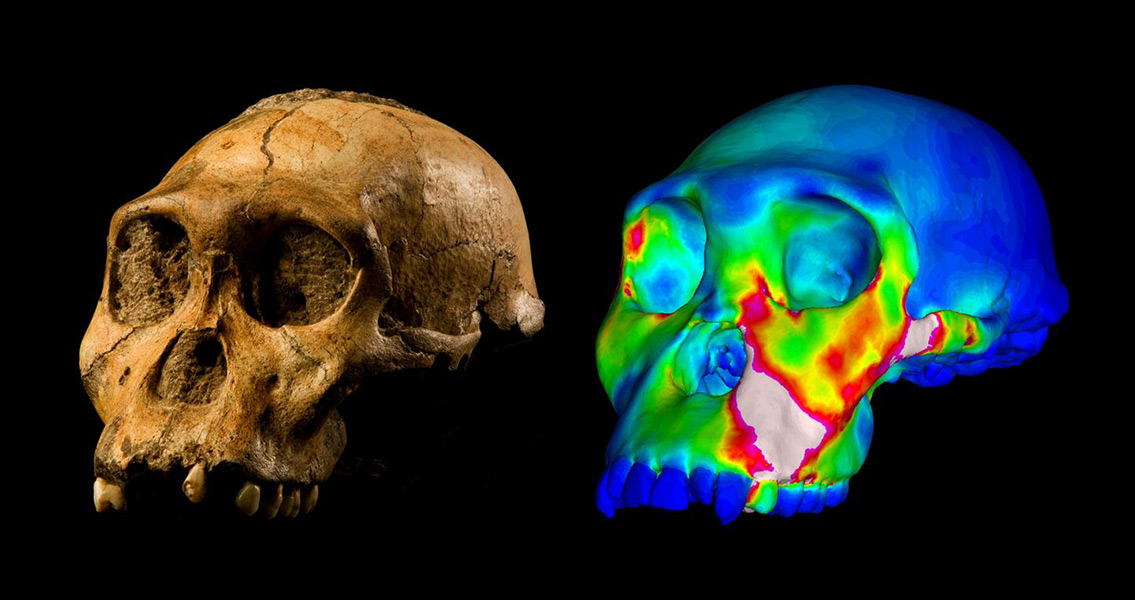
Australopithecus sediba; a species first discovered at the archaeological site of Malapa in the Cradle of Humankind World Heritage Site, South Africa, in 2008. A.sediba‘s phylogenetic relationships have been a source of debate since its initial discovery. Some have hypothesized that A.sediba was close to the genetic ancestry of the Homo genus, while others have suggested that it was in fact a phylogenetic relative of A.africanus. Although not answering the question of whether A.sebiba is a close evolutionary relative of the Homo genus, the new study does provide insights into the evolution of early human species. A 2012 study argued that A.sediba lived off a woodland diet, including hard foods mixed in with tree bark, fruit, leaves and other plant products. This conclusion was based on dental microwear data, which seemed to show tooth damage indicative of a diet of hard to chew foods. The authors of the new paper have used mechanical tests on a model of A.sediba’s skull to show that in fact the creature did not have the requisite tooth and jaw structure to survive on a diet of hard foods. Indeed, the study suggests that if A.sediba had bitten down as hard as possible with its molar teeth, it would have dislocated its jaw. To test the biomechancial properties of the A.sediba skull model, the team used techniques similar to those deployed by engineers to test whether airplanes, vehicles, and mechanical devices will break during use. Significantly, these new findings seem to distinguish A.sediba from other members of the Australopithecus genus. “Most australopiths had amazing adaptations in their jaws, teeth and faces that allowed them to process foods that were difficult to chew or crack open. Among other things, they were able to efficiently bite down on foods with very high forces,” said Professor David Strait, team leader and anthropologist from Washington University in St. Louis, US, in a press release. It is widely believed that humans are descended from an australopith ancestor. Since its discovery, A.sediba has been considered a possible candidate for that ancestor, or at least a close relative to it. The limitation in biting force discovered by the team is something A.sediba shares with modern humans. “Humans also have this limitation on biting forcefully and we suspect that early Homo had it as well, yet the other australopiths that we have examined are not nearly as limited in this regard,” said co-author Dr. Justin Ledogar, from the University of New England in Australia, in the press release. “This means that whereas some australopith populations were evolving adaptations to maximize their ability to bite powerfully, others (including A. sediba) were evolving in the opposite direction.” Ultimately, the new study shows the impact of diet and ecology on the development of the Homo genus’ ancestors. The difference in jaw strength among australopiths revealed by the study suggests ecological factors disrupted their eating patterns and behaviours, thus causing different evolutionary adaptations. As the study explains, “Thus, even if A.sediba and Homo were descended from different gracile australopith ancestors, it is evident that one must understand the dietary selective pressures that influenced the ancestors that preceded the earliest members of Homo if one is to understand the origin of the genus.” For more information: www.nature.com Image courtesy of Brett Eloff provided courtesy of Lee Berger and the University of the Witwatersrand.]]>
Categories
Breaking News

Skull Study Dates Homo naledi to Two Million Years Ago

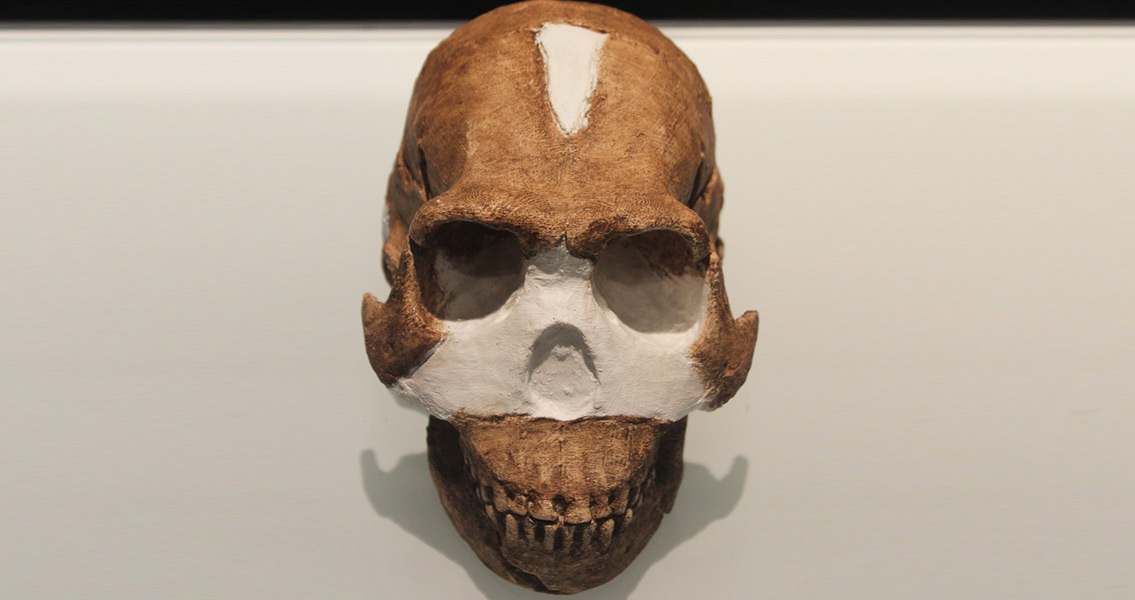
Homo naledi, a species first discovered earlier this year which is part of the Homo genus. In a paper published in the South African Journal of Science, Professor J. Francis Thackeray from the Evolutionary Studies Institute at the University of Witwatersrand suggests that H.naledi lived two million years ago (plus or minus 500,000 years). He bases his conclusion on a comparative analysis of H.naledi and other Homo species’ skulls. If proven correct, Thackeray’s conclusion could be hugely important in furthering our understanding of the evolution and development of the Homo genus, allowing H.naledi to be placed in the human family tree. In September of this year Professor Lee Berger, also from the University of Witwatersrand, first announced the discovery of H.naledi. Over 1,500 bones from the hominin species were discovered in the Rising Star cave in the Cradle of Civilisation World Heritage Site, South Africa. The name H.naledi comes from the word for a star in the Sesotho language. The fossils unearthed at the cave constitute a complete skeleton, an extreme rarity when it comes to early members of the homo genus. This fact allowed Berger and his team to conclude that it was one of the oldest members of the homo genus. H.naledi was ape like in many respects, but also had several characteristics in common with modern humans. H.naledi’s brain size was likely similar to that of a gorilla, based on analyses of its skull, while its pelvis and shoulders were also ape like. It has been classed as a hominin due to the advanced shape of its skull, long legs, small teeth and modern-like feet. Attempts to conclusively date the fossils have so far proven unsuccessful, however. A study by Paul HGM Dirks, carried out in conjunction with Berger, concluded that the usual method of dating such fossils; stratigraphic analysis of the area they were excavated from, had proven inconclusive due to the unusual geological and taphonomic context of the Dinaledia Chamber where the remains of H.naledi were discovered. Stratigrahic analysis is the method which has been used to date other hominin fossils, such as Australopithecus africanus. Thackeray has based his conclusion on a statistical analysis of the skull size of different hominin specimens. “The method is based on a least squares linear regression analysis of mean values of measurements for crania of 12 hominin species… The analyses were performed to obtain standard errors of m-coefficients (sem) in regression equations of the form y = mx + c, based on pairwise comparisons of cranial data, as described elsewhere for pairs of hominin specimens”. He writes in the study. His results confirm that H.naledi is indeed significantly different from the ten other species included in the study. Secondly, he was able to determine the level of similarity between different species’ skulls. He found that H.naledi was most similar to the skulls attributed to Homo habilis, known to date to 1.8 million years ago, and to some extent to Homo rudolfensis, which lived between 2 and 2.5 million years ago. As he explains in the study, “…H. naledi appears to be most similar to specimens attributed to early Homo, notably H. habilis, and (to a lesser extent) H. rudolfensis and H. erectus.” Significant questions remain about H.naledi, and where it fits into the evolutionary tree. Thackeray’s study has the potential to make clearer H.naledi’s place in the history of the Homo genus. For more information: Thackeray JF. Estimating the age and affinities of Homo naledi. S Afr J Sci. 2015;111(11/12), Art. #a0124, 2 pages. http:// dx.doi.org/10.17159/sajs.2015/ a0124 Image courtesy of Wikimedia Commons user: Martinvl]]>