Categories
Breaking News

A.Sediba Likely Ate Similar Food to Homo Sapiens

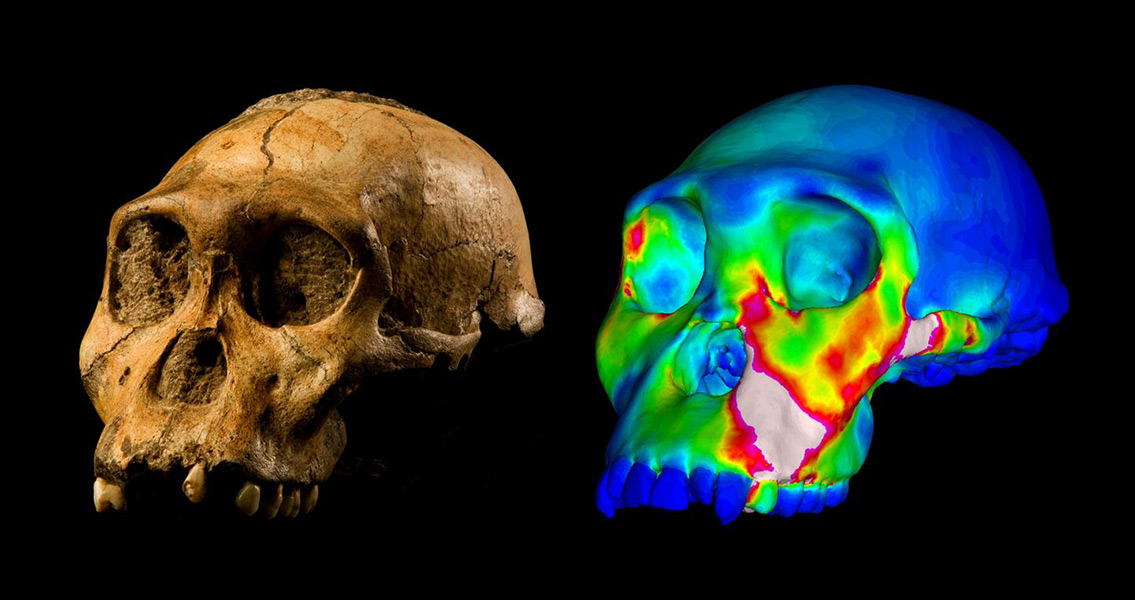
Australopithecus sediba; a species first discovered at the archaeological site of Malapa in the Cradle of Humankind World Heritage Site, South Africa, in 2008. A.sediba‘s phylogenetic relationships have been a source of debate since its initial discovery. Some have hypothesized that A.sediba was close to the genetic ancestry of the Homo genus, while others have suggested that it was in fact a phylogenetic relative of A.africanus. Although not answering the question of whether A.sebiba is a close evolutionary relative of the Homo genus, the new study does provide insights into the evolution of early human species. A 2012 study argued that A.sediba lived off a woodland diet, including hard foods mixed in with tree bark, fruit, leaves and other plant products. This conclusion was based on dental microwear data, which seemed to show tooth damage indicative of a diet of hard to chew foods. The authors of the new paper have used mechanical tests on a model of A.sediba’s skull to show that in fact the creature did not have the requisite tooth and jaw structure to survive on a diet of hard foods. Indeed, the study suggests that if A.sediba had bitten down as hard as possible with its molar teeth, it would have dislocated its jaw. To test the biomechancial properties of the A.sediba skull model, the team used techniques similar to those deployed by engineers to test whether airplanes, vehicles, and mechanical devices will break during use. Significantly, these new findings seem to distinguish A.sediba from other members of the Australopithecus genus. “Most australopiths had amazing adaptations in their jaws, teeth and faces that allowed them to process foods that were difficult to chew or crack open. Among other things, they were able to efficiently bite down on foods with very high forces,” said Professor David Strait, team leader and anthropologist from Washington University in St. Louis, US, in a press release. It is widely believed that humans are descended from an australopith ancestor. Since its discovery, A.sediba has been considered a possible candidate for that ancestor, or at least a close relative to it. The limitation in biting force discovered by the team is something A.sediba shares with modern humans. “Humans also have this limitation on biting forcefully and we suspect that early Homo had it as well, yet the other australopiths that we have examined are not nearly as limited in this regard,” said co-author Dr. Justin Ledogar, from the University of New England in Australia, in the press release. “This means that whereas some australopith populations were evolving adaptations to maximize their ability to bite powerfully, others (including A. sediba) were evolving in the opposite direction.” Ultimately, the new study shows the impact of diet and ecology on the development of the Homo genus’ ancestors. The difference in jaw strength among australopiths revealed by the study suggests ecological factors disrupted their eating patterns and behaviours, thus causing different evolutionary adaptations. As the study explains, “Thus, even if A.sediba and Homo were descended from different gracile australopith ancestors, it is evident that one must understand the dietary selective pressures that influenced the ancestors that preceded the earliest members of Homo if one is to understand the origin of the genus.” For more information: www.nature.com Image courtesy of Brett Eloff provided courtesy of Lee Berger and the University of the Witwatersrand.]]>
Categories
Breaking News

Homo Habilis Were First Out of Africa

Homo erectus as long believed, but a smaller species, Homo habilis, also called Handy Man, Discovery News writes. The senior author of the study told the website that the Homo habilis species was characterised by more ape-like features than previously thought, such as climbing besides walking on two legs, but also had some features characteristic of modern humans; such as a large brain, and tool-making skills. It was, however, shorter than Homo erectus: a more muscular species more closely resembling modern man. Using the huge dataset, Mark Collard, who is professor at the Human Evolutionary Studies Program of Simon Fraser University, and his team compared a number of alternative evolutionary trees and looked into how well each tree fit in with the dataset. There were three possible outcomes: either the tree was inconsistent with the dataset and was hence rejected, it was partially consistent, or it was fully consistent with the dataset. Based on what they found from the comparisons, the researchers suggest that Handy Man went into Asia and Europe from Africa and somewhere in Asia it gave rise to Homo erectus. Collard explains that the ‘Upright Man’ then went into Africa, a bold suggestion in the face of current consensus but backed by evolutionary data, apparently. The little Handy Man was also the ancestor of another species, this time even smaller: the Homo floresiensis, the ‘Hobbit Humans’ who were thought to have been nothing more than physically deformed humans. In fact, according to the theory of Collard and his team, H.floresienis were a separate species that inhabited the island of Flores in Indonesia. As to where the first modern human originated, Collard says this most likely happened in South Africa. He told Discovery News that “The fact that Australopithecus sediba [a two-million-year-old fossil] groups with Homo is consistent with the idea that the earliest known representative of the genus Homo originated in South Africa.” Another interesting conclusion of the team was that the Neanderthals were almost certainly a species exclusive to Eurasia; there was no evidence that its representatives had ever been in Africa. At the same time the researchers were unable to establish the immediate ancestor of this species, as scientist before them had been unable to trace back the origins of other hominin species from the Middle Pleistocene. Collard said he hoped his team’s findings would encourage further research by other scientists in South Africa, China, and Southeast Asia, where some of the oldest known human fossils have been unearthed. Asked by Discovery News to comment on the study, the director of New York University’s Center for the Study of Human Origins, Terry Harrison, said it would definitely fuel a debate among palaeoanthropologists, hardly a surprise given the way it challenges long-held beliefs in the area. Another commenter, human origins professor Bernard Wood from George Washington University, said the team who did the study had made an important step in furthering our understanding about evolution, which he called “superficial” at present. Image courtesy of Wikimedia Commons user: Royroydeb ]]>

Categories
Breaking News

2-Million-Year-Old Skin Found in South Africa

Australopithecus remains have announced that one of the fossils had skin on. The six fossils discovered so far have been dated to 2 million years ago and belong to the species Australopithecus sediba, which combined features of both the original Australopithecus, the first erect hominin species, and of modern Homo species. The find is all the more fascinating because, in addition to this being possibly the oldest hominin skin ever discovered, the fossils contain traces of organic matter from the food these ancient human ancestors ate. The initial discovery was made by chance: the lead researcher’s son stumbled across a human fossil in the Malapa Reserve near Johannesburg, in 2008. Until then, science did not even know this species had existed. Since then, excavation works have expanded significantly, and the team has even built an on-site laboratory where they can examine their finds in a secure environment. So far, the site has yielded bones belonging to six individuals, including an almost complete skull. Based on the evidence, the researchers have established that representatives of the Australopithecus species were much shorter than modern humans, standing at some 1.30 metres, and with a correspondingly smaller frame. While they walked on two legs, they also had more curved fingers than later hominins, suggesting they were also skilled climbers. Yet the most striking feature, according to Lee Berger, the leader of the research team, is the Australopithecus seiba’s head, which was disproportionately small, with the brain about the size of a modern man’s fist. The skin remains found on the fossils could tell the scientists a lot about those hominins’ lifestyle, while the organic substances between the teeth of some of the fossils could reveal something about their diet. This would be possible due to the kind of rock in which the fossils were found, which, unlike other sorts of rock, is capable of preserving organic substances. Two million years ago the site used to be a cave in the ground, Berger told the Naked Scientists podcast. It later collapsed in on itself, creating conditions he compared to a pool filled with liquid concrete, in which the bones were then thrown and preserved. The team has no way of knowing how these proto-humans got into the cave but suggest it may have been a trap they didn’t notice or contained something that lured them in. The team expects to unearth more human remains from the ancient cave and in order to protect them from environmental factors, has actually built a whole laboratory on the site. This will most likely turn the place into a tourist attraction and already the scientists are allowing visitors to look at the excavation site. The endeavour was challenging because the place is part of a nature reserve but, says Berger, the team came up with a structure that organically fits in its surroundings. This has made this site a unique one, where tourists will be able to witness the ongoing work of the researchers as they further their insight into the nature of this species and possibly establish where exactly they stand in relation to modern humans. Image courtesy of Wikimedia Commons user: Lee Berger]]>