

here Image courtesy of Wikimedia Commons user: AA]]>

www.efeo.fr ]]>
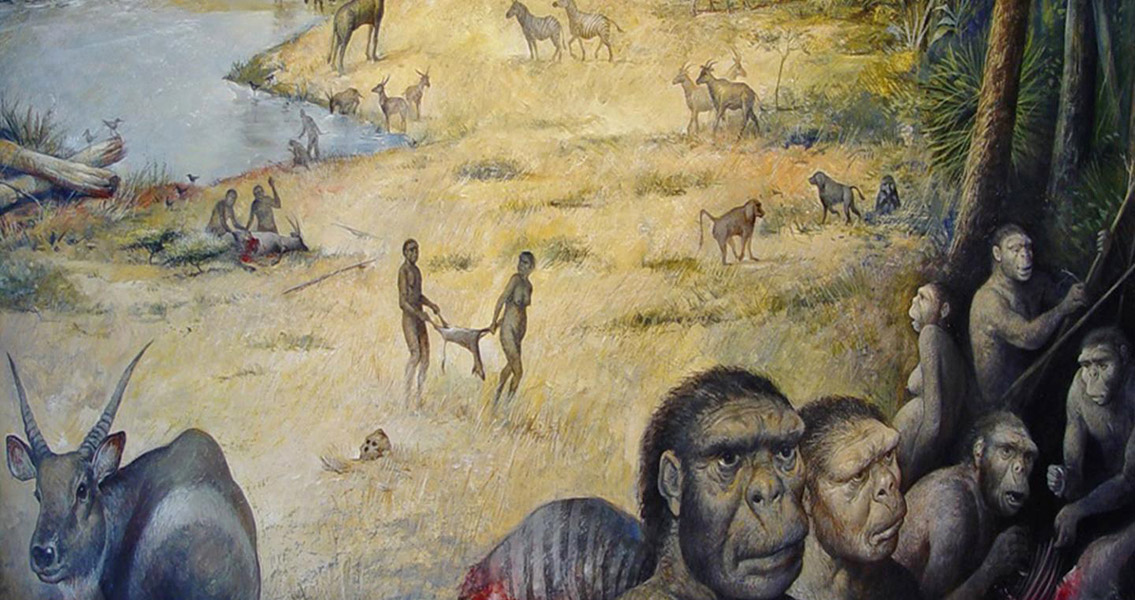
Homo habilis and Paranthropus boisei, these two species were similar in that they had a rough lifespan of anywhere from three to four decades and a height of around 4.5 feet to 5.5 feet. However, the latter is thought to have been more heavyset and with a smaller brain capacity than Homo habilis. Scientists involved in the research feel that the two species were unlikely to have camped there, but instead used the cover of the nearby acacia and palm trees to feed off of the carcasses of either their own kills or those taken from other carnivores. When and where early human ancestors began eating more meat are crucial questions, as an increased amount of protein in the diet of hominins is thought to be one of the first indicators of an increase in brain size. The research study can be found online here Image courtesy of M.Lopez-Herrera via The Olduvai Paleoanthropology and Paleoecology Project and Enrique Baquedano.]]>

Nature this week says that our Paleolithic evolutionary ancestors helped pave the way for their own evolution into modern humans by both eating meat, and preparing their food in certain ways prior to cooking it. The changes led humans living in the Stone Age to evolve with smaller teeth and faces thanks in no small part to adopting a more omnivorous diet that required some complexity to prepare, according to study author Daniel Lieberman from Harvard University. Research conducted into cooking in the past has singled out how pivotal it was to human evolution, but has been criticized for being too broad in giving credit for the changes that occurred to the face and head over the last 3 million years or so. The new study tackles this question; in an interview with USA Today, Lieberman did acknowledge that cooking food is certainly important, but the simple act of roasting raw meat over a fire isn’t the entirety of the story. The author and his colleagues point out in the research study how pounding, slicing, chopping, and other methods of food preparation and processing had effects on human anatomy and physiology that were profound – even to the point in helping humanity develop the ability to speak and run on two legs. There are other important facets of the paper, including the methods used to gather research. One of these methods involved volunteers willing to chew all manner of food while the researchers monitored their bite strength and other variables. Katherine Zink, a colleague of Lieberman from Harvard, worked together with him to see how humans handled masticating food like beets, carrots, yams, and even raw goat meat sourced from local goats. At first, the goat meat proved to be too tough for human teeth; however, once sliced into smaller pieces, the meat was much more manageable and was easily eaten. Vegetables that were eaten intact instead of first pounded by a stone tool were likewise harder to eat for the volunteers. Based on these findings, the research team feels that the inclusion of meat – sliced meat especially – into the diet of our human ancestors made it easier for them to enjoy relatively high levels of nutrition without having to work their jaws quite as hard. This could have contributed to the differences in jaw muscles and teeth in Homo erectus, a human ancestor that evolved shortly after the practice of using stone tools and eating meat. As humans no longer had to process and prepare their food by mouth but were instead able to do so with tools, early humanity evolved adaptations like shorter jaws and smaller faces that improved their ability to speak and to run. However, not everyone at Harvard is convinced that the new study is on the mark. Richard Wrangham, a colleague of both Zink and Lieberman, told USA Today that the relatively diminutive digestive tract of Homo erectus would have precluded the species from extracting enough calories from raw plants to thrive. Instead, he says that cooking food would have had to have played a much more important role than it does in the new study. The research can be found online here]]>

Tree Physiology, can be found online here]]>

here Image courtesy of Wikimedia Commons user: Timdwilliamson]]>
here Image courtesy of STRI]]>

K. newportensis and K. clallamensis. Originally thought to be related to the raccoon, modern paleobiologists say the genus is likely to be most closely related to the sea otter. However, a team of researchers from the American Museum of Natural History found that the pair of mystery predators had similar jaw construction that would have been ideal for anchoring a pair of long, saber-like teeth against prey encased in shells and using leverage to pry them open. Research paper co-author Camille Grohé, a postdoctoral fellow from the museum’s Paleontology division, said in a recent press release that the initial scope of the study was to see if the two Kolponomos species used techniques similar to those of sea otters to feed. These modern marine carnivores often pry mussels, clams, and other hard-shelled marine invertebrates off of surfaces by using rock tools or their bare hands. Sea otters then crush these hells open with their teeth or smash them open with a rock tool, and the researchers were looking for parallels. However, a curious parallel was discovered when Z. Jack Tseng, a fellow paleontologist and colleague of Grohé, found similarities between the jaws of the Smilodon and that of the Kolponomos specimens. Tseng, the lead author of the study, said that both the saber-toothed tiger and the marine bear had unique profiles featuring deep jawbones with a distinctive tapering towards the back. Additionally, both Kolponomos and Smilodon have expansions at the back surface of their skulls and at their mastoid process. This suggested to the researchers that both the tiger and the two marine bear species would have had a plenitude of muscles attached therein that would have made it easy for the animals to move their heads both with control and with considerable force. Nobody expected to involve a saber-toothed tiger into a study of clam-eating marine carnivores, Tseng added, but that is exactly what ended up happening in the end. Research into the skulls of the marine bear specimens was conducted at the museum’s Microscopy and Imaging Facility through the use of computed tomography (CT). CT scans of the skulls were compared to those of other carnivores, including leopards, brown bears, river and sea otters, grey wolves, and the Smilodon. The data gathered was applied to creating biomechanical models to determine which most closely matched those of the Kolponomos specimens. The team found that the saber-tooth tiger’s jaw mechanics and those of the marine bear bore the closest similarities out of all the other animals included in the study. The results indicate that Kolponomos might have fed by using its jaw to pry and dislodge marine prey before using the rest of its teeth, adapted to cracking the shells, to enjoy its meal. No, this doesn’t mean that Kolponomos was related to Smilodon like some sort of monstrous “manbearpig” creature as popularized by satirical American television. Instead, researchers say that this is clearly a case of convergent evolution between two completely unrelated species. For more information on the research article, visit the journal Proceedings of the Royal Society B, here Image courtesy of @ AMNH/J. Tseng, C. Grohé, J. Flynn]]>