Categories
Breaking News

Ancient City Gutted By Fire in Three Hours, Study Says

LiveScience, researchers from Israel’s Weizmann Institute of Science created their own mud bricks by taking soil, removing any large stones, and then creating a mixture of water, straw, and mud. This mixture was then poured into brick molds and cured in an oven. This method of construction was popular in antiquity and continues to be popular within the region today thanks to how cost-effective it is, according to Ruth Shahack-Gross, one of the scientists involved in the project, as the main building material is soil that can be sourced from the local landscape. Analysis of the remains of burned bricks at Tel Megiddo revealed that they reached a core temperature of approximately 600 degrees Celsius (more than 1,100 degrees Fahrenheit). Researchers subjected their own bricks to intense heat in an oven to re-create the conditions the ancient city’s bricks experienced, running the experiment on several different types of bricks made with varying construction ratios and of different shapes and sizes. The research results indicated that the bricks reached the temperature threshold in as little as two to three hours. Surprisingly, the amount of straw used in constructing mud bricks had little influence on how long it took for modern bricks to reach a core temperature of 600 C. Smaller bricks reached this target temperature more quickly than larger bricks, which was expected. Researchers said that the fire could have spread even faster thanks to items within Tel Megiddo’s dwellings such as bedding, oil, matting, furniture and wooden support beams. The new research study is the first of its kind, and to that effect many scientists have suggested follow-up experiments to account for any number of other factors that can contribute to a fire. The age of the bricks being subjected to heat may play a role, as older bricks with voids within them from decayed straw may not burn at the same rate as new bricks. Additionally, with fire being inherently chaotic, temperature alone may not be the best way to measure an event such as an entire city burning to the ground. In real-world situations, mud bricks may not be heated from all sides such as in the experiment but from only one side, depending on the location of the fire’s ignition point. Shahack-Gross stated that the limitations of this initial experiment are indeed clear, and that the research team is fully aware that conducting experiments in a laboratory under controlled conditions cannot truly mimic the events of the past. The research study, recently published in the journal Antiquity, can be found online here]]>

Categories
Editorial

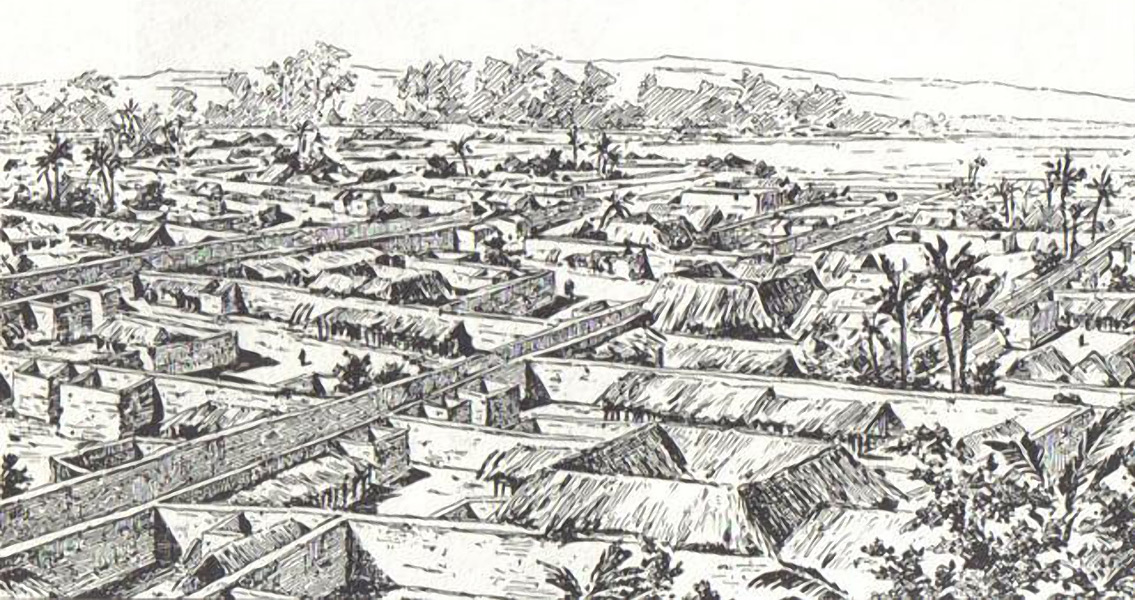
Benin City: A Stunning Metropolis Annihilated By the British Empire

Modern estimates suggest that at one point the walls were four times longer than the Great Wall of China, using up to a hundred times more material than the Great Pyramid of Cheops. Beyond the city limits, further walls were constructed to divide the surroundings of the capital into around 500 distinct villages. This complicated network of walls was all dug by hand, the mosaic of settlement boundaries covering 6,500 sq. km in total. Huge metal lamps fueled by palm oil lined the city’s streets, a precursor to modern street lighting. When the Portuguese first laid eyes on the city in the middle of the jungle, they classified it as one of the most beautiful, well designed cities in the world. Lourenco Pinto, the captain of a Portuguese ship, observed in 1691: “Great Benin, where the King resides, is larger than Lisbon, all the streets run straight and as far as the eyes can see. The houses are large, especially that of the king which is richly decorated and has Fine columns. The city is wealthy and industrious. It is so well governed that theft is unknown and the people live in such Security that they have no door to their houses.” Now, nothing of that city, believed to have been founded in 900 CE, remains. A new city has been built on the site, but no traces of the original’s unique splendor can be seen. The first centuries of European contact had seen Benin City enjoy a mutually beneficial trade relationship with Portugal. That all started to change in the nineteenth century, however, as Britain and other imperial powers upped their exploitation of Africa, moving from trading to the more profitable system of direct colonial take over. By 1884, chiefs of a plethora of tribes in the Niger Delta had signed treaties placing their people under the protection of the British crown. A protectorate government was set up with a headquarters in Calabar, and the area of British interest in the region continued to expand. By 1886 the activities of the Royal Niger Company had engulfed the area surrounding Benin, but the Oba (king) of Benin refused to sign up to the same treaties. For years Benin held out against many of the trading and other demands made by the British, yet the situation became increasingly perilous for the increasingly isolated kingdom. As Dr. Victor Osaro Edo wrote in 2009: “The fall of Benin from 1885 onwards became inevitable.” A trigger came in January 1897, when the Acting Consul-General in the region: James Phillips, led a large delegation to Benin City. The delegation hadn’t made their intentions clear and were making their visit during the Igue festival, when the Oba was not supposed to receive any visitors. What the expedition’s real intentions were is still debated, but Phillips’ unannounced arrival was seen as an invasion and intercepted by the Oba’s forces. In the ensuing battle, only two officers survived of the roughly 200 people in Phillips’ party. The retaliation by the British forces, known as the Benin Expedition, was swift and brutal. A large British force of 1,200 soldiers, at the time labelled the Punitive Expedition, was deployed. In February 1897, the machine gun bearing troops arrived at Benin, their orders were to conquer the city. Fierce fighting ensued, the Benin forces resisting for 17 days before the British expedition (including a large force of African recruits) took the Kingdom. What followed was a wave of destruction, the people of the city forced to flee as the invaders burnt it to the ground. The Oba’s palace was destroyed, while he was forced to live the rest of his life in exile in Calabar. The cultural relics of the city: ivory and bronze sculptures, were looted and then sold off to pay for the Benin Expedition. Today, around a thousand Benin bronzes can still be found in public and private collections around the globe, most notably in Britain but also elsewhere. These artefacts of the kingdom are relics of the achievements of the great city of Benin, and a powerful reminder of its fate at the hands of British imperialism. ]]>

Categories
Breaking News

Cahokia Human Sacrifices Sourced from Local Population

www.onlinelibrary.wiley.com Image courtesy of Wikimedia Commons user: Herb Roe ]]>

Categories
Editorial

February History News Round-Up

Research by the University of California at Berkley (UCB) has provided an explanation for the abandonment of the Mesoamerican city of Cantona in 900 CE. The pre-Aztec city had a population of 90,000 people at its peak, but was left completely deserted. Analysis of sediments in the nearby Lake Aljojuca allowed researchers from UCB to determine that the region had undergone a period of frequent drought, lasting over 500 years from 600 CE. They were also able to glean insights into population movements in the period of drought, noting that initially Cantona’s population had increased, possibly as a result of mass immigration to the city by those searching for water, before its sudden decline. Elsewhere, researchers from the University of Arizona applied social network analytical methods to archaeological data, and gained insights into the ancient importance of community. During the 250 year period starting from 1200 CE, huge swathes of the North-American South-west became uninhabited. Through their study, the researchers determined that the communities that survived in this period tended to be those with extensive connections to other communities. Essentially, the study provided an analysis of the significance of social networks, on a regional scale. Finally, a combined study, produced by academics from the University of Colorado in Boulder and the Santa Fe Institute, compared the urban growth patterns of ancient and modern civilisations. The study, which focused on pre-contact sites along the basin of Mexico, concluded that ancient cities in the region developed in much the same way as modern ones. The research throws into question the commonly held belief that modernity and industrialisation have made modern day cities distinct from ancient. Two meditating monks Tukdam is an advanced state of meditation achieved by Buddhist monks. It is thought that remaining in this state for more than three weeks leads the body to shrink, and appear mummified. Buddhist doctors, such as Dr. Barry Kerzin, have long argued that many Buddhist mummies are not in fact dead, but in this advanced state of meditation. Two discoveries in February have brought Tukdam and Buddhist mummification into the limelight. In Mongolia, a startlingly well preserved, two hundred year old monk was discovered in the Lotus position, suggesting he had been meditating when he died. The monk’s body demonstrated very few sings of decomposition, aside from a slight grey tint to his skin and his body being slumped to one side. In Holland, researchers from the Drents Museum carried out tests on a mummified Buddhist monk encased in a statue. Although it had been known previously that the monk was in the statue, the researchers were stunned to find that organs of the monk had been removed, and pieces of paper containing ancient Chinese writing inserted into his body. The pieces of paper are currently being translated, in the hope of gaining more insight into the monk and his burial. Migration Two unrelated studies have both provided fascinating insights into the spread and migration of species. The first, by academics from Tel Aviv University in Israel, made a startling conclusion about when humans first colonised Eurasia. An almost complete, 55,000 year old skull found in the Manot cave near Galilee, has provided direct anatomical evidence of when humans first colonised the Levant corridor, the piece of land connecting Africa to Europe. The discovery has raised some fascinating questions, firstly suggesting that Homo Sapiens inhabited the Levant Corridor at the same time as other Hominins, and secondly that the first H.Sapiens in Europe were not in fact direct migrants from Africa, but descended from those that had settled in the Corridor. Another study looked at the migration of Solenopsis geminata, or Red Fire ants. University of Illinois academics analysed the genetic code of ants from 192 locations to determine a time frame for their “Global invasion”. The biologists concluded that the spread of the ants to Africa, the Americas, Australia, India, and Southeast Asia, took place because Spanish Galleons unwittingly transported them in the sixteenth century. Essentially, the biological invasion by the fire ants was directly linked to the Spanish Empire establishing the first globalised trading network. Both study’s are fascinating, as they reveal the new detail with which ancient migration and population dispersal of different species can be monitored. Ancient Egyptian Healthcare System Perhaps one of the most startling stories from February concerns Ancient Egypt. Excavations at Deir el-Medina, a village built for workers tasked with constructing tombs during the New Kingdom (1550-1070 BCE) period, has revealed that the workers received extra amenities from the state in exchange for their services. Recently discovered papyri texts from the site have suggested that grain distribution in the village had remained consistent, even at times when workers were unable to work due to sickness. This suggests that the state provided some level of sick pay to the workers it valued so highly. The discovery reveals the seemingly never ending stream of new information that can be gleaned about the incredibly complex societies of Ancient Egypt. Image courtesy of Wikimedia commons user: Tomascastelazo]]>

Categories
Breaking News

Ancient Cities and Modern Cities: Not So Different

Categories
Breaking News

Half-Millennium Long Drought Caused City's Abandonment

Image courtesy of Wikimedia commons user: FlickReviewR]]>