Categories
Breaking News

Bison Fossils Shed Light on 'Ice Free Corridor' Migration

Proceedings of the National Academy of Sciences, their study argues that the corridor was fully open by around 13,000 years ago. The results suggest that although the corridor could account for the later movement of humans and animals, both northward and southward, it couldn’t explain the initial dispersal of humans from Alaska into the rest of North America. Around 15,000 years ago the first humans migrated southwards from the furthest reaches of North America, colonising the rest of the continent. In the 1970s, geological evidence was taken as proof that this initial movement was facilitated by the ice free corridor through the Rocky Mountains. More recent research suggested that the Cordilleran and Laurentide ice sheets merged together at the peak of the last Ice Age, closing the corridor before humans made their initial migration. It was a revelation which pointed to a Pacific coast route for humans into southern North America, yet the Rocky Mountain corridor has long remained a source of interest. “The opening of the corridor provided new opportunities for migration and the exchange of ideas between people living north and south of the ice sheets,” said Peter Heintzman, a postdoctoral researcher at UC Santa Cruz and lead author of the study. Previous work by one of the co-authors of the study, Ben Shapiro, had shown that the bison populations north and south of the ice sheets were distinct by the time the corridor opened. This meant that through genetic analysis it was possible for scientists to track the movement of both northern and southern bison through the corridor. “The radiocarbon dates told us how old the fossils were, but the key thing was the genetic analysis, because that told us when bison from the northern and southern populations were able to meet within the corridor,” explained Heintzman. From the genetic analysis, it became clear that the southern bison started moving northward around 13,400 years ago, suggesting the southern part of the corridor had opened first. The corridor became fully open by around 13,000 years ago, allowing the northern bison to migrate southward and shown in the first signs of population overlap within the corridor. As for human migration through the corridor, Shapiro suggests it was mostly from south to north. Sites from the Clovis culture were abundant south of the corridor by around 13,000 years ago, but declined from south to north in the corridor region. “When the corridor opened, people were already living south of there. And because those people were bison hunters, we can assume they would have followed the bison as they moved north into the corridor,” Shapiro said. Image courtesy of Government of Yukon]]>

Categories
Breaking News

Researchers Look for Corn and Find Bison Bones Instead

Categories
Breaking News

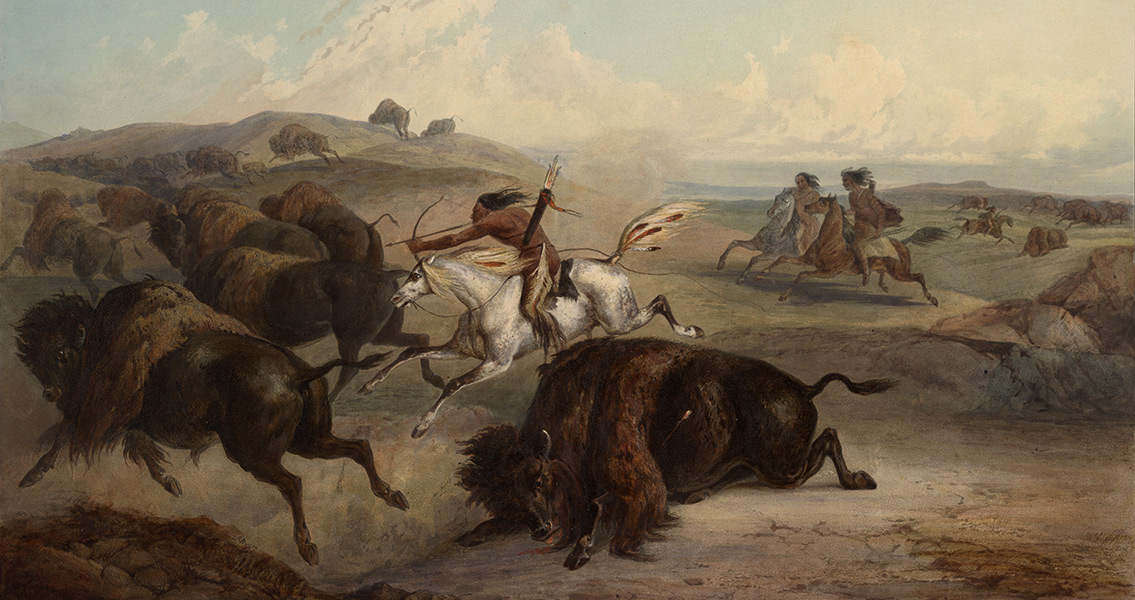
Bison-Hunting Shaped Native American Society

Early American Studies, reveals how the Illinois’ adaptation to the distinctive prairie environment influenced their history. “Although most historians have ignored the bison as a factor in the history of the Illinois and their region, the animals were a central fact of life there,” Morrissey explained. The traditional food eaten by Algonquians near the Great Lakes was beaver. On the Plains of the Midwest, however, beaver were scarce and of low nutritional quality. Bison, on the other hand, were plentiful. Bison hunting gave the Illinois new opportunities and shaped Illinois society in fundamental ways. “A unique economy, pedestrian (i.e., non-equestrian) bison hunting required two things: a large population and much labor,” Morrissey writes. “Because bison could be effectively hunted and processed only in large groups, committing to the bison required (but also enabled) larger villages.” Also, the processing stage was vitally important in the bison economy. As a result, the Illinois needed specialist workers to preserve the meat, render the tallow and tan the hides, Morrissey explains. “The Illinois conducted their bison economy with a gendered division of labor in which women performed the difficult tasks of hide and meat processing, this meant that the Illinois needed women.” The bison economy’s reliance on women for curing meat and creating hides fueled slave raids by the Illinois. In search of new female workers, the Illinois raided their nearby neighbours and enemies, creating a condition of continual war. Morrissey explained that “the Illinois were creating a cycle: more bison exploitation encouraged more raiding, and more violence, and larger settlements and . . . more bison.” When Native Americans came into contact with European explorers, the Illinois fought particularly intense wars. Morrissey argues that the effects of European colonisation on the Illinois cannot be understood independently of their bison economy, such was their dependence on these animals. European diseases began to hit Illinois villages in the 1670s and 1680s when European missionaries and fur traders, especially those specialising in bison hide trading, brought microbes and viruses. Diseases began to affect the Illinois significantly in the early contact period. These diseases put extra strain on the Illinois bison economy. Disease amongst the Illinois led to a shortage in specialist workers. This, in turn, led to increased slave raids and war, stretching the Illinois population to breaking point. “What seems clear is that the bison economy and the colonial changes combined to produce devastation for the Illinois in ways that were unique and particularly intense,” Morrissey argues. For more information: www.muse.jhu.edu Image courtesy of Wikimedia Commons user: Jan Arkesteijn]]>