New Amazon Population Revealed
Archaeologists have discovered remarkable new evidence that parts of the Amazon long thought uninhabited were in fact home to thriving, diverse populations of up to a million people.
The researchers from the University of Exeter have unearthed remains revealing that a 1,800 km stretch of Southern Amazonia was continuously occupied from 1250 until 1600 by people living in fortified villages.
Key to the research was the analysis of mysterious earthworks called geoglyphs – man made ditches with strange square, circular or hexagonal shapes. The new study, published in the journal Nature Communications, shows there are an estimated 1,300 geoglyphs across 400,000 square km of Southern Amazonia, with 81 in the area focused on in the latest research.
The archaeologists estimate there would have been between 1,000 and 1,500 enclosed villages, with two-thirds of the sites yet to be found.
“There is a common misconception that the Amazon is an untouched landscape, home to scattered, nomadic communities,” said Dr Jonas Gregorio de Souza from the University of Exeter’s Department of Archaeology.
“This is not the case. We have found that some populations away from the major rivers are much larger than previously thought, and these people had an impact on the environment which we can still find today.”
Dr de Souza continued: “The Amazon is crucial to regulating the Earth’s climate, and knowing more about its history will help everyone make informed decision about how it should be cared for in the future.”
With large swathes of the Amazon rainforest still unexplored by archaeologists, especially in the areas away from major rivers, the latest discovery is helping fill in gaps in the history of the Amazon.
Professor José Iriarte, from the University of Exeter, another member of the research team, said: “We are so excited to have found such a wealth of evidence. Most of the Amazon hasn’t been excavated yet, but studies such as ours mean we are gradually piecing together more and more information about the history of the largest rainforest on the planet
“Our research shows we need to re-evaluate the history of the Amazon. It certainly wasn’t an area populated only near the banks of large rivers, and the people who lived there did change the landscape. The area we surveyed had a population of at least tens of thousands.”
North America’s Oldest Footprints Discovered
13,000-year-old human footprints have been discovered on Canada’s Pacific coast, the oldest ever found in North America.
The finding could have significant repercussions for the history of how North America was populated. It is widely believed that humans migrated to the continent from Eurasia during the last ice age, which ended 11,700 years ago.
It is thought they entered on what is now the west coast of British Columbia, however, the search for archaeological evidence has been hindered by the densely forested and difficult to access landscape.
Archaeologist Duncan McLaren and colleagues from the University of Victoria, Canada, have spent several years excavating tidal sediments on the shoreline of Calvert Island, British Columbia, searching for traces of human activity.
Their findings have now been published in the online open access journal PLOS ONE. They reveal that 29 footprints have been uncovered of at least three different sizes. This suggests that they likely belonged to two adults and a child who were all walking barefoot.
Radiocarbon dating has estimated the footprints to be around 13,000 years old. This suggests humans were present on the west coast of British Columbia as it emerged from the last ice age.
“The results presented here add to the growing body of information pertaining to the early deglaciation and associated human presence on the west coast of Canada at the end of the Last Glacial Maximum,” the authors write in the introduction to their recently published study.
13,000 years ago, the sea level on the shores of Calvert Island was up to ten feet lower than it is today. Even so, it still would have only been accessible by boat.
“[This] implies that the people who left the footprints were seafarers who used boats to get around, gather and hunt for food and live and explore the islands,” Duncan Mclaren, lead study author and anthropologist at the Hakai Institute and the University of Victoria in British Columbia, told the New York Times.
Pre-historic Russia-Canada Connection Illuminated With Insect Fossils
[caption id="attachment_8580" align="alignnone" width="1440"] A new species of scorpionfly fossil from 53 million years ago at McAbee, British Columbia named Eomerope eonearctica. This insect is very similar to a fossil species that lived at the same time north of Vladivostok on the Asian Pacific coast, highlighting connections between Canada and Russia in ancient times. Credit: SFU[/caption]
A newly discovered, 53 million-year old insect fossil is shining new light on the ancient Canada-Russia connection.
Known as a scorpionfly, the insect discovered at the McAbee fossil bed site in British Columbia bears a ‘striking resemblance’ to fossils of the same period from Pacific coastal Russia.
“We’ve seen this connection before through fossil plants and animals, but these insects show this in a beautiful way,” said Bruce Archibald, a research associate at Simon Fraser University’s Department of Biological Sciences.
“They are so much alike that only the wing colour of the new McAbee species tells them apart.”
The new Canadian species has been named Eomerope eonearctica, while its Russian counterpart is Eomerope asiatica, which was first described in 1974.
“I’m not aware of any case where two such species so much alike and so close in age have been found in both Pacific Russia and Pacific Canada, and that’s pretty great,” said Archibald.
According to Archibald, the insect’s only living relative is found in the temperate forest of central Chile, which has a climate similar to British Columbia’s 53 million years ago.
Archibald worked with Alexandr Rasnitsyn, of Moscow’s Russian Academy of Sciences to describe the scorpionfly find. Their research has been published in The Canadian Entomologist.
Featured Image: Compound structure with a small enclosure in the interior of a larger one. Credit: University of Exeter
]]>

 Horse Evolution Mystery Solved?
The genetic ancestors of the modern horse were animals with five toes. Generally, it is believed that horses evolved to have fewer digits, but new research is challenging that theory and arguing that remnants of the five toes are still present in modern hooves.
Humans and horses actually evolved from the same common ancestor, a creature with five digits. As a consequence of living on open grassland, horses adapted to move across these plains. Scientist’s widely believe that this adaption saw horses evolve to have fewer digits. The first horse only had four digits, its later descendant had three, while modern horses have just a central digit, known as the metacarpal.
In research published in a recent issue of Royal Society Open Science, a team of scientists are proposing that rather than horses simply losing four digits, all five merged to form the compacted forelimbs with hooves seen today.
Currently, scientists accept that splints, small bones found along the outer sides of the metacarpal in modern horses, are partially formed remnants of second and fourth digits. Tapering mid-way down the metacarpal, these fragments were inherited from an earlier ancestor, but ceased to develop into fully formed digits in modern horses. The authors of the new paper claim that this theory is incomplete, failing to account for the animals’ first and fifth digits.
“With a distinct surface from the metacarpal, we know the splints on today’s horses to be the remnants of the second and fourth digits,” said Nikos Solounias, a paleontologist from New York Institute of Technology (NYITCOM) and an author on the study. “However, these partially formed digits also appear to contain their own elevated surfaces which hold additional evolutionary clues. We find these ridges, located on the posterior of each splint, to be the partially formed remains of the first and fifth digits, which were once connected to the cartilages of the hoof.”
Key to the research are the famous Laetoil footrprints in Tanzania, which show that the famous, eight-million-year-old horse known as Hipparion primigenium walked alongside early humans and had three digits. According to a NYITCOM statement, Solounias analysed the footprints and came to the conclusion that Hipparion actually had five compacted toes, the forelimb divided into five sections – suggesting the small toes had binded together.
“Interestingly, we not only find hints of the missing digits on the modern horse, but also its ancestors, such as Hipparion and Mesohippus, two species believed to have three toes,” said Solounias.
Neurovascular evidence has provided further support to the NYITCOM researchers’ theory, with dissections of modern equine foetus forelimbs revealing a greater number of arteries and nerves than would be expected in a single digit.
“If today’s horse does indeed have one digit per forelimb, we would expect each forelimb to have a total of two veins, two arteries, and two nerve bundles,” said Melinda Danowitz, a recent NYITCOM graduate who worked with Solounias on the study. “However, our dissections found between five and seven neurovascular bundles per forelimb, suggesting that additional toes begin to develop, but do not become fully differentiated.”
King Ramses Statue Moved to New Home
A colossal, 83 tonne, 3,200 year old statue of the Ancient Egyptian King Ramses II has been moved to a new home, according to Reuters. The complex operation, which saw the statue moved 400m to Cairo’s new Grand Egyptian Museum, required army engineers and specialist contractors.
Reuters reports that the statue was put inside a cage, mounted on a truck and suspended from a steel beam to help reduce the impact of any jolts during the journey. Road surfaces on the route were treated with special materials to ensure they could adequately take the massive weight of the statue.
The entire operation cost 13.6 million Egyptian pounds ($770,000).
The statue was first discovered at the Mit Rahina archaeological site in 1820. Brought to Ramses Square in Cairo in 1955, it was moved again in 2006 due to pollution and congestion, according to Reuters. It was placed in a storage area away from public view, until now.
It will be the first site visitors to the Grand Egyptian Museum will see. The museum is set to partially open this year, before its full launch in 2022.
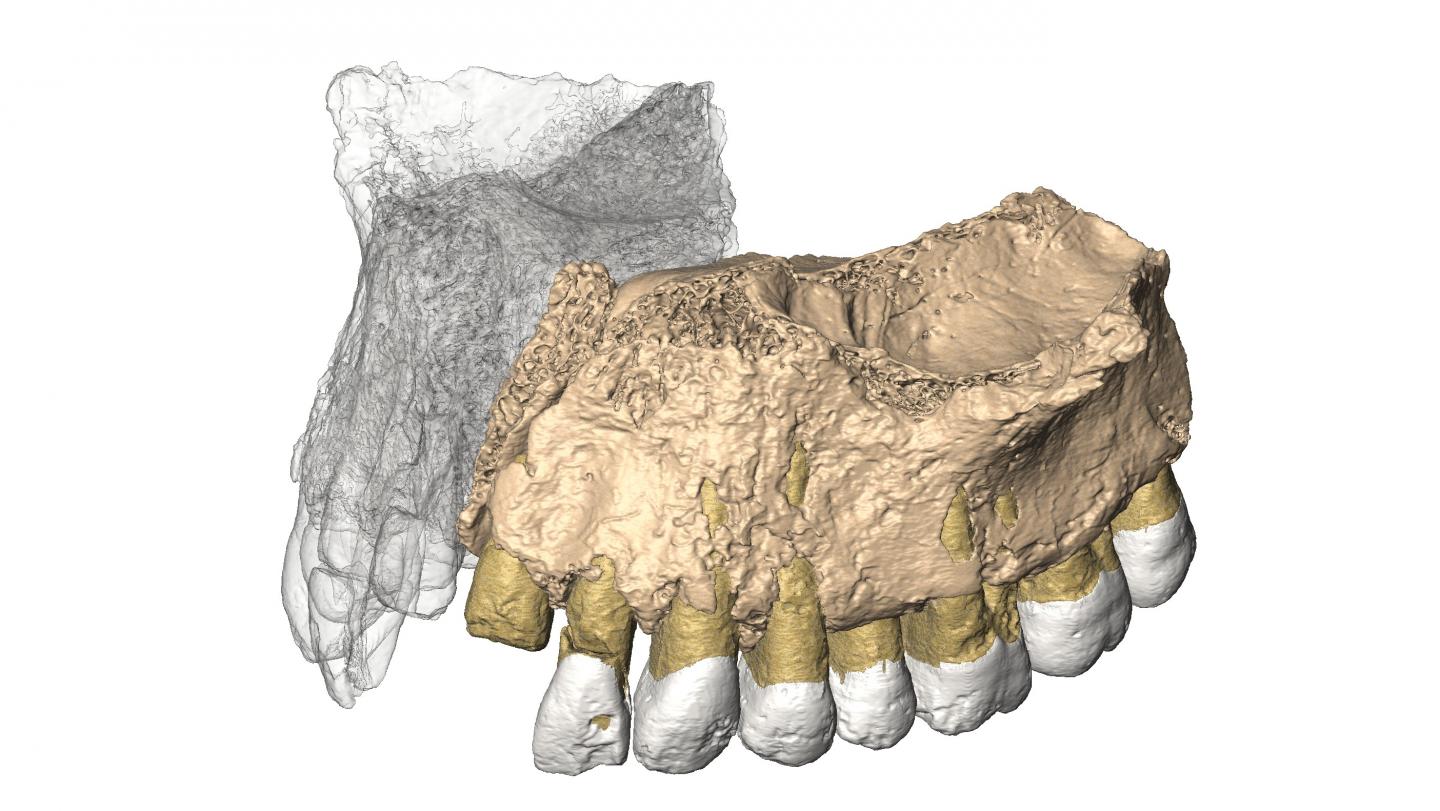
Featured image: Reconstruced maxilla from microCT images of the jawbone discovered in Israel. Image credit: Gerhard Weber, University of Vienna, Austria]]>
 Dual Migration Routes to Scandinavia Suggested by new Genomic Data
The first human settlers to Scandinavia arrived by two distinct migration routes, new research suggests. The new study, which has been published in the journal PLOS Biology, also suggests that the resulting mixed population genetically adapted to the extreme environmental conditions.
Although there is consistent evidence of a human presence in the Scandinavian peninsula from around 11,700 years ago, the migration routes and genetic makeup of the first Scandinavians have until now remained elusive.
Researchers from Uppsala University sequenced the genomes of seven hunter-gatherers excavated from across Scandinavia and dated to be between 9,500 to 6,000 years old. They determined from their findings that migrations into Scandinavia likely followed two routes, one from central Europe and one from the Northeast along the Norwegian Atlantic Coast.
The two groups met and mixed in Scandinavia, creating a genetically diverse population with variants that haven’t been passed along to modern Europeans.
Several genetic variants in the hunter-gatherers were found to be linked to a gene associated with physical performance. The study authors hypothesise that this could be part of the physical adaption to cold weather. In addition, the hunter-gatherers had a high-frequency of genetic variants linked to reduced skin pigmentation, a known adaptation to environments with low UV radiation, such as those at high latitude.
“We used cutting-edge genomic approaches to investigate hypotheses about the early colonization of northern Europe after the ice-sheet of the last glaciation retracted. It is really great to see how evidence from different disciplines can be combined to understand these complex past demographic processes,” said population geneticist Torsten Günther, one of the lead authors, in a press release.
Council Accused of Covering Up Major Archaeological Find
North Somerset Council in the UK has been accused of trying to keep a major archaeological find quiet, according to the BBC.
The pre-Christian cemetery, containing over 300 graves, was discovered in the village of Yatton in 2017, during works to develop the land for housing. Some have claimed that the local council attempted to keep the find “hush-hush”, although the council told the BBC that publicising cemetery excavations was not common practice.
“I’m amazed there hasn’t been more public communication between the archaeologists, the developer and the local community – it’s almost scandalous,” Mark Horton, professor of archaeology at the University of Bristol, told the BBC.
“It’s normal procedure – even if the public aren’t allowed inside – to put information on the outside about what’s been found and it does seem to be really bad practice that there’s such secrecy about this project.”
The remarkable site is close to both an Iron Age fort and a Roman hill fort.
An archaeologist for the council claimed that the fact human remains were found at the site meant that information about it was not made widely available to the public.
“It seems like we’ve been covering it up, but it’s common practice not to publicise the excavation of cemeteries like this to avoid risking the integrity of the site,” said Cat Lodge, archaeologist for the council.
Boor Homes, the company developing the site, said in a statement to the BBC that “no identified grave goods” or “datable artefacts” had been unearthed, while the skeletons “are in varying states of survival”.
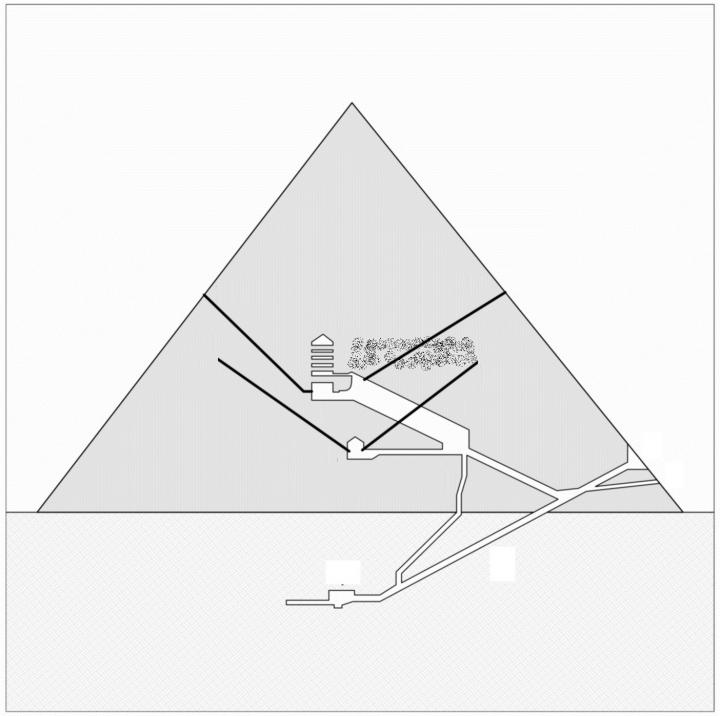
Featured image: North-south section of the Great Pyramid showing (dust-filled area) the hypothetical project of the chamber, in connection with the lower southern shaft. The upper southern shaft does not intersects the chamber (as instead suggested by the section) because, when viewed in plan, it is displaced to the west with respect to the Great Gallery. Courtesy of Giulio Magli]]>