

www.maneyonline.com Image courtesy of Wikimedia Commons user: Rennett Stowe from USA ]]>
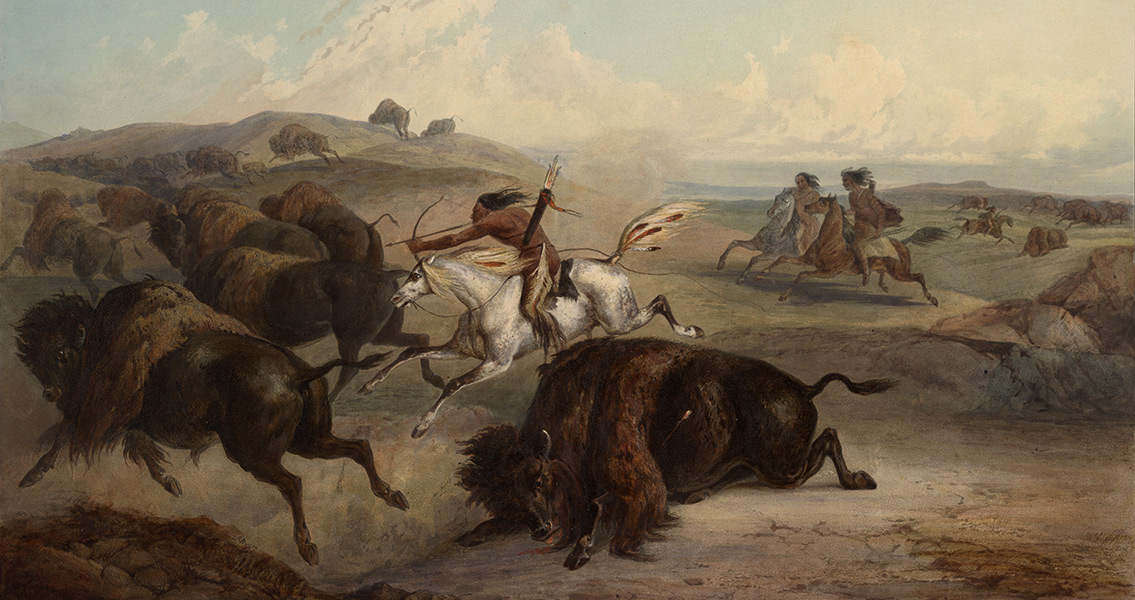
Early American Studies, reveals how the Illinois’ adaptation to the distinctive prairie environment influenced their history. “Although most historians have ignored the bison as a factor in the history of the Illinois and their region, the animals were a central fact of life there,” Morrissey explained. The traditional food eaten by Algonquians near the Great Lakes was beaver. On the Plains of the Midwest, however, beaver were scarce and of low nutritional quality. Bison, on the other hand, were plentiful. Bison hunting gave the Illinois new opportunities and shaped Illinois society in fundamental ways. “A unique economy, pedestrian (i.e., non-equestrian) bison hunting required two things: a large population and much labor,” Morrissey writes. “Because bison could be effectively hunted and processed only in large groups, committing to the bison required (but also enabled) larger villages.” Also, the processing stage was vitally important in the bison economy. As a result, the Illinois needed specialist workers to preserve the meat, render the tallow and tan the hides, Morrissey explains. “The Illinois conducted their bison economy with a gendered division of labor in which women performed the difficult tasks of hide and meat processing, this meant that the Illinois needed women.” The bison economy’s reliance on women for curing meat and creating hides fueled slave raids by the Illinois. In search of new female workers, the Illinois raided their nearby neighbours and enemies, creating a condition of continual war. Morrissey explained that “the Illinois were creating a cycle: more bison exploitation encouraged more raiding, and more violence, and larger settlements and . . . more bison.” When Native Americans came into contact with European explorers, the Illinois fought particularly intense wars. Morrissey argues that the effects of European colonisation on the Illinois cannot be understood independently of their bison economy, such was their dependence on these animals. European diseases began to hit Illinois villages in the 1670s and 1680s when European missionaries and fur traders, especially those specialising in bison hide trading, brought microbes and viruses. Diseases began to affect the Illinois significantly in the early contact period. These diseases put extra strain on the Illinois bison economy. Disease amongst the Illinois led to a shortage in specialist workers. This, in turn, led to increased slave raids and war, stretching the Illinois population to breaking point. “What seems clear is that the bison economy and the colonial changes combined to produce devastation for the Illinois in ways that were unique and particularly intense,” Morrissey argues. For more information: www.muse.jhu.edu Image courtesy of Wikimedia Commons user: Jan Arkesteijn]]>


Someone would expect that a small town in Illinois of 7,970 people would not have much history. But recently, a group of archaeologists have found evidence of a nearly 1,000 year old Native American village in Murphysboro, which is near the Southern Illinois Airport. This village would have pre-dated any European contact. This find was actually by accident. The group of archaeologists that found the historic land were from the Illinois Archaeological Survey, and their purpose was to survey land in order for the state of Illinois to build. Instead of finding good land for a modern road to be built on, they found something even more valuable. It is not known for certain the tribe or culture that the archaeologists dug up, but they found material such as clay that was used to make pots, which gave them a few ideas. There are about four known Native American tribes that currently live or have lived in Illinois: Kaskaskia, Moingwena, Peoria and the Moingona. They were part of the Shawnee people that came from the American Midwest. The history of the Shawnee people began in the late Pleistocene age, where at that time they were known as the Paleo-Indians. They hunted large animals such as bison, mastodons, caribou and mammoths. Some of these Paleo-Indians moved to the Ohio region, and settled there. At around 1000 AD, they started to flourish and took up a culture known as the Fort Ancient culture. They were known as the mound builders, as they constructed massive earthen mounds for homes, burials and also for ceremonial purposes. They grew mostly maize and had year-round nuclear families that lived in settlements of about 40 to 50 individuals. These settlements would be scatted along terraces that overlooked rivers and also on flood plains. Some groups had habits of moving to different locations. Now, there are only 1.03% Native Americans in the small town of Murphysboro, and an even meager 0.3% in the whole state of Illinois.
Patrick Durst, the Senior Researcher of the Illinois State Archaeological Survey, stated that the find has opened up a new area of study for him and his team. They will conduct further research to find out if the groups that lived in this location formed any of the tribes that are known today, or if they stayed in the area and became something else. The tribes today actually came after the remnants of what were found at the site.
Charcoal was found in the soil, which caused Durst and his team to believe that several homes were burnt down. The excavation also brought up old clay pots, tools and stones. They also found mussel shells and deer and fish bones on the site, which correlates to the way of the Fort Ancient culture of hunting and settling around the local rivers. The artifacts will be further analyzed to better identify the people the artifacts belonged to and their way of life.
]]>