Categories
Breaking News

An Iron Throne in the Great Pyramid? – The History News of the Week

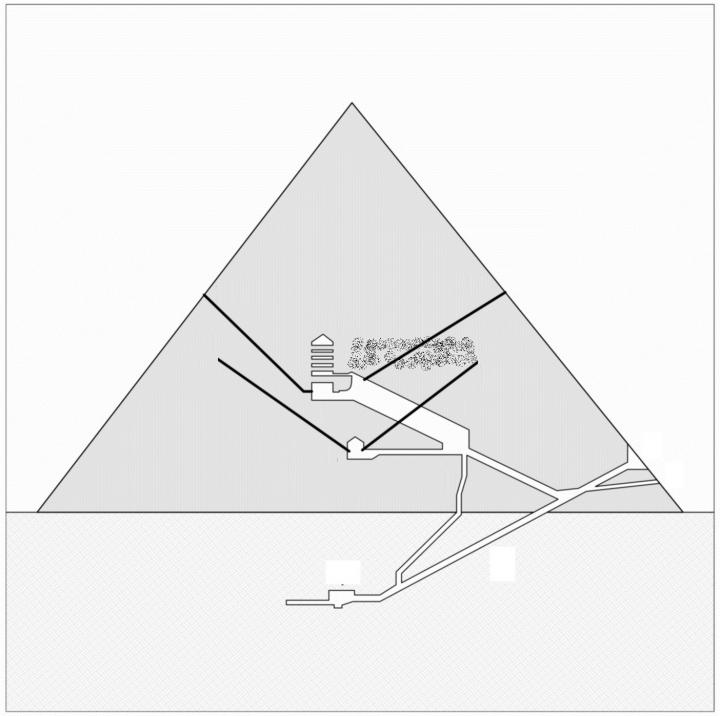
Cheops Pyramid Void an Iron Throne Room? An Italian archaeologist has come up with a theory for the huge void recently discovered in the Cheops (Khufu) Pyramid. In November 2017, the results of the Scan Pyramids project were published in the journal Nature. They revealed a huge void measuring at least thirty metres long within the Pyramid of Cheops. The project used a non-invasive technique based on the measurement of muons: elementary particles that are generated in cosmic rays and absorbed differently depending on the materials they go through. Giulio Magli, Director of the Department of Mathematics and Professor of Archaeoastronomy at the Politecnico di Milano, has now come up with a possible explanation for the mysterious void, suggesting it could be a Pharaoh’s “iron throne”. “Cheops Pyramid, built around 2550 BC, is one of the largest and most complex monuments in the history of architecture. Its internal rooms are accessible through narrow tunnels, one of which, before arriving at the funerary chamber, widens and rises suddenly forming the so-called Great Gallery,” Magli explained in a press release. “The newly discovered room is over this gallery, but does not have a practical function of “relieving weight ” from it, because the roof of the gallery itself was already built with a corbelled technique for this very reason.” Magli continued: “There is a possible interpretation, which is in good agreement with what we know about the Egyptian funerary religion as witnessed in the Pyramids Texts. In these texts it is said that the pharaoh, before reaching the stars of the north, will have to pass the “gates of the sky” and sit on his “throne of iron”. It would be possible to check Magli’s hypothesis by exploring the north shaft of the Cheops Pyramid. At present, it’s not known for sure that the north shaft leads into the mysterious void, as the available images are only approximations of the pyramid’s layout. Dual Migration Routes to Scandinavia Suggested by new Genomic Data The first human settlers to Scandinavia arrived by two distinct migration routes, new research suggests. The new study, which has been published in the journal PLOS Biology, also suggests that the resulting mixed population genetically adapted to the extreme environmental conditions. Although there is consistent evidence of a human presence in the Scandinavian peninsula from around 11,700 years ago, the migration routes and genetic makeup of the first Scandinavians have until now remained elusive. Researchers from Uppsala University sequenced the genomes of seven hunter-gatherers excavated from across Scandinavia and dated to be between 9,500 to 6,000 years old. They determined from their findings that migrations into Scandinavia likely followed two routes, one from central Europe and one from the Northeast along the Norwegian Atlantic Coast. The two groups met and mixed in Scandinavia, creating a genetically diverse population with variants that haven’t been passed along to modern Europeans. Several genetic variants in the hunter-gatherers were found to be linked to a gene associated with physical performance. The study authors hypothesise that this could be part of the physical adaption to cold weather. In addition, the hunter-gatherers had a high-frequency of genetic variants linked to reduced skin pigmentation, a known adaptation to environments with low UV radiation, such as those at high latitude. “We used cutting-edge genomic approaches to investigate hypotheses about the early colonization of northern Europe after the ice-sheet of the last glaciation retracted. It is really great to see how evidence from different disciplines can be combined to understand these complex past demographic processes,” said population geneticist Torsten Günther, one of the lead authors, in a press release. Council Accused of Covering Up Major Archaeological Find North Somerset Council in the UK has been accused of trying to keep a major archaeological find quiet, according to the BBC. The pre-Christian cemetery, containing over 300 graves, was discovered in the village of Yatton in 2017, during works to develop the land for housing. Some have claimed that the local council attempted to keep the find “hush-hush”, although the council told the BBC that publicising cemetery excavations was not common practice. “I’m amazed there hasn’t been more public communication between the archaeologists, the developer and the local community – it’s almost scandalous,” Mark Horton, professor of archaeology at the University of Bristol, told the BBC. “It’s normal procedure – even if the public aren’t allowed inside – to put information on the outside about what’s been found and it does seem to be really bad practice that there’s such secrecy about this project.” The remarkable site is close to both an Iron Age fort and a Roman hill fort. An archaeologist for the council claimed that the fact human remains were found at the site meant that information about it was not made widely available to the public. “It seems like we’ve been covering it up, but it’s common practice not to publicise the excavation of cemeteries like this to avoid risking the integrity of the site,” said Cat Lodge, archaeologist for the council. Boor Homes, the company developing the site, said in a statement to the BBC that “no identified grave goods” or “datable artefacts” had been unearthed, while the skeletons “are in varying states of survival”. Featured image: North-south section of the Great Pyramid showing (dust-filled area) the hypothetical project of the chamber, in connection with the lower southern shaft. The upper southern shaft does not intersects the chamber (as instead suggested by the section) because, when viewed in plan, it is displaced to the west with respect to the Great Gallery. Courtesy of Giulio Magli]]>

Categories
Breaking News

History News of the Week – A Cover-up of a Nazi Plot, a Ghost Species, and a Rethink on Australia

Churchill Tried to Cover-up Nazi Royal Plot Newly released papers from the UK’s National Archives have revealed that Winston Churchill wanted to “destroy all traces” of telegrams about a Nazi plot to reinstate the abdicated King Edward VIII to the throne in return for his support during the Second World War. According to the Guardian, the telegrams reveal a plan to kidnap the Duke of Windsor – as the abdicated monarch was then known, and his wife Wallis Simpson, in Portugal in 1940. The Cabinet Office papers released by the National Archives reveal a 1953 appeal from Churchill to US president Dwight D Eisenhower and the French government to prevent publication of the telegrams for at least “10 to 20 years”, the Guardian reports. Churchill believed the telegrams were likely to give the misleading impression that the duke was in regular touch with German agents, and open to ideas which were disloyal. The prime minister’s appeal was made after he’d learnt a microfilm of the documents had fallen into the hands of the US State Department, and were being considered for inclusion in the US’ official history of the war. Although Churchill succeeded, and publication of the telegrams was delayed by a few years, they still eventually came to light in 1957. “Ghost” Species Points to Interbreeding Between Humans and Other Hominins Through studying saliva, scientists have discovered clues to a “ghost” species of archaic humans that may have contributed genetic material to the ancestors of people living in Sub-Saharan Africa today. The new findings add to growing evidence that sexual relationships between different species of archaic humans might not have been unusual, and in fact the norm. Previous research has already concluded that the ancestors of modern humans interbred with other hominin species, such as Neanderthals and Denisovans, in Asia and Europe. The latest research, published in the journal Molecular Biology and Evolution, adds to other recent genetic analyses indicating ancient Africans also interbred with other early hominins. “It seems that interbreeding between different early hominin species is not the exception — it’s the norm,” said Omer Gokcumen, PhD, an assistant professor of biological sciences in the University at Buffalo College of Arts and Sciences. “Our research traced the evolution of an important mucin protein called MUC7 that is found in saliva,” he said. “When we looked at the history of the gene that codes for the protein, we see the signature of archaic admixture in modern day Sub-Saharan African populations.” The MUC7 protein gives spit its slimy consistency, as well as binding to microbes, which may help the body get rid of disease-causing bacteria. The team of scientists were researching the purpose and origins of the protein by examining the gene in more than 2,500 human genomes, when they discovered that one group from Sub-Saharan Africa had a significantly different version to that found in other humans. “Based on our analysis, the most plausible explanation for this extreme variation is archaic introgression – the introduction of genetic material from a ‘ghost’ species of ancient hominins,” Gokcumen says. “This unknown human relative could be a species that has been discovered, such as a subspecies of Homo erectus, or an undiscovered hominin. We call it a ‘ghost’ species because we don’t have the fossils.” The study was led by Gokcumen and Stefan Ruhl, DDS, PhD, a professor of oral biology in UB’s School of Dental Medicine. Humans May Have Arrived in Australia 10,000 Years Earlier than Thought Newly discovered artefacts suggest humans arrived in Australia 10,000 years earlier than previously believed. Exactly when Australia was first settled by humans has long been shrouded in ambiguity, with recent studies seemingly pushing the approximate date further and further back in time. A team of researchers led by the University of Queensland, and including scientists from the University of Washington, found and dated artefacts from Madjedbebe, Northern Australia that suggest humans arrived there 65,000 years ago. A paper detailing the artefacts and the dating method has been published in the journal Nature. The new findings could have a significant impact on theories about the emergence of early humans and how they coexisted with their environment. In particular, according to the researchers it throws serious doubt on the idea that humans caused the extinction of megafauna such as giant kangaroos, wombats and tortoises. “Previously it was thought that humans arrived and hunted them out or disturbed their habits, leading to extinction, but these dates confirm that people arrived so far before that they wouldn’t be the central cause of the death of megafauna,” co-author and UW associate professor of anthropology Ben Marwick said. “It shifts the idea of humans charging into the landscape and killing off the megafauna. It moves toward a vision of humans moving in and coexisting, which is quite a different view of human evolution.” Among the artefacts discovered were ochre crayons and other pigments, as well as objects believed to be the world’s oldest edge-ground hatchets, potential evidence that these ancient humans ground seeds and processed plants. The artefacts were dated using radiocarbon dating and optical stimulated luminescence (OSL) – a technique used on minerals that can reveal a variety of things, such as the last time a grain of sand was exposed to sunlight – useful for determining when an artefact was buried. Featured Image courtesy Bundesarchiv, Bild 183-14059-0005 / CC-BY-SA 3.0 [CC BY-SA 3.0 de (http://creativecommons.org/licenses/by-sa/3.0/de/deed.en)], via Wikimedia Commons ]]>