Categories
Breaking News

An Iron Throne in the Great Pyramid? – The History News of the Week

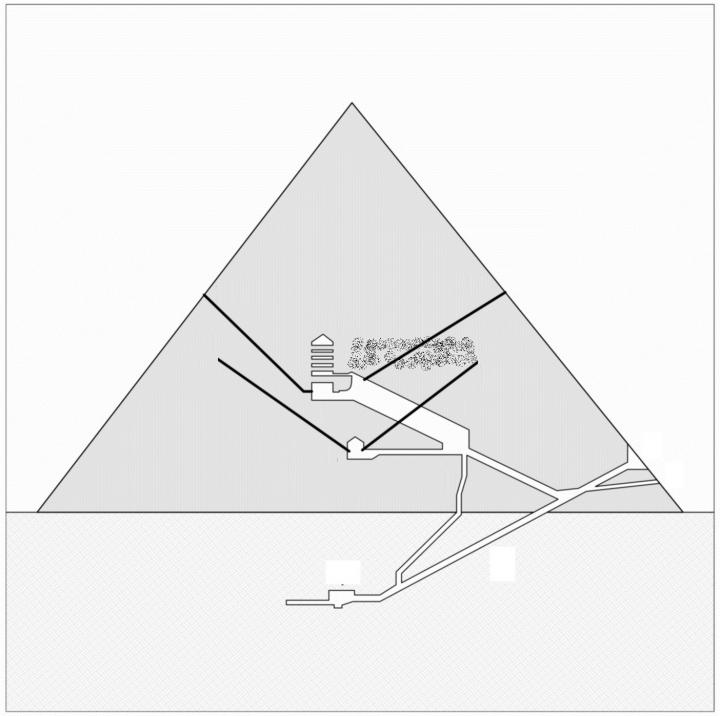
Cheops Pyramid Void an Iron Throne Room? An Italian archaeologist has come up with a theory for the huge void recently discovered in the Cheops (Khufu) Pyramid. In November 2017, the results of the Scan Pyramids project were published in the journal Nature. They revealed a huge void measuring at least thirty metres long within the Pyramid of Cheops. The project used a non-invasive technique based on the measurement of muons: elementary particles that are generated in cosmic rays and absorbed differently depending on the materials they go through. Giulio Magli, Director of the Department of Mathematics and Professor of Archaeoastronomy at the Politecnico di Milano, has now come up with a possible explanation for the mysterious void, suggesting it could be a Pharaoh’s “iron throne”. “Cheops Pyramid, built around 2550 BC, is one of the largest and most complex monuments in the history of architecture. Its internal rooms are accessible through narrow tunnels, one of which, before arriving at the funerary chamber, widens and rises suddenly forming the so-called Great Gallery,” Magli explained in a press release. “The newly discovered room is over this gallery, but does not have a practical function of “relieving weight ” from it, because the roof of the gallery itself was already built with a corbelled technique for this very reason.” Magli continued: “There is a possible interpretation, which is in good agreement with what we know about the Egyptian funerary religion as witnessed in the Pyramids Texts. In these texts it is said that the pharaoh, before reaching the stars of the north, will have to pass the “gates of the sky” and sit on his “throne of iron”. It would be possible to check Magli’s hypothesis by exploring the north shaft of the Cheops Pyramid. At present, it’s not known for sure that the north shaft leads into the mysterious void, as the available images are only approximations of the pyramid’s layout. Dual Migration Routes to Scandinavia Suggested by new Genomic Data The first human settlers to Scandinavia arrived by two distinct migration routes, new research suggests. The new study, which has been published in the journal PLOS Biology, also suggests that the resulting mixed population genetically adapted to the extreme environmental conditions. Although there is consistent evidence of a human presence in the Scandinavian peninsula from around 11,700 years ago, the migration routes and genetic makeup of the first Scandinavians have until now remained elusive. Researchers from Uppsala University sequenced the genomes of seven hunter-gatherers excavated from across Scandinavia and dated to be between 9,500 to 6,000 years old. They determined from their findings that migrations into Scandinavia likely followed two routes, one from central Europe and one from the Northeast along the Norwegian Atlantic Coast. The two groups met and mixed in Scandinavia, creating a genetically diverse population with variants that haven’t been passed along to modern Europeans. Several genetic variants in the hunter-gatherers were found to be linked to a gene associated with physical performance. The study authors hypothesise that this could be part of the physical adaption to cold weather. In addition, the hunter-gatherers had a high-frequency of genetic variants linked to reduced skin pigmentation, a known adaptation to environments with low UV radiation, such as those at high latitude. “We used cutting-edge genomic approaches to investigate hypotheses about the early colonization of northern Europe after the ice-sheet of the last glaciation retracted. It is really great to see how evidence from different disciplines can be combined to understand these complex past demographic processes,” said population geneticist Torsten Günther, one of the lead authors, in a press release. Council Accused of Covering Up Major Archaeological Find North Somerset Council in the UK has been accused of trying to keep a major archaeological find quiet, according to the BBC. The pre-Christian cemetery, containing over 300 graves, was discovered in the village of Yatton in 2017, during works to develop the land for housing. Some have claimed that the local council attempted to keep the find “hush-hush”, although the council told the BBC that publicising cemetery excavations was not common practice. “I’m amazed there hasn’t been more public communication between the archaeologists, the developer and the local community – it’s almost scandalous,” Mark Horton, professor of archaeology at the University of Bristol, told the BBC. “It’s normal procedure – even if the public aren’t allowed inside – to put information on the outside about what’s been found and it does seem to be really bad practice that there’s such secrecy about this project.” The remarkable site is close to both an Iron Age fort and a Roman hill fort. An archaeologist for the council claimed that the fact human remains were found at the site meant that information about it was not made widely available to the public. “It seems like we’ve been covering it up, but it’s common practice not to publicise the excavation of cemeteries like this to avoid risking the integrity of the site,” said Cat Lodge, archaeologist for the council. Boor Homes, the company developing the site, said in a statement to the BBC that “no identified grave goods” or “datable artefacts” had been unearthed, while the skeletons “are in varying states of survival”. Featured image: North-south section of the Great Pyramid showing (dust-filled area) the hypothetical project of the chamber, in connection with the lower southern shaft. The upper southern shaft does not intersects the chamber (as instead suggested by the section) because, when viewed in plan, it is displaced to the west with respect to the Great Gallery. Courtesy of Giulio Magli]]>
Categories
Breaking News

Researchers Discover Maya “Nesting” Pyramids

Guardian. The presence of the third structure suggests the Kukulkan pyramid was built in three separate stages. The first, innermost pyramid was constructed between the years 550 and 800. The middle pyramid, which was discovered in the 1930s, was built between the years 800 and 1000. The largest, final pyramid dates back to the years 1,050 to 1,300. Structures like El Castillo were constructed one on top of the other for a variety of reasons, including the arrival of new leaders or deterioration. The research team is hopeful the find will reveal information about the original Maya culture prior to influences from central Mexico populations. The Mesoamerican Maya civilization was notable for its hieroglyphic script, the only fully developed writing system within the pre-Columbian Americas, and also for its architecture, art, calendar, mathematics, and astronomy system. In 2015 archeologists discovered the pyramid was built on top of a cenote (sinkhole), common to the region and considered sacred by the Maya. The sinkhole under the temple is approximately 82 by 114 feet (25 by 35 meters) and could be up to 65 feet (20 meters) deep. Researchers also found that the pyramid sits on a 16 foot (4.9 meter) layer of limestone on top of the cenote. The discovery of the limestone layer, like the discovery of the third pyramid, was made using a new noninvasive technology involving the placement of electrodes in the area surrounding a structure and sending an electrical current into the ground. While the current is being emitted measurements to determine whether or not sub-surface elements are impeding or increasing the electrical potential are taken and then processed with software that creates three-dimensional maps of the subsurface area. A Mesoamerican step-pyramid, El Castillo dominates the center of the Chichen Itza complex. It was built by a pre-Columbian Maya civilization between the ninth and twelfth centuries CE. The pyramid functioned as a temple to the Yucatec Maya Feathered Serpent god Kukulkan, who was closely related to the Aztec god Quetzalcoatl. The National Institute of Anthropology and History has begun closing pyramids and monuments to the public in an effort to preserve the buildings, so while visitors can still walk around them, they can no longer climb or enter them. Climbing El Castillo was halted after a woman fell to her death in 2006. Today, it remains one of Mexico’s most recognized pre-Columbian structures. ]]>

Categories
Breaking News

Secrets of the Pyramids Being Revealed by Cosmic Particles

ScanPyramids project was launched in October 2015, with the aim of mapping some of the largest pyramids in Egypt. As well as studying the great pyramid of Khufu, the project is exploring the pyramid of Khafre on the Giza plateau, and two pyramids on the site of Dahshur known as Bent and Red. On 13th October, Dr Khaled El-Enany, Egypt’s minister of antiquities, met with the archaeological committee overseeing the project to review the findings of the first year of the mission. So far, the project has focused on only two pyramids: Khufu and Bent. Khufu in particular has yielded some interesting findings. Two anomalies in the great pyramid’s structure have been detected, one at the upper part of the entrance gate and another at its north eastern side, which could be evidence of secret cavities beneath the pyramid’s surface or potential clues into the pyramids’ construction. Further research has now started in order to work out the nature of the anomalies, as well as glean more information about their functions, nature and size. The goal of the ScanPyramids project is “to probe the heart of the largest pyramids in Egypt, without drilling the slightest opening”. The key to the non-invasive project is a host of cutting edge techniques. Radiographic muons (aka cosmic particles), infrared thermography and photogrammetry are being used to scan the pyramids and then create detailed 3D reconstructions. Muons are much more deeply penetrating than X-rays, meaning they can be used to see through much thicker material than the likes of computed tomography (CT Scanning). Although the ScanPyramids project isn’t the first time muons have been used to study pyramids the combination of innovative techniques aims to offer ground breaking insights into their construction, detecting hitherto unknown structures. All of the pyramids at the centre of the study date to the Fourth Dynasty of Ancient Egypt. The Bent and the Red pyramid, both located on the site of Dahshur about fifteen kilometres south of Saqqara, were built during the reign of Snefru, between 2575 BCE and 2551 BCE. The pyramids of Khufu and Khafre are situated on the Giza plateau about twenty kilometres from Cairo. They were built during the reigns of Snefru’s son and grandson respectively. Over four millennia old, the four ancient pyramids remain a mystery to scientists, engineers and archaeologists alike. Khufu, the last of the Seven Wonders of the Ancient World still standing, is a particular source of awe and bewilderment. With an original height of 150 metres, base of five hectares and mass of over 5 million tons, Khufu is the largest stone monument ever built by humans; yet no one can say with any certainty how the Ancient Egyptians managed to complete such a feat in just 25 years. The pyramids’ internal structures are another source of mystery. Plans and previous excavations of various pyramids have revealed a host of inexplicable anomalies that could be signs of hidden chambers. By measuring the density of walls and precisely mapping out the layouts of the pyramids, the ScanPyramids project hopes to solve these enduring mysteries that have baffled Egyptologists for centuries.]]>

Categories
Breaking News

Oldest Papyrus Scrolls in Egypt Placed On Display

Categories
Breaking News

First Maya City With Grid Design Revealed

Live Science that the ancient city was marked by a so-called ceremonial route, running from west to east, with only a 3-degree deviation from true east, a remarkable accuracy. This ceremonial route, a perfectly straight line, was lined by as many as 15 flat-topped pyramids which would have stood as tall as 100 feet. Each had a temple on top, which people reached by steps in the pyramids. At the easternmost end of the route there was a structure including three main pyramids along with some other buildings, arranged to face each other. Such triadic structures have been found in other Maya cities as well. In the northern and southern parts of the city were residential areas, again conforming to the overall grid design, Pugh said, and the whole area was encircled by a stone wall for protection. Apparently, Nixtun-Ch’ich was a beautiful, “shiny” city at its height, based on evidence of white plaster that may have been used for the buildings. However, for the people living in it, this design may not have been the most pleasant one due to its strictness, imposing a sense of constant control. This conclusion is based on the atmosphere of early European grid-design cities that started being built during the early Renaissance. Compared to Nixtun-Ch’ich, other ancient Maya cities were more “relaxed” in terms of design, with more open spaces. There is one other city on the land of the former Maya empire, Teotihuacan, which was also built according to a grid design but that city was inhabited by another civilisation about which little is known. Pugh’s research was actually focused on a community building and artefacts dating to a much later period, about the fourteenth century CE. The building was probably the place where the local Maya heirs, the Chakan Itza, held meetings, performed religious ceremonies, and generally conducted matters of state. There were two altars with turtle sculptures in the building, as well as figures of parrots and snakes along the walls. The building, Pugh says, was probably used for about two centuries. The Maya civilisation has been the subject of extensive study since the nineteenth century but the reasons for its decline, which occurred sometime around 900 CE, are still unclear. This was the first geographically focused empire in the region, which at its height spanned the Yucatan Peninsula, Tabasco and Chiapas in what is today Mexico, as well as Guatemala, Belize, western Honduras and El Salvador. The first evidence of Maya culture dates back to 1800 BCE but the golden age, the Classic Period of the civilisation, is considered to have lasted from 250 to 900 CE. Among its hallmarks are the stone pyramids where the Maya worshiped their gods, and the Maya calendar, whose accuracy is still a mystery for modern science. Image courtesy of Wikimedia Commons user: joiseyshowaa]]>

Categories
Breaking News

1,800-Year-Old Liquid Mercury Found in Teotihuacan

Categories
Breaking News

New Excavations Begin in Sudan

Image courtesy of Wikimedia commons user: Wufei07]]>

Categories
Breaking News

Japanese Tomb May Have Been Pyramid-Shaped

Categories
Breaking News

Ancient Peruvian Astronomy Lab