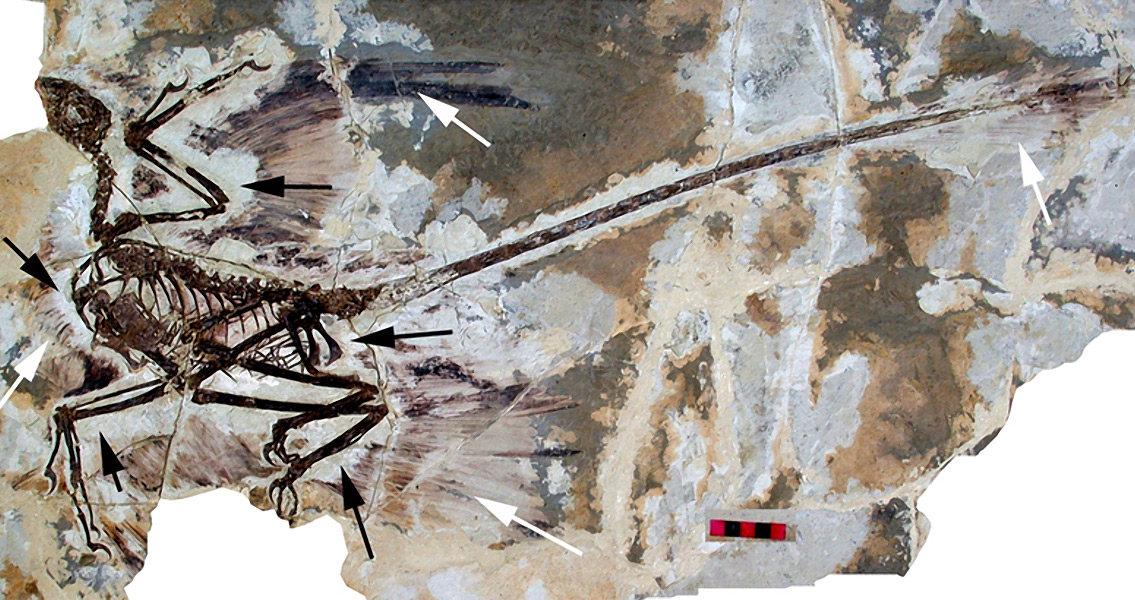
Zhenyuanlong by the researchers who examined it, the dinosaur was a close relative of the Velociraptor and lived around 125 million years ago. The fossil was discovered accidentally by a farmer in northeastern China, just like another recent discovery, this time of a bat-like dinosaur, in the same part of the country. In a paper published in Nature, researchers Steve Brusatte from the University of Edinburgh and Junchang Lu from the Chinese Academy of Geological Sciences detail the find, explaining it belonged to the dromaeosaurids, a clave of very close bird relatives including the Velociraptor – a species that gained notoriety with the Jurassic Park film series. All the specimens belonging to that clave have been found in northeastern China, in Liaoning province. So far they have been classified into five species groups, some of them containing just one species. Most of the dromaeosaurids were very small, the authors say in the paper, close in size to a modern cat or a medium-sized dog, and they all had long arms. The only exclusion from these characteristics was a fossil of a species named Tianyuraptor, which was close to two metres long and whose arms were around half the length of its legs. However, no evidence of feathers was found on that fossil. The newly discovered fossil, slightly smaller than a Tianyuraptor, was covered in feathers. This was a stroke of luck for the researchers as they had previously believed these larger bird ancestors were not very good at flying, if they could fly at all. The Zhenyuanlong, on the other hand, almost certainly could and did fly. The dinosaur had large wings and on them, as well as on its tail, the researchers found pennaceous feathers, also called quill feathers, which are essential for flying and are present in all modern flying birds. This led the team to suggest that the non-flying and flying dinosaurs were contemporaries during the early Cretaceous. As regards the individual characteristics of the fossil, examination revealed it was a young specimen based on the extent of fusion between different bones, including the vertebrae. The last year and a half has been very productive for palaeontologists who focus on the evolution of birds. In addition to the many discoveries of feathered dinosaurs, last year a team of scientists also linked dinosaur bones with bird bones, something that had not previously been possible because of the hard line distinguishing developmental biology from palaeontology. That team, however, was interdisciplinary and looked both at dinosaur fossil bones from the wrist and the wrist bones of modern bird embryos, identifying at least one bone that was present both in dinosaurs and in birds. For more information: “A large, short-armed, winged dromaeosaurid (Dinosauria: Theropoda) from the Early Cretaceous of China and its implications for feather evolution” Image courtesy of Wikimedia Commons user: David W. E. Hone, Helmut Tischlinger, Xing Xu, Fucheng Zhang]]>
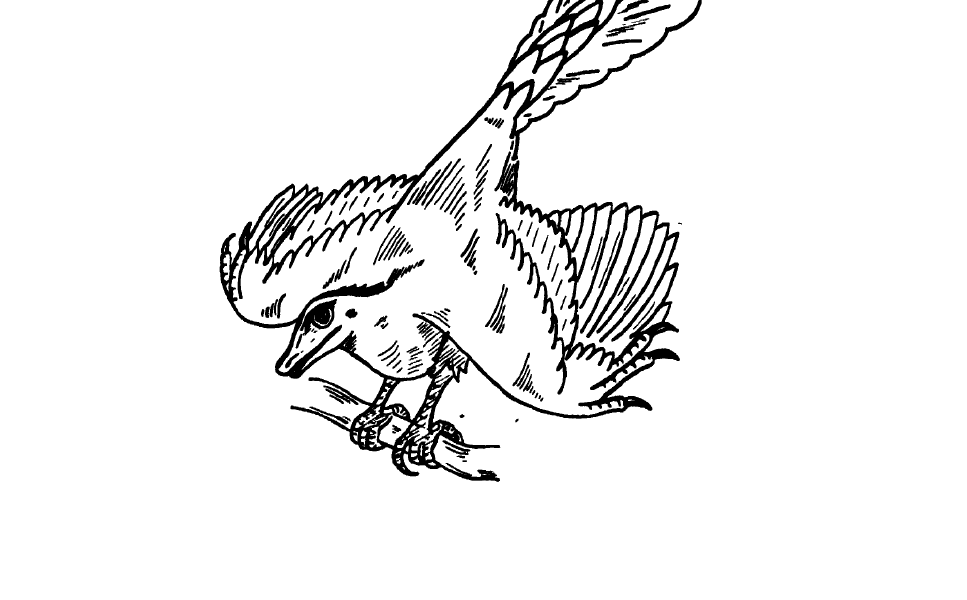
Kulindadromeus zabaikalicus, which had feathers. For nearly two centuries it has been taught that dinosaurs were large reptiles that had tough scales and a lizard-shaped head. The recent discovery may prove years of schoolwork wrong. The dinosaur found was 4.5 feet (1.5m) long, beaked, with large legs, short arms, a long tail and is thought to have been bipedal. This is actually not the first feathered dinosaur of its kind to be found. Way back in the 1990s, scientists have found at least five species of dinosaurs in China that had feathers. These dinosaurs were theropods (a type of dinosaur) and carnivores. The infamous Tyrannosaurus rex is a part of this group. However, the dinosaur that was recently found was a herbivore and from a different dinosaur family, which meant that it could not have been related to the older feathered species found. The Kulindadromeus must have evolved differently than the rest of these dinosaurs, and hence many other dinosaurs may be the same way. Because of this, scientists are rethinking what dinosaurs may have looked like. The Kulindadromeus genus of dinosaur lived in Siberia, near the Kulinda River. Its legs and elbows were feathered, and there were streamlined feathers on its back. At least six skulls of this dinosaur was found in a fossil bed at the bottom of a lake, and they were all juveniles, which has scientists believe that they did not die in a catastrophe, but rather separate events. The skulls were buried under volcanic ash, preserving much of the feather imprints on the fossil bones. “Kulindadromeus” means “Kulinda River running dinosaur”, while “zabaikalicus” relates to the region of Siberia where it was discovered, Zabaikalsky Krai. The skin of the dinosaur resembled the skin of some birds, which provides even more evidence that today’s birds have evolved from the dinosaurs, according to the study. Lead author on the paper, Pascal Godefroit, is a paleontologist from the Royal Belgian Institute of Natural Science in Brussels. He and his colleagues state that while this find is significant, more studies should be done on this subject. There is a lack of evidence that feathers developed in all dinosaurs, since fossil records with feathers are in the minority. Before this, birds were thought to have come from the line of the archaeopteryx and other winged creatures. These feathers may have served as a method for insulation, such as in the case of Kulindadromeus, which lived in colder climates. Larger dinosaurs also may have had fewer feathers than smaller dinosaurs, as they would conserve heat more easily. We’re still a long way off from confirming whether or not all dinosaurs had feathers, but what it does mean is that feathers did not start off with birds, instead they evolved very early in history with the dinosaurs.]]>