here Image courtesy of NASA/JPL/USGS]]>

here Image courtesy of NASA/JPL/USGS]]>

The Journal of Theoretical Biology, can be found here Image courtesy of Scott Persons]]>
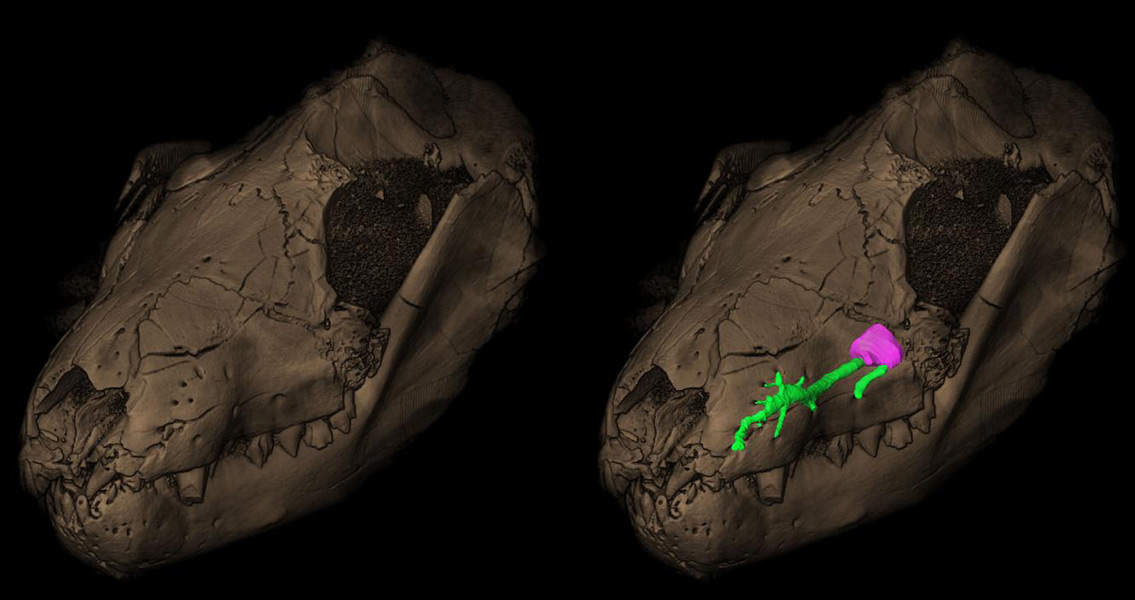
Scientific Reports, the new study suggests that something seemingly as trivial as hair, more specifically whiskers, allowed mammal like reptiles to outlive their ferocious competitors in the jungle. Dr Julien Benoit and his colleagues from the University of the Witwatersrand, Professors Paul Manger and Bruce Rubidge, studied the fossils of mammal like reptiles, known as therapsids, unearthed in the Karoo of South Africa. They found evidence that leads them to believe the therapsids may have evolved whiskers as a means to operate nocturnally during the Mesozoic Age, well before the ascendancy of the dinosaurs. “Whiskers are an amazing sensory tool to have when you are nocturnal and the evolution of whiskers possibly assisted in the survival of the therapsids – and more specifically the probainognathians – which eventually evolved into mammals as we know them today,” explained Dr. Benoit, in a press release from the University of Witwatersrand. An order of Triassic and Permian period reptiles, therapsids are widely considered the predecessors to modern mammals. It has long baffled scientists how this group of creatures were able to survive not only the competition from the dinosaurs, but also the mass extinction events that wiped out most dinosaur species. A rich fossil record exists of the therapsids, providing insight into their key role in the development of modern mammals. However, until now there was no evidence of hair among therapsids, meaning it was a development believed limited to mammals. Benoit’s team used a unique approach to solve the issue. Instead of looking for fossilised evidence of hair, they deployed scanning technology to search for the neural structures which could have allowed hair to develop in therapsids. Through computerised X-ray micro-tomography (CT scan) and digital three-dimensional modelling, Benoit discovered that therapsids had a shorter maxillary canal, a bony tube in the snout of the animal that houses the trigeminal nerve, than reptiles. The trigeminal nerve is responsible for motor functions in the face. Shortening of the maxillary canal allows for the movement of the trigeminal nerve, letting it extend into the soft tissue of the lips and nose where it innervates a creature’s whiskers. “This leaves the trigeminal nerve free to follow the movements of a flexible snout.” explained Benoit. “In reptiles this canal is long and the nerve is enclosed in the maxilla all along its length, which prevents any movement of the nose and lips,” The team’s research suggests that a mobile snout evolved between 240-246 millions years ago in the Prozostrodontia, a group of dog like therapsids which were direct ancestors of modern mammals. Research carried out on mutant mice suggests that two mammalian features, the cerebellum and the trigeminal nerve, were controlled by the same gene: MSX2. This is the gene that regulates the development of mammary glands and body hairs. As Benoit explained, “This is the gene that makes us mammals”. It seems, based on the team’s CT studies of probainognathians, the group to which Prozostrodontians belong, that MSX2 underwent a significant change in its expression 240-246 million years ago. This could have triggered the evolution of a host of mammalian traits, including hair and whiskers, an enlarged cerebellum, complete ossification of the skull roof, and more importantly, the mammary glands. Developing whiskers would have allowed therapsids to operate in the jungle at night, providing them a key advantage over dinosaurs. The animals may have been afforded the opportunity to hunt without coming into contact with their dangerous rivals. “Our research has shown that these features of mammals were already present in advanced therapsids, prior to the appearance of mammals,” says Benoit. “It also has implications for understanding how mammals survived the domination of dinosaurs during the Mesozoic period and the subsequent evolutionary success of mammals.” For more information: ww.nature.com Image courtesy of Wits University ]]>

Geology, the study has answered one of the most curious questions surrounding the mass extinction event which took place 65 million years ago. ]]>


P. falciparum parasite. The first recorded instances of the disease in humans took place in China in 2,700 BCE. It has since had a constant, and dramatic effect on history, with some historians arguing that it played a leading role in the fall of the Roman Empire. Now, a new study argues that the origins of malaria go back much further than ancient China, to the time of the dinosaurs. Typically, malaria is thought to be of a reasonably modern origin, with estimates placing its beginnings to between 15,000 and 8 million years ago. The new study, published in the journal American Entomologist, argues that malaria evolved in insects at least 100 million years ago. George Poinar, a researcher from Oregon State University, claims that the disease may have begun in an insect such as the biting midge. His conclusions have been reached through careful analysis of the fossil record, including a one hundred million-year-old Protoculicoides biting midge preserved in Myanmar Amber, which contained numerous oocysts of the malarial parasite Paleohaemoproteus burmacis in its body cavity. “Scientists have argued and disagreed for a long time about how malaria evolved and how old it is,” Poinar explained in a press release from OSU. “I think the fossil evidence shows that modern malaria vectored by mosquitoes is at least 20 million years old, and earlier forms of the disease, carried by biting midges, are at least 100 million years old and probably much older.” Poinar and his wife Roberta garnered attention in 2007 with their book ‘What Bugged the Dinosaurs?’, in which they suggest that the evolution and development of blood sucking, disease spreading insects could have played a pivotal role in wiping out the dinosaurs. They argue that a single global event, such as a meteor strike, failed to explain dinosaur extinction. “There were catastrophic events known to have happened around that time, such as asteroid impacts and lava flows,” Poinar said in the OSU press release. “But it’s still clear that dinosaurs declined and slowly became extinct over thousands of years, which suggests other issues must also have been at work. Insects, microbial pathogens and vertebrate diseases were just emerging around that same time, including malaria.” In the new study, Poinar argues that insects must be considered the primary hosts of malaria, since the sexual reproduction stage of the parasites does not occur in the vertebrate animals they infect. In particular, he highlights Gregarinida as the parasite group which could have been the progenitor of the disease. “Based on the host range and life cycle of representatives of the Coccidia and Gregarinida, the progenitor for malarial organisms (Haemosporidia) is considered to have evolved from gregarine protozoa.” he writes in the newly published journal article. Based on the fossil evidence, he concludes that reptiles may have been the first vertebrate hosts of malaria, “Fossil evidence and molecular studies indicate that the original vertebrate hosts of malarial or plasmodid organisms were reptiles; thus, the mid-Cretaceous biting midge infected with P. burmitis could well represent an early prototype of a malarial vector–vertebrate association.” He writes in the study. Poinar’s research suggests that malaria is millions of years older than traditionally believed. By charting its ancient history, new insights could be gleaned into its effects on vertebrate survival millions of years ago, as well as providing new insights into its deadly modern day life-cycle. For more information: oxfordjournals.org Image by George Poinar, Jr., courtesy of Oregon State University]]>

Timurlengia euotica, were discovered over the course of nine years during international expeditions to the Kyzylkum Desert of Uzbekistan. The creature lived around 90 millions years ago, and slots into a 20 million year gap in the fossil record of tyrannosaurs. Although a fellow tyrannosaur, T.eutoica is not the ancestor of T-Rex. About the size of a horse, Timurleniga could have weighed up to six hundred pounds. Its long legs mean it was likely a fast runner. “Timurlengia was a nimble pursuit hunter with slender, blade-like teeth suitable for slicing through meat,” explained Hans Sues, chair of the Department of Paleobiology at the Smithsonian’s National Museum of Natural History, in a press release. “It probably preyed on the various large plant-eaters, especially early duck-billed dinosaurs, which shared its world. Clues from the life of Timurlengia allow us to fill in gaps and better understand the life and evolution of other related dinosaurs, like T. rex.” Perhaps surprisingly, the study, published in the Proceedings of the National Academy of Sciences, suggests that brains came before brawn in the evolution of Tyrannosaurs. Prior to the development of their giant size and strength, Tyrannosaurs developed keen senses and cognitive abilities. These heightened abilities allowed them to reach the top of the food chain after other large meat eating dinosaurs had gone extinct, 80 – 90 million years ago. Although typically associated with North America, T.rex’s and other Cretaceous dinosaurs mostly had their routes in Central Asia. “The discoveries from the Kyzylkum Desert of Uzbekistan are now helping us to trace the early history of these animals, many of which later flourished in our own backyard in North America.” Sues said in the press release. The new species was discovered while Sues and a team of paleontologists led by Steve Brusatte at the University of Edinburgh were sorting through the bones brought back from the Kyzylkum Desert. CT scans of the brain case allowed the team to reconstruct Timurlengia’s brain and gather insights into the development of its abilities. “The ancestors of T. rex would have looked a whole lot like Timurlengia, a horse-sized hunter with a big brain and keen hearing that would put us to shame,” explained Brusatte. Tyrannosaurs originated in the Jurassic Period around 170 million years ago, but they were barely the size of a human. 100 million years later, in the Cretaceous Period, they had evolved into animals like T-rex, which weighed up to 7 tons. The fact Timurlengia was so small, despite living some 80 million years after tyrannosaurs had first appeared, indicates the group’s terrifying size only occurred relatively late in their evolutionary history. For more information: www.pnas.org Image courtesy of © Proceedings of the National Academy of Sciences]]>

Protoceratops andrewsi being greater than the overall growth of the animal by demonstrating positive allometry.” As well as changing in shape, the frill also changed in size, becoming proportionately wider as the dinosaur got older. This has been taken by the QMUL team as evidence that the frills were connected to sexual selection. As they explain in the study, although there are some exceptions in the animal kingdom where positive allometric traits are not connected to sexual selection, they are incredibly rare. “If a trait is shown to be positively allometric then, in the absence of a plausible alternative regarding its evolution, we can take this as evidence supporting a hypothesis of evolution via sexual selection or socio-sexual dominance signals.” Other explanations for the horns and frills on Ceratopsian dinosaurs exist. Some palaeontolgists have argued that the horns and frills were merely a means of defence against predators, while others have suggested that the ornamental bone structures were a means for the animals to identify other members of their herd. These explanations are not mutually exclusive, and it is possible that the structures had multiple functions. Meanwhile, the authors of the study argue that the findings provide further evidence of the importance of sexual selection in shaping biodiversity. “Biologists are increasingly realising that sexual selection is a massively important force in shaping biodiversity both now and in the past. Not only does sexual selection account for most of the stranger, prettier and more impressive features that we see in the animal kingdom, it also seems to play a part in determining how new species arise, and there is increasing evidence that it also has effects on extinction rates and on the ways by which animals are able to adapt to changing environments.” said Dr Rob Knell, Reader in Evolutionary Ecology, also from QMUL’s School of Biological and Chemical Sciences. Image courtesy of Wikimedia Commons user: Luis Miguel Bugallo Sánche]]>

Scientific Reports. Evidence of the mating ceremony has been left behind in 100 million year old fossils, according to Martin Lockley, a professor of geology at the University of Colorado Denver and the author of the study. Modern male birds perform a mating ritual known as ‘nest scrape display’ or ‘scrape ceremonies’, where they show off their prowess as a provider by excavating pseudo nests for potential mates. An international research team led by Lockley discovered large ‘scrapes’ in the prehistoric Dakota Sandstone of western Colorado, which they’ve interpreted as evidence of scrape ceremonies among Cretaceous Dinosaurs. “Thus, these scrapes represent a hitherto unrecognised category of physical trace fossil evidence ostensibly associated with early behavioural phases in the breeding cycle of non-avian theropod dinosaurs”, Lockley writes in the study itself. The findings make a significant addition to what is currently a major focus of paleobiological research: the connection between dinosaurs and modern bird species. Despite extensive phylogenetic and morphological evidence highlighting physical and biological similarities, the latest discovery provides a rare example of behavioural evidence preserved in the fossil record. Four sites in the Cretaceous Dakota Sandstone of Colorado have been identified by the team as containing traces of large nest scrape display. Significantly, the traces are spread out over a broad area, with three sites discovered in the west of the state and one in the east, suggesting nest scrape display rituals were widespread among the dinosaurs that inhabited the region. In a press release, Lockley explained the significance of the find: “These are the first sites with evidence of dinosaur mating display rituals ever discovered, and the first physical evidence of courtship behavior,” he said. “These huge scrape displays fill in a missing gap in our understanding of dinosaur behavior.” Over 50 examples of substrate scraping measuring up to two metres in diameter have been discovered, in an area rich in footprints from both carnivorous and herbivorous dinosaurs. Lockley, a paleontologist specialising in dinosaur tracks, insists the scrapes are compelling evidence of leks (display arenas), “consistent with “nest scrape display” behaviour among many extant ground-nesting birds.” He provides evidence in the study that the scrape marks are not from actual nests, nor simply examples of digging for shelter, food or water. The discovery confirms what paleontologists could previously only speculate about: the evolutionary driver known as ‘sexual selection’ was present among dinosaurs. Both birds and mammals since prehistoric times have used male competitiveness as a basis for reproduction. Males looking for a mate compete with their rivals to win the affections of females, who choose the most impressive performers to reproduce with. In the case of nest scrape display, the model nests are the means for the males to demonstrate their suitability as a mate. “This is physical evidence of pre-historic foreplay that is very similar to birds today. Modern birds using scrape ceremony courtship usually do so near their final nesting sites. So the fossil scrape evidence offers a tantalizing clue that dinosaurs in ‘heat’ may have gathered here millions of years ago to breed and then nest nearby.” said Lockley, in the University of Colorado Denver press release. For more information: www.nature.com Image courtesy of University of Colorado Denver ]]>
