
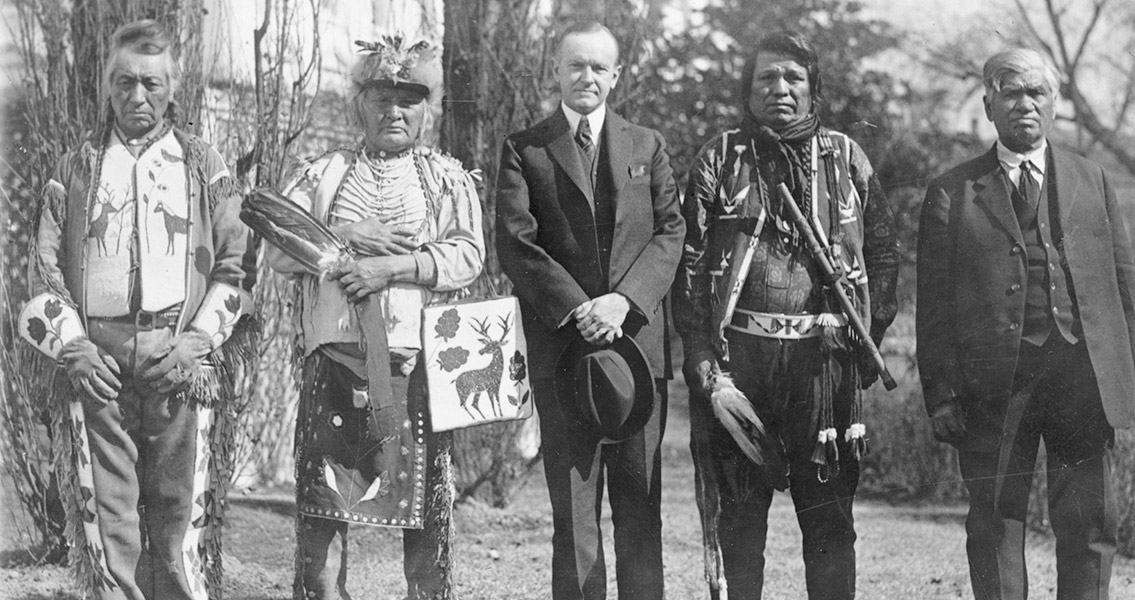
“Be it enacted by the Senate and House of Representatives of the United States of America in Congress assembled, That all noncitizen Indians born within the territorial limits of the United States be, and they are hereby, declared to be citizens of the United States: Provided, That the granting of such citizenship shall not in any manner impair or otherwise affect the right of any Indian to tribal or other property.” President Calvin Coolidge, who had signed the Act, spent much of his presidency trying to appear as a supporter of Native American rights. As the Act was publicly announced, Coolidge posed for a photo with three Osage Indians, two of which were wearing traditional ceremonial dress, outside the White House. Prior to the passing of the Act into law, the USA did not recognise Native Americans as US citizens; excluding them from the rights and guarantees given in the Fourteenth and Fifteenth Amendments. Until 1924, citizenship had only been available to those of 50% or less Native American heritage, or Native American women who had married US citizens. The 1887 Dawes Act had been the previous benchmark of US policy towards Native Americans. It dissolved all Native American tribes as legal entities and redistributed land among individual heads of family, who would become federal and state tax payers. Any remaining land was then deemed surplus and sold off, with the proceeds going towards building Native American schools. Masquerading as a reform to benefit the indigenous people, the Dawes Act’s impact was often the opposite. By 1932, the sale of unclaimed land under the Dawes Act had seen total Native American territories in the USA fall by two thirds. Meanwhile, it left the Native American families with an impossible decision: assimilate into white American culture, or preserve their heritage in poverty. It was a dilemma the Indian Citizenship Act failed to alleviate. Voting rights were not even guaranteed to all Native Americans by the Indian Citizenship Act, denying them the opportunity to meaningfully participate in the US democracy. The US Constitution allowed the states to determine their own voting laws, which meant they could place education or property ownership obligations on their electors to exclude the majority of Native Americans. It wasn’t until 1957 that all states allowed Native Americans to vote, highlighting just how arduous the battle for Native American Civil Rights has been. As has often been the case in US history, the Indian Citizenship Act laid the grounds for Native American assimilation into US life through citizenship, at least showing a difference in perception towards Native Americans. It provided little opportunity however, for Native Americans to defend their dying heritage or achieve true equality and freedom in US society.]]>


Beringia for the Bering Strait that separates Alaska and Russia, was indeed the route taken by early Native American forebears. In a press release accompanying the publication of the report, University of California, Berkeley associate professor Yun Song commented that while there is a level of uncertainty in when this migration occurred and when the northern and southern Native American populations diverged, researchers will be able to become more precise in their estimates as additional ancient genomes become sequenced. Song, one of the co-authors of the new study, added that there were three different statistical models used in conjunction with one of the most modern and comprehensive sets of data ever to be used in the quest to identify the genetic forebears of Native Americans. The data sets consisted of genomes mapped from the remains of 23 different North and South American individuals that have been dated to between 200 and 6,000 years ago. These ancient genome sequences were then compared to genetic data collected from modern humans belonging to Native American tribes as well as those inhabiting Siberia. According to the team’s findings, the populations that would eventually become the northern and southern Native American civilizations broke apart from one another sometime between 11,500 and 14,500 years ago. While the majority of those that migrated to the south are the forebears of native Central and South American populations, part of North America was populated by these individuals as well. According to UC Berkeley professor Rasmus Nielsen, the first unique Native American culture, known as the Clovis, first appeared around 13,000 years in the past, which corresponds with the time that modern Native American bloodlines began to diversify. This date can be pinpointed with such confidence thanks to the discovery of the remains of a 12,600 year old boy who was revealed to have been associated with the Clovis after careful analysis. ]]>

www.jstor.org Image courtesy of Wikimedia Commons user: Magnus Manske]]>


