Categories
News

The Battle of Changping- The decisive battle of the Warring States

The battle in numbers The powerful army of the State of Zhao had 450,000 soldiers under the command of Lian Po and later Zhao Kuo. At the end of the battle when the survivors of this army had surrendered the youngest 240 soldiers were released, the remainder were executed, buried alive in pits that even today occasionally bone or bone fragments are unearthed. The State of Qin was led by Wang He and he was replaced by the legendary military leader Bai Qi. This change led to the final battle where the tactics of Bai Qi outmanoeuvred those of the Zhao leader. In all over 650,000 soldiers were killed or seriously wounded during the conflict making it one of the most lethal battles in military history.  

Before we look at the battle, we should look at the military equipment and tactics used at that time.

The military chariot was still in use in Chinese warfare long after it had ceased to be used in the Middle East. The chariots use was however in decline during the Warring States Period.   Massed infantry were beginning to excel largely due to the massed use of the crossbow. The increase in use of an infantry force meant the peasantry could easily be drafted and relied less on the nobility to control the chariots. Further back in ancient Chinese history at the Battle of Muye in 1046BC, the victorious Zhou army had 45,000 soldiers and 300 chariots. By the time of the Warring States the military strength of each state had grown considerably. The Qin had an army of over 1 million infantry, 1,000 chariots and 10,000 cavalry on horses. Another factor in the increased size of each army was the increase in casualties with 340,000 killed at the battles of Maling and Yique. The Qin general Bai Qi was reported to have been responsible for close to 900,000 enemy being killed during his military career. At that time records may have been inaccurate and soldiers were paid on the number of enemy they killed so enemy deaths may have been exaggerated. None the less the Warring States was a period of excessive bloodshed. This was largely due to the use of mass infantry units where fighting became more intense and at close quarters. As the aristocracy became less involved on the battlefield their leaders became more despotic as Chinese nobles became part of the literate class and not the warrior class. The chief weapons used were the crossbow, which was mass-produced with training easily accomplished. It was a powerful, accurate long range weapon at the time. The infantry were equipped with several weapons although the dagger-axe was the most popular. They were on a pole of 9 to 18 feet and consisted of a spear with a slashing blade.

Back to the Battle of Changping- the beginning of the conflict

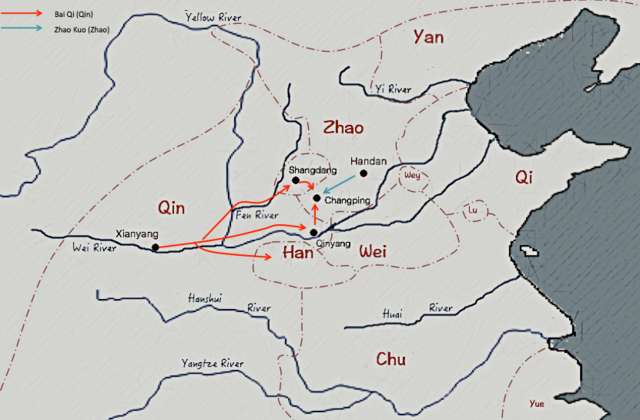
In 265BC, the state of Han was invaded by the Qin. The intention was to take the province of Shangdang. The Qin army quickly passed through the territory with main roads and fortresses all falling within the next four years. Shangdang was cut off from the Han territory and due to fall into Qin hands. In a remarkable act the Han then gave their neighbours, the Zhao kingdom the prize of Shangdang. At that time, Shangdang was of great importance strategically to the Zhao, if it fell into Qin hands then the Zhao heartland would be liable to attack. King Xiaocheng accepted the offer of Shangdang and sent an army under the leadership of Lian Po to quell the threat posed. They met at Changping with Wang He leading the Qin army. Lian Po had already suffered several minor defeats to the Qin during his military career and decided to wait and hope the Qin would eventually go. He had several fortresses built and waited, this turned into a stalemate lasting three years. The Qin did attack one time, even breaching the walls of the Zhao defenders. The attack though did not have sufficient numbers to bring defeat, so the stalemate continued.

A change in strategy

The Qin sent some of their spies into Zhao and Han territory spreading the message that Lian Po was too old and a coward not wanting to fight. The Zhao king removed Lian Po and replaced him with Zhao Kuo, the son of a famous general, Zhao She. Before he died, Zhao She had said that his son should never command an army, Zhao She’s wife had approached the king asking that her son not be given the appointment, the king refused and Zhao Kuo was sent to Changping. In the meantime the Qin had replaced their own general with Bai Qi, a renowned fighter and tactician. Zhao Kuo’s command of the Zhao army began in July 260 BC. He had an army of around 400,000 and he ordered them to invade the Qin camp. During the attack the Qin operated a manoeuvre that looked like a retreat that actually became an ambush. The forward lines of the Zhao army advanced as far as the Qin fortress. The Qin in ambush positions cut off the rearguard of the Zhao forces while simultaneously surrounding the fortress belonging to the Zhao. The Zhao army found itself split into two and all its supply lines were cut off. Bai Qi, the commander of the Qin forces ordered constant counter attacks against the Zhao. The Zhao were positioned on a hillside where they hastily made fortifications and hoped for reinforcements to arrive.

Zhao Foreign Policy

For decades, opportunism had been the focus or drive of the Zhao foreign policy. They had ever shifting alliances with their surrounding states in an effort to stop the expansionism of the Qin state. Since 295 BC they had even had alliances with the Qin themselves when the opportunity suited their needs. On this occasion the states of Chu and Qi would not come to the aid of the Zhao. Meanwhile, the Qin king, Zhaoxiang sent messages to the Henei region in today’s Henan province ordering all males over 15 years of age to assemble south of Changping and block any Zhao supplies and reinforcements. After being besieged on the hillside for 46 days, the Zhao encampment, driven by hunger and despair, made several desperate attempts to escape. They were unable to break out of the stranglehold the Qin had erected. Zhao Kuo, led his finest troops in a last desperate attempt and was cut down by the massed ranks of crossbowmen.  

Surrender and Execution

The remainder of the Zhao army surrendered but fearing a revolt and opposition from the people of Shangdang towards the Qin, Bai Qi ordered the execution of the prisoners. He spared 240 of the youngest soldiers sending them back to their homes to spread the fear about the Qin army. The Battle of Changping is regarded as one of the bloodiest battles in world history with around 650,000 casualties, 450,000 being on the side of the losing Zhao state. Those soldiers executed were mostly buried alive in pits and centuries later Emperor Xuanzong of Tang erected a temple on the execution site which became known as the Temple of Bones.

Aftermath of the battle

Both states of Qin and Zhao were financially crippled and exhausted of domestic supplies after more than three years of fighting. The Qin state was able to quickly recover, however the Zhao state was not able to. In the years leading up to the Battle of Changping, the state of Zhao was one of the stronger participants in the Warring States Period. The Zhao never fully recovered from this defeat and they were conquered by the state of Qin around thirty years later. This gave the state of Qin military superiority over the surrounding states. Further battles took place against the state of Chu before the dominance of the state of Qin led to the unification of China in 221 BC.]]>

Categories
Editorial

Meet Ching Shih: the prostitute-turned-pirate who banned rape in her 50,000-man fleet

Obscure beginnings Like so many politically influential women before (and after) her, Ching Shih went undocumented by history for a shockingly long time. In fact, her legacy was only first explored in depth in 1987, when Dian Murray published Pirates of the South China Coast, 1790-1810 – 143 years after the pirate lord died. Records call her Ching Shih, Madam Ching or Zheng Shi, all meaning ‘widow of Zheng Yi’; though she was born Shil Gang Xu, a girl from the Guangdong (Canton) province of south east China. At one point, it seems she worked as a prostitute on a floating brothel; though there is scant documentation of her life before 1801.  

A pirate’s life for Shih

At this point, she had a chance encounter with Zheng Yi, pirate commandeer of the Red Flag Fleet. Legend would have us believe that he pillaged the floating brothel and captured her; other stories suggest that he proposed, but that she refused unless he would sign over half his fleet. If this is true, it was the first significant negotiation of what turned out to be an astute strategic mind. Either way, they married; and Zheng Yi did indeed gift her an equal partnership in leadership of his 200 ships.  

The Red Flag Fleet grows

Zheng Yi hailed from a long lineage of pirates. His name commanded a great deal of respect; and the ever-strategic Ching Shih advised him to unite the various pirate fleets of the South China Sea under the banner of the Red Flag Fleet. In 1804, just three years after their marriage, accounts tell us that the fleet had grown to either 300 or 600 ships of 50-100 pirates each. At the very least, that would mean 15,000 pirates were answering to the couple. At the most, it would have been 60,000. At the height of its power, some records provide estimates of 1,800 ships. Later that year, the fleet issued a blockade of a Portuguese trading port in Macau. The Portuguese squadron quickly fell to the power of the Red Flag and even the British Royal Navy stepped back from the conflict.  

Navigating a power vacuum

Six years into her marriage, Ching Shih was widowed. As is typical for their story, there are multiple accounts of Zheng Yi’s cause of death: he is alleged to have died in the Tay Son Rebellion in Vietnam in 1807, but also to have died in a typhoon or simply fallen overboard. As his heir, some even point fingers at Ching Shih. However he might have died, Ching Shih had to act fast – lest her empire crumble. She formed an alliance with her adoptive son, Cheung Po Tsai. Together, their secured the loyalty of a selection of Zheng Yi’s relatives, all of whom were leaders in the fleet. The wife of Cheung Po Tsai’s lieutenant, Cai Qian Ma, was a Western weaponry expert who spoke fluent English. Within the fleet, she was notorious for her viciousness in battle, addiction to opiates, and sexual exploits. But as well as this, Cai Qian Ma was an expert negotiator. She was able to provide Ching Shih and Cheung Po Tsai with strong connections to Western weapon dealers – thereby supplying the fleet with British guns. [caption id="attachment_8849" align="aligncenter" width="450"] The merciless pirate lord, Ching Shih. Credit: thefemalesoldier.com[/caption]

Seeing red: the merciless Madam Ching

As Ching Shih secured her position, her code of conduct tightened. If a town sent a makeshift army out to fight the fleet, the Red Flag would sink the army and go ashore to kill all adult males they found. Often, resisters had their feet nailed to the decks before a beating. However, towns that did not resist and instead paid a tribute were rewarded with protection. Any pirate who tried to loot a town that had previously paid tribute to the Red Flag was beheaded and buried at sea. A violent death also befell any pirate who disobeyed an order, went ashore without permission, stole treasure or raped a female captive. Even if the sex was consensual, he’d be beheaded. However, pirates were permitted to marry attractive female captives, which would elevate the women to normal members of the fleet with rights and duties. Their husbands were bound to be faithful to their wives (upon pain of death, obviously). Ugly women, it is said, were released with no harm done. Interestingly, deserters weren’t killed. They’d simply have their ears cut off.  

Ching Shih’s financial policy

Any money seized in a raid would be accounted for and registered before it was distributed. Ching Shih worked out a system whereby the ship responsible for the capture would receive 20% of the loot. The remainder went into a large collective fund to be spread among the entire fleet. Failure to comply with her policy would result in severe public whippings or beheading.  

Why didn’t the Qing government stop Ching Shih sooner?

There had never been a great naval tradition in the Chinese empire. A small selection of the Qing fleet were copies of captured pirate ships, but most of its fleet was made up of converted merchant vessels. Even then, they were greatly outnumbered by the technologically superior Red Flag ships. After a vicious exchange that saw the death of notable pirates including Cai Qian Ma, as well as government officials, the Qing government and the Red Flag fleet engaged in a pitched naval battle in 1808. The pirates enjoyed a glorious victory, causing the Qing government to reach out to Portugal and Britain again. Despite concessions offered to the two external powers, they were unable to help.  

The tide turns against Ching Shih

In 1809, the tide turned. The imperial government continued to pour resources into their destruction and it became a question of attrition. The following year, the government issued amnesty for all pirates willing to lay down their arms. Cheung Po Tsai entered into a negotiation with the Qing forces, but was unable to make any headway. Ching Shih took the reins and walked, unarmed, into the governor’s office in Guangdong.  

Shih who dares, wins

Due to her conversational prowess, all but 400 of her pirates would be able to walk free without ceding any of their wealth – on the condition that they all kneel before the governor and pay homage. Ching Shih refused. She expertly steered the conversation to a resolution, whereby she and Cheung Po Tsai would kneel – but only if their legal relationship as mother and son could be dissolved and they were allowed to be married. The two were wed with the governor as witness, and as per tradition, they knelt to thank him. Ching Shih had negotiated freedom for all but 400 of her fleet, kept all of their riches, not had to pay homage outside of usual marriage ritual, was able to marry the man she loved – and both became members of the Chinese aristocracy ‘by Imperial decree’. [caption id="attachment_8850" align="aligncenter" width="440"] Ching Shih is immortalised in Disney’s Pirates of the Caribbean franchise as ‘Mistress Ching’.[/caption]

Ching Shih: the family woman

Cheung Po Tsai died at sea 9 years later, and his widow would go on to marry another former underling. They returned to the Guangdong province, where she opened a gambling house and brothel. Ching Shih lived to see her son and grandchildren grow up, and died in her bed, surrounded by her family, in 1844.]]>

Categories
Breaking News

Humans left Africa 270,000 years earlier than we thought

One of the tools from the discovery site in Shangchen, China. Credit: Professor Zhaoyu Zhu[/caption] Prior to this discovery, the earliest evidence of humanity outside Africa was a collection of skeletal remains and stone tools found in Dmanisi, Georgia, which have been dated to 1.85 million years ago – 270,000 years after the new discovery in Shangchen in the southern Chinese Loess Plateau. The research, published in the journal Nature, also suggests that the ancient humans returned to the same site repeatedly, possibly for hunting. The collection includes a notch, scrapers, cobble, hammer stones and pointed pieces. Each item shows sign of human use. The hammer stones, for instance, had been intentionally flaked. Fragments of animal bones that would have been contemporaneous with the items were also found. Most of the artefacts were made of quartzite and quartz, suggesting that the materials were sourced from the foothills and streams of the Qinling Mountains around 5 to 10 kilometres from the site. [caption id="attachment_8815" align="aligncenter" width="425"] The extensive collection of 2.1 million years old artefacts is causing archaeologists to reconsider the overall story of human migration. Credit: Professor Zhaoyu Zhu[/caption] Because the 96 stone artefacts were found in 17 different layers of fossil soils that had developed over a period of one million years, we now know that early humans occupied the Chinese Loess Plateau under varying climatic conditions between 1.2 and 2.12 million years ago. Professor Dennell says: “Our discovery means it is necessary now to reconsider the timing of when early humans left Africa.” The find “may add a new chapter to the story of hominin evolution, suggesting that some of these species left Africa far earlier than once believed and managed to travel over 8,000 miles east of their evolutionary birthplace,” The New York Times reports. The age of the tools “suggests that the hominins who made them were neither tall nor big-brained. Instead, they may have been small bipedal apes, with brains about the size of a chimpanzee’s.” Michael Petraglia, a paleoanthropologist at the Max Planck Institute for the Science of Human History comment:S “The implications of all this are large. We must re-evaluate our understanding of human prehistory in Eurasia.”]]>

Categories
Breaking News

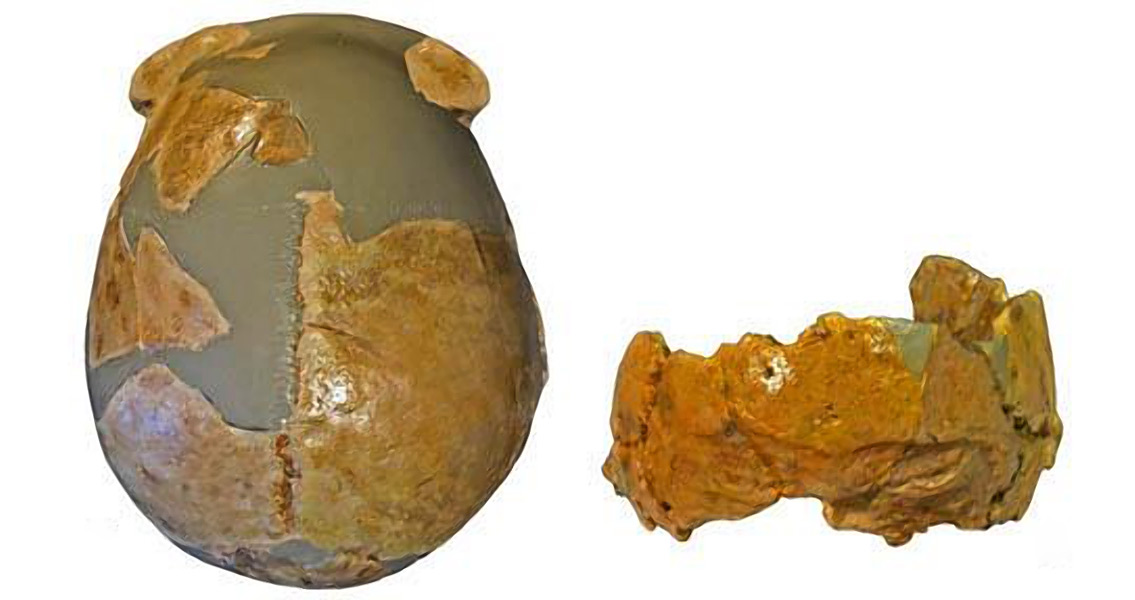
Neanderthal and Human Characteristics Shown in Two Ancient Skulls

Categories
Breaking News

Chinese Princess Bride and General Discovered Buried Together

Wenwu in 2015. This same article has now been translated into English and published in the journal Chinese Cultural Relics. In the journal article, the archaeologists also discuss the other tombs they found in the cemetery, noting that they excavated 69 tombs in total. The research team included members from the Shanxi Provincial Institute of Archaeology, the Shanxi University’s School of History and Culture, the Agency of Cultural Relics and Tourism of Jinyuan District, Taiyuan city, and the Taiyuan Municipal Institute of Cultural Relics and Archaeology. ]]>

Categories
Breaking News

Early Chinese Culture Altered by Shifting Monsoons

Proceedings of the National Academy of Sciences, can be found here Image courtesy of Yonaton Goldsmith ]]>

Categories
Breaking News

8,500-year-old Silk Found in Chinese Tombs, Oldest Evidence Ever

Live Science. Jiahu had previously been the location of other remarkable archaeological finds; the site has yielded evidence of the earliest known examples of playable musical instruments in the form of bone flutes. Additionally, evidence of what may be the earliest instances of Chinese as a written language was also found on the site. Legend has it that the wife of the Yellow Emperor was surprised when a silkworm cocoon fell into her teacup one day, yielding nearly a kilometer of thread after it was unraveled. While this is of course legend, as far as silk weaving and breeding silkworms for that goal goes, ancient tales seemed to radiate out from Jiahu and the surrounding area, according to archaeologist Decai Gong, the study’s co-author and a scientist from the University of Science and Technology of China at Heifei. Additionally, older research on Jiahu found that mulberry trees thrive in the warm and humid climate of the region; with mulberry leaves being the singular food of silkworms. Researchers collected soil samples from a trio of tombs located at Jiahu. After chemical analysis, two of these three tombs were found to have had silk proteins in their samples. One of these two tombs has been dated to 8,500 years old, making the discovery the earliest evidence of the use of silk in ancient China according to Gong – extending back much further than the previous 5,000-year date. There are difficulties in understanding how silk would have been used at Jiahu, researchers say. However, the scientists made the suggestion that those interred in the tomb might have been wrapped in silk garments. The discovery of weaving tools and bone needles at the site seems to support that idea, as it suggests that the residents of Jiahu possessed the basic sewing and weaving skills needed. In fact, Gong said that it would not have been impossible for those living in Jiahu at the time to have created fabric from silk. The researchers say that they will continue to look for evidence of silk at the Jiahu tombs in the future. Gong added that other nearby sites will also be examined for trace evidence as well. The research study, published recently in the journal PLOS ONE, is available online here]]>

Categories
Breaking News

Thousands of Animal Artifacts Entombed with Emperor

Categories
Breaking News

Was the Terracotta Army the Result of Greek Influence?

Guardian. “We now think the Terracotta Army, the acrobats and the bronze sculptures found on site, have been inspired by ancient Greek sculptures and art.” Lukas Nickel, from Vienna University, told the Guardian: “I imagine that a Greek sculptor may have been at the site to train the locals.” Ying Zheng, who took the name of Qin Shi Huang Di—the First Emperor of Qinook, ascended to the throne in 246 BCE when he was only 13-years-old. By 221 BCE, he had successfully unified a number of warring kingdoms. During his reign, Qin standardized coins, measures and weights; interlinked the kingdom’s states with roads and canals; and built the first Great Wall. According to the writings of the court’s historian Siam Qian, Qin ordered the construction of the mausoleum soon after becoming emperor. Over 700,000 laborers labored on the project, which was completed in 209 BCE, a year after Qin’s death. Archaeological finds from the site have already revealed the extent of early trade. The Silk Road, with numerous caravan stops and trading posts, was established in the third century during the Han dynasty. However, a number of the trade routes had already been in existence for years. Chinese historians documented the arrival of Roman traders when Augustus was emperor of Rome (27 BCE to 14 CE), during which time Chinese silk was flooding into Rome. Writers like Seneca even denounced those who wore it as immoral and effete. The research is discussed in the documentary, The Greatest Tomb on Earth, sponsored jointly by the BBC and National Geographic. ]]>

Categories
Breaking News

Excavation of Haihunhou Tomb in China Completed

ChinaDaily, Department of Culture head for Jiangji Province Chi Hong remarked that the finds will be put on display after conservation efforts have been completed, and that archaeological researchers are hard at work removing the accumulated detritus left behind by two millennia of entombment. Liu He, the individual interred within the tomb, was found buried with several jade artifacts. Sharing the coffin with the remains were an oversized jade pillow, which Liu He was laid to rest on, as well as a sword and pendant made from the same material. Other artifacts made from jade include a seal inscribed with the man’s name laid across his waist. A gilded glass mat lies beneath Liu He, itself lying upon a pile of 100 pieces of gold cakes. The amount of gold pulled from Haihunhou tomb has already broken all Chinese archeological records. 478 individual artifacts have been discovered so far throughout the tomb. Other treasures, such as jade-inlaid bronze plaques, gilded bronze boxes and beads of agate were also found within several lacquered wooden boxes within the coffin identified through X-ray imaging techniques. Ancient Chinese literary works, such as ‘The Medical Book’, ‘The Book of Rites’, ‘The Book of Changes’, and ‘The Analects of Confucious’ were also found within the tomb, all of which were written on more than 5,000 individual slips of bamboo. These slips have been subjected to infrared scanning in order to clarify the writing, long since faded to near-illegibility, and work continues to further scan, clean and solidify these texts, to be completed by the end of the year. Additional research on these bamboo texts will begin in 2017, according to Chi Hong. Liu He, who lived from 92 BCE to 59 BCE, was given the title of Marquis Haihun after his dethronement. The Western Han monarch’s reign only lasted for 27 days, the shortest of its kind. Records dating from the time period say he was deposed because his lifestyle was considered exceedingly inappropriate for the time, as he neglected to comply with many of the Han Dynasty’s cultural taboos prohibiting certain actions during the mourning period for the recently deceased Emperor Zhao, Liu’s uncle. A total of 1127 misconducts were recorded by the Dynasty and used as justification for his dethronement. ]]>