here ]]>

here ]]>


Greek Reporter has just revealed that the Greek Ministry of Defense, Infrastructure, and Finance has received a letter from the Culture Ministry on behalf of the General Directorate for Antiquities and Cultural Heritage that could place the future of the Elliniko site, and the ability of Greece to move forward with recovering from its myriad financial woes, in jeopardy. The original plans for the site included a small portion of the area to be reserved as an archaeological site, according to the Culture Ministry. However, new developments at the airport have revealed that the scope of the dig site is much more expansive than it was originally estimated to be. In its letter, the Culture Ministry has urged recipients to respond urgently to the new plans. Regardless of whether the Culture Ministry succeeds in setting aside larger swathes of Elliniko for archaeological study, the bureaucratic result is likely to be at the very least a delay in the privatization project – something that has been in development since 2014. Additionally, there are fears now that delays may expose the Greek government to litigation from Lamda Development in the wake of the recently signed memorandum of understanding between the two parties. According to the Greek-language newspaper Kathimerini, opposition leaders in the Greek government have responded angrily. Stavros Theodrakis, leader of the centrist To Potami political party, spoke out in condemning the move, going so far as to accuse factions within the ruling Syriza Party and a handful of government ministers of coming together in collusion to delay the Elliniko project. Likewise, Union of Centrists leader Vassilis Leventis felt that it was unnecessary to discuss Elliniko’s archaeological significance after the investment had already been agreed upon. The Elliniko privatization project will provide the equivalent of more than $1 billion USD to the Greek government. Additionally, it will create around 70,000 new jobs after construction is completed on the new tourist center, which will include hospitality staff for the numerous new hotels, restaurants, and other amenities set to be created for the region in an effort to create the largest metropolitan park of its kind. The plans also call for the creation of a kilometer’s worth of new recreational beachfront. ]]>


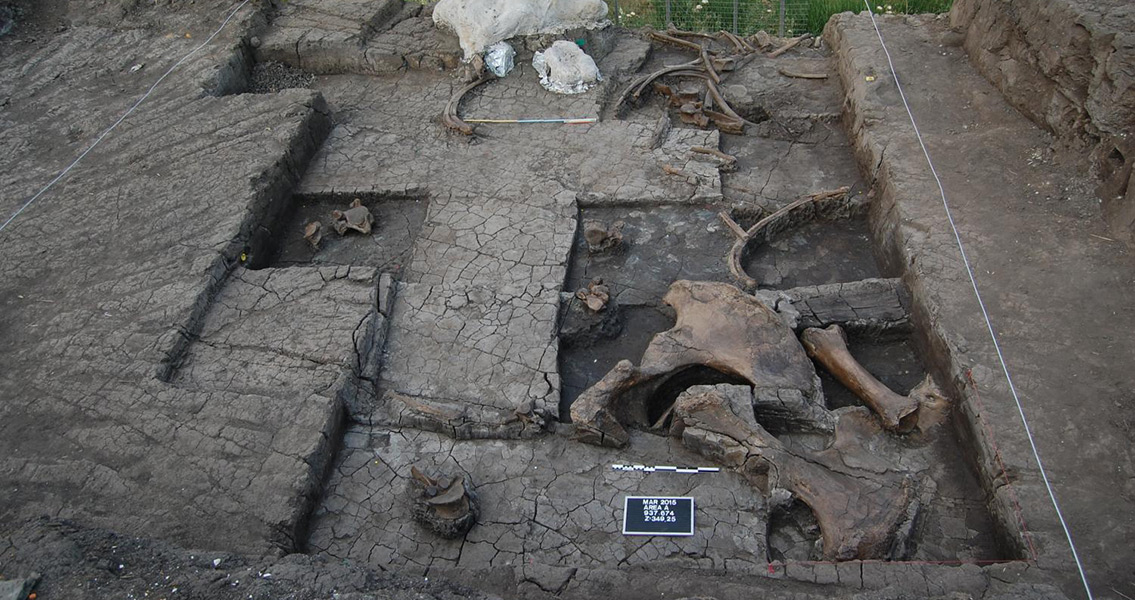
Elephas antiquus, more commonly known as the straight-tusked elephant, a long-extinct species that is thought to be the progenitor of the African elephant. Marathousa 1 was likely to have been a butchering site based on the types of stone artifacts found in close proximity to the remains of the elephant. Additionally, highly distinctive kerf marks were left behind on the bones of the elephant, ostensibly a result of the stone tools as they were used to separate the elephant meat from its bones. So far, early analysis results seem to indicate that the site dates to the Middle Pleistocene, putting it roughly between 300,000 and 600,000 years old. According to Katerina Harvati, a professor with Tübingen University’s Center for Human Evolution and Paleoenvironment, the Greek site is unique due to several of its characteristics. In a press release published by the University, she remarked that the Megalopolis site is the only one in the Balkan region where evidence of an early Paleolithic elephant being butchered had been uncovered. Easily one of the most ancient archaeological sites within the entire country, Marathousa 1 lies within what would have been an epicenter for human migration routes into Europe while also acting as a refuge for human, animal, and plant populations during ice ages. Harvati said that research into the region and its Paleolithic importance has largely gone unnoticed because of Greece’s role in Classical history. Much of the scholarship has revolved around the Hellenistic period and eschewed the Lower Paleolithic as a result. Despite this, the researcher added that Marathousa 1 was and continues to be a high-value site for revealing the secrets behind how humanity dispersed into Europe and how early humans adapted to and behaved within the region as a whole. Professor Havarti, along with her colleagues from both Germany and Greece, hopes to aid in closing the Paleoanthropology research gap that exists in southeastern Europe as a result of this previous focus on the Classical period. Image courtesy of Greek Ministry of Culture ]]>

