
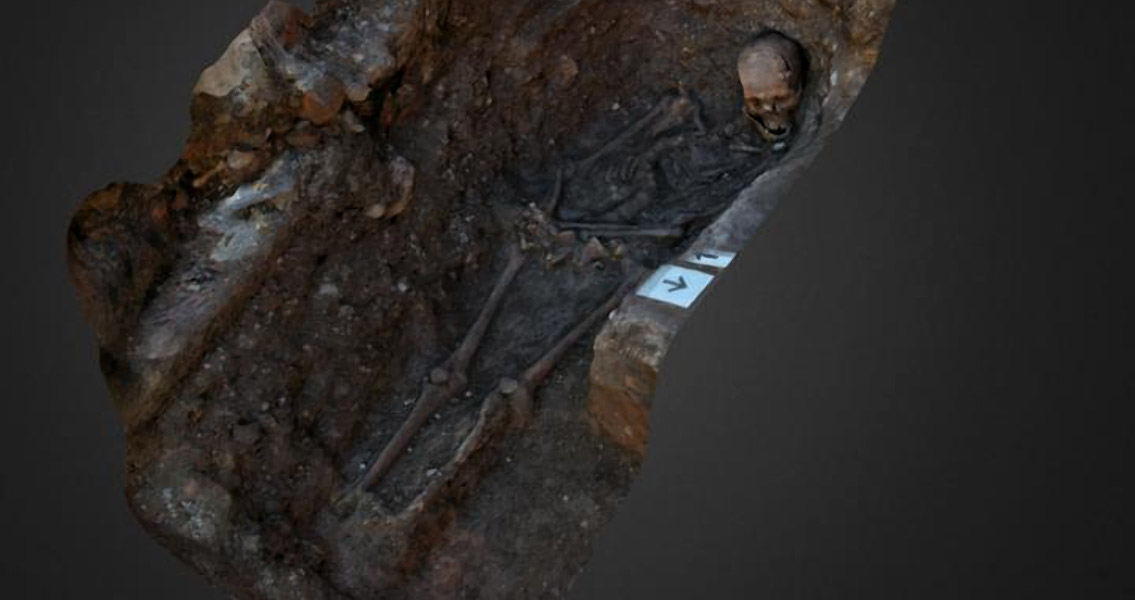
Sketchfab, a 3D sharing platform, the interactive model can be rotated and examined in order to provide an immersive pathway to study the king’s grave – and reveals the perfunctory, less-than-reverent nature in which his remains were interred. In fact, researchers discovered that the grave itself was dug poorly and seemingly in haste, as its sides sloped and its base was uneven. The grave was also too short to accommodate the king’s body properly, resulting in it being laid out slumped to one side with the head propped up – providing evidence that matches contemporary accounts that the monarch was buried unceremoniously. In a university press release, ULAS site supervisor Matthew Morris said that two-dimensional images of the burial, while having a drama all of their own, aren’t as arresting as a three-dimensional model is, especially when it comes to grasping the spatial relationships that are revealed. The first man to lay eyes on the remains of the king since his internment centuries ago added that the new 3D model of the grave affords researchers the ability to continue examining it long after the end of the excavation. Additionally, it allows scientists to examine the grave from angles that would have been impossible during the initial exhumation. The process used to create the digital reconstruction of the grave, known as photogrammetry, has seen widespread use not just in archaeology but in other industries as well, including the entertainment industry. The technique is both cost-effective and swift in building a three-dimensional model out of several two-dimensional images. The grave, along with other 3D imaged archaeological sites explored and documented by ULAS, can be explored on the Sketchfab website Image courtesy of University of Leicester ]]>

reinterment earlier this year. Accounts from the time claim that Richard was slain in the battle before his naked body was taken to Leicester to be buried. Since the discovery, detailed examination of Richard’s body has allowed forensic archaeologists to gain a better understanding of the events leading to his death. It has also helped form a better image of the man himself, dispelling some myths which originated in the aftermath of the battle and were probably a consequence of the victors trying to discredit their former enemy, and challenging the portrayal given in Shakespeare’s play, Richard III. The Wars of the Roses had started thirty years before, at a battle in St. Albans. Richard of York led a force of some 3,000 men against King Henry VI on 22nd May, 1455. A number of factors had contributed to the outbreak of the war: Henry’s descent into insanity, the perceived dangerous influence of his wife Margaret of Anjou, and a growing class of powerful magnates in the countryside who increasingly ignored the authority of the king. A sporadic war waged between the Houses of York and Lancaster which ultimately ended with a Yorkist victory, and Richard of York winning the right to inherit the throne on Henry’s death at the expense of his son Edward. Continued conflict over the rights to the throne meant that the York victory over Henry in 1460 was not decisive, and the Wars of the Roses would continue until the Battle of Bosworth Field. Richard III took the throne amid much controversy in July 1483. He had been named Lord Protector of the realm for his twelve year old nephew Edward V earlier in the year, following the death of this brother Edward IV. Before Edward V could be crowned, the marriage of his parents was declared invalid, making their child ineligible for the throne. As a result, Richard assumed the English crown with backing from the House of Lords, and rumours began to circulate that Edward V and his brother Richard of Shrewsbury had been killed on Richard III’s orders. Henry Tudor spent the weeks before August 22nd creating an army to attack Richard III. The first months of Richard’s reign had seen him alienate both Lancastrians and his fellow Yorkists, leading to a growing clamour for the Lancastrians to depose Richard. Knowing his forces would be heavily outnumbered by the king’s armies, Henry turned to the King of France, Charles VIII, and the powerful South Wales landowner, Rhys ap Thomas, to provide soldiers to bolster his forces. In addition, Henry contacted his stepfather Lord Stanley, who secretly donated finances to fund Henry’s cause. Henry’s forces landed at Milford Haven on August 1st, and began their march towards England, collecting the soldiers offered by Rhys ap Thomas along the way. Richard III underestimated the amount of support he had in Wales, and realising that the Welsh would not attack Henry’s army, set forth with his troops to intercept them. Meeting near Leicester on 22nd August, Henry had an army of only around 5,000, compared to Richard’s force of some 12000 men. Few first hand accounts of the battle remain, but it seems that the course of the fighting was swayed when Lord Stanley sent his troops into the battle in aid of Henry. Richard had not called on the powerful Stanley family to join in the battle and their substantial armies, although close to the fighting, had initially remained uninvolved. What caused Lord Stanley to send his troops in, aiding his stepson and betraying the king, is unclear. It proved decisive however, Richard’s armies were caught be surprise, and the king killed in the ambush. Henry was crowned Henry VII in the aftermath, and his marriage to Elizabeth of York the following year united the Lancastrian and Yorkist claims to the throne – ending the Wars of the Roses and signaling the start of one of England’s most famous dynasties. ]]>