Categories
Editorial

Robin Hood, From Violent Criminal to Movie Hero

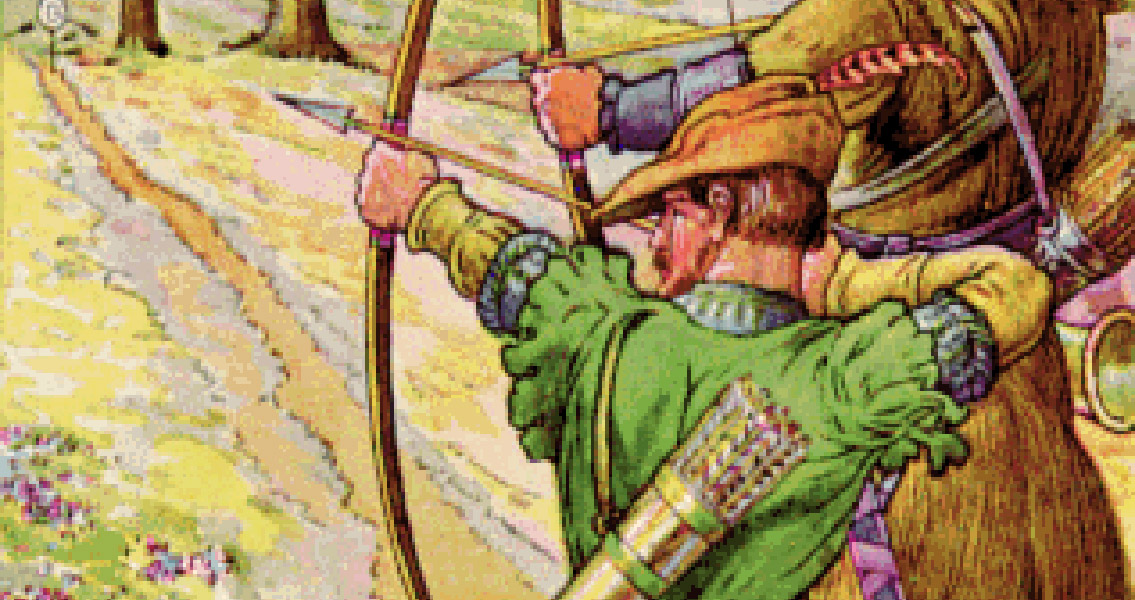
The Vision of Piers Plowman, contains the earliest known mention of Robin Hood, “I kan nought parfitly my Paternoster as the preest it syngeth, But I kan rymes of Robyn Hood and Randolf, Erl of Chestre.” Although the reference in Langland’s poem is vague: it is far from clear whether ‘Robyn Hood’ and ‘Randolf Erl of Chester’ are connected in someway or if the ‘rymes’ are from unconnected traditions, it does at least show that a character by the name of Robin Hood had entered the popular imagination by this point. Going back even earlier, historians have found evidence in thirteenth century English legal records of criminals being labelled with the epithets “Robehod” or “Rabunhod”. Crucially, this highlights that contrary to the heroic, romanticised Robin Hood depicted in recent movies which fall into simple narratives of good versus evil, the name was initially synonymous with violence and crime. The high minded rebel who stole from the rich to give to the poor is a more recent construction. Fourteenth century ballads describe a violent yeoman who lived in Sherwood forest and clashed with the Sheriff of Nottingham. Later, perhaps in the wake of events such as baronial rebellions and the 1381 Peasants’ Revolt, the ballads of Robin Hood started to take on their philanthropic edge. One of the earliest recorded about Robin Hood: The Lyttle Geste of Robyn Hode, concludes with the line that he “did poor men much good”. In a time of growing discontent at the feudal system, it’s likely that stories of a man who challenged the forces of law and order became increasingly appealing. Through the centuries the stories of Robin Hood twisted, changed and evolved to the point it has become almost impossible to determine when the rebellious outlaw was supposed to have carried out his daring acts, let alone if he ever really existed. Sixteenth century historian John Major’s ‘History of Great Britain’ depicts Robin Hood as a follower of King Richard I (1157 – 1199). It describes him as a fallen nobleman who defied Richard’s cousin King John while the rightful king was imprisoned. This is a narrative of Robin Hood’s life that is hugely popular now, however, Major was the first to describe it. Earlier accounts placed Robin Hood in different times and regions, while court rolls from the fourteenth century describe a number of ‘Robin Hoods’ active during the reign of Edward II (1284 – 1327). Whereas some historians suggest that the whole story of Robin Hood could be traced back to one real individual (with a number of candidates as to who this person was and when he lived), others suggest that he was an amalgamation of a number of people. As historian David Baldwin told History Extra last year, although Robin Hood was an invented hero, “There were men like Robin Hood, however, such as fugitives who flouted the harsh forest laws [unpopular laws that retained vast areas of semi-wild landscape over which the king and his court could hunt], and these fugitives were largely admired by the oppressed peasantry.” Beyond its origins, Robin Hood is a folklore tradition that has evolved and expanded with the times, developing in sync with changes in society and reflecting the cultures who tell the story as much as the one from which it originated. ]]>
Categories
Breaking News

Robin Hood’S Village Being Excavated in Nottinghamshire

th July and is expected to be completed by 25th July. Edwinstowe is a typical forest village and understanding its growth and development over time will allow experts to understand how different villages grew with the changing times. This free community excavation project has already made major waves across the world. More than 100 individual volunteers have been celebrating the Festival of British Archaeology over a period of 13 days by trying to uncover one of its best kept secrets. This has helped the project to grab headlines across the world as well. Project members will be posting regular updates about their findings and discoveries on Facebook and Twitter and any Robin Hood fan interested to know more about the project can easily follow them on one of the two social networking channels. ]]>

Categories
News

Who Was Robin Hood’s First True Love?

For ’tis a fine life, and ’tis void of all strife. 
‘So ’tis, sir,’ Clorinda reply’d; 
‘But oh,’ said bold Robin, ‘How sweet would it be, 
If Clorinda would be my bride!’ She blusht at the motion; yet, after a pause 
Said, Yes, sir, and with all my heart; 
‘Then let’s send for a priest,’ said Robin Hood, 
‘And be married before we do part.’ Expert on the Robin Hood Folklore and Robin Hood enthusiast, Ralph Needham, says that the ballad must have been written long after the tale of Robin Hood became popular. To hear of anther love interest before Marian might imply that another story had taken place prior to the more popular version or as others might like to believe, there were additions to the legend long after it became such a popular tale. Nonetheless, Marian will always remain an important part of the story. The love between Robin Hood and Maid Marian is embedded among the larger picture, making it more intriguing. The ballad, the legend, the folktale, all ends with only one true love for Robin Hood, and that is what readers have always kept in their hearts; the love between himself and Maid Marian.]]>

Categories
Editorial

It’s Good to Be Bad: Shining the Spotlight on the Villain

And, really, if we take a quick look at some of the famous and infamous villains, such as Dr. Hannibal Lecter, Hans Gruber, Col. Hans Landa or The Joker, the films in which they appeared wouldn’t have had such an impact without them, or they would be something entirely different. And most actors relish playing those roles, as they can get away with a lot more, as opposed to when they are playing the hero. We always root for the heroes, but they are often one-dimensional characters, limited by the requirements of the script and the expectations of the audience, as they have to be the epitome of all that is good and righteous. Ok, maybe every now and then, there comes a hero that is a bit more complex and dark, with his own demons, but still, he has to obey some rules. A villain doesn’t have to do any of that. He’s not constrained by morals, ethics, and while we may not love them, we certainly love to hate them. If a villain is smart, powerful, ruthless, cunning and often charismatic, we feel that much more satisfied when the hero triumphs. But this is not only true of films. Examples of this can also be found in literature, mythology and folklore of all cultures, and while the line between these three is often blurred, and they share some of the stories and characters, the rules are almost the same. As this subject is really broad, this time we’re going to focus on one well-known Hero vs. Villain rivalry, the one between Robin Hood and the Sheriff of Nottingham. Without question, the Sheriff of Nottingham is Robin Hood’s principal nemesis. There have been many incarnations of both Robin and the Sheriff in films, literature, folklore and each of them brought something new, establishing a distance from the original story in terms of accuracy. It is almost impossible to determine the real facts, or even if Robin or Sheriff were historical figures, but, that’s not our concern at this time. We’re going to focus on what’s common to all the interpretations, the antagonism between the two of them. A good source, if you’re interested in a more in-depth study, is “Robin Hood: A Collection of All the Ancient Poems, Songs, and Ballads, Now Extant, Relative to That Celebrated English Outlaw; To Which Are Prefixed Historical Anecdotes of His Life” by Joseph Ritson (PIBN: 1000597106). We practically know all there is to know about Robin Hood, but the same cannot be said about the Sheriff of Nottingham. The Sheriff himself was appointed by the King, as a legal authority, but that certainly didn’t make him the moral authority, as he and his henchmen were rotten and corrupt, introducing unfair taxes and robbing the people they supposed to protect, executing everyone who stood in their path. He is most commonly portrayed as intelligent, ruthless, greedy figure, who will do anything to stop Robin Hood, the only one brave enough to stand up to him. While we are more familiar with Robin, as he is the hero of this story, and more attention has been given to him and the people around him, such as the Merry Men, or Maid Marian, some space has been left for the Sheriff of Nottingham to counterbalance the good deeds done by Robin, thus making the story more suspenseful and making the hero more likable by setting him up against a truly heinous villain. And although the Sheriff doesn’t have the support of the people, or his associates, which might assist him sometimes, but at the same time have their own agenda, he still has considerable means at his disposal which he uses to battle Robin, including his blackmail, bribe, money or worse. Even though he is evil, he isn’t just a mere psychopath, spewing venom, but a more shrewd, calculated figure, driven by ambition and greed, using his intellect in addition to violence to remove the opponents who stand in his way. In that aspect, he serves as a perfect foil for Robin Hood, displaying character traits of equal intensity, but on the opposite end of the scale. Also, some of the tactics employed by Robin and his men, such as theft, are justified as they present the only way of fighting the villainous authority figure. And that is the key fact that explains our perception of a hero: as someone who is defined by his great deeds, and not necessarily someone who is morally incorruptible. That, in turn, defines the role of a villain, as well, who isn’t burdened by similar requirements. The villain’s job is to provide the archenemy and moral nemesis for our hero. That’s what makes a villain. However, being a great villain is something a lot more complex, as the author needs to infuse the character with a human element, motivation and the reasons for his wrongdoings, making him into something more than a cardboard cutout. As a consequence of that, the story sets itself apart from the bunch, ultimately becoming something more: a legend.]]>