Categories
News

Taming the Tomato: The Strange Case of the Edible Wolf Peach

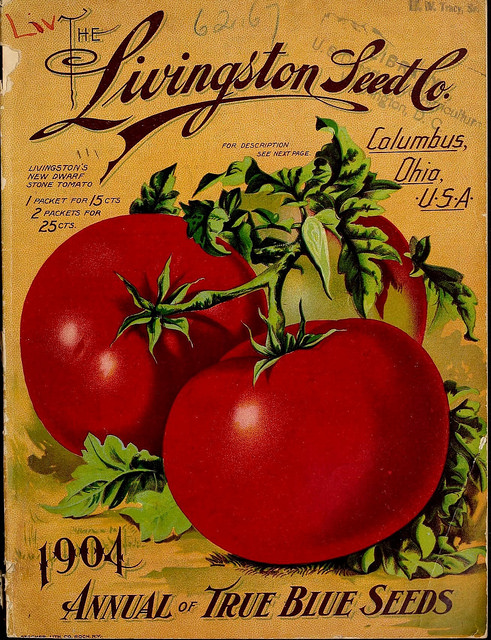
Introduction: Today tomatoes are a staple food that we hardly stop to think about (except for heirloom tomato aficionados trying to find the fruit with the perfect flavor.) But only a few hundred years ago the attitude toward tomatoes in northern Europe, and among northern European settlers in North America, was quite different. They saw tomatoes as exotic ornamentals, or deadly poisons, or aphrodisiacs, or possibly aids in black magic. This ambivalence is still reflected in the tomato’s scientific name, Lycopersicon esculentum, which translates to “edible wolf peach.” That name was settled on in 1768. Fifteen years earlier Carl Linnaeus, the first botanist to place the tomato in the Latin system of classification, wasn’t so willing to vouch for its edibility; he called it Solanum lycopersicum, “wolf peach of the nightshade family.” Given the known toxicity of many nightshades, this was hardly reassuring. So how did the tomato get such a bad rap, and how did that change? There are several conflicting stories about that. Here’s some of what historians know and guess:

First Impressions

Tomatoes were first domesticated by Aztecs in the Andes who began selectively breeding the small-fruited wild tomato for heavier production of larger fruits. We don’t know exactly when this process began, but when Spanish explorers first brought tomatoes back to Europe in the early 1500s the plants had been long domesticated and substantially altered by the process. The English word ‘tomato’ comes from the Nahuatl (Aztec) word ‘xitomatl.’ But that wasn’t the first name by which the new fruit was known back in Europe. In French the tomato was called the pomme d’amour, ‘apple of love.’ There are several theories about that name. Some say that the tomato was confused with its botanical relative the mandrake, which is described as an aphrodisiac as far back as the Bible. Others say that it may have been a corruption of one of the tomato’s other early written names: the Italian pomo d’oro, ‘golden apple,’ which may suggest that the first imported tomatoes were yellow, or the Spanish pome dei Moro, Moorish apple (which may also be the source of the Italian name.) In Mediterranean areas the tomato was soon accepted as a food source. But in northern Europe there was much more skepticism.

Strong Poison

In England and Germany tomatoes were initially regarded as ornamental but dangerously poisonous. Some people said that their bright red color clearly signaled poisons lurking within. Some were understandably wary since the tomato was closely related to deadly nightshade as well as mandrake (which may or may not have actually had aphrodisiac effects, but was certainly poisonous taken in any significant quantity), and since tomato leaves and stems really were poisonous. Apparently some aristocrats’ experiments with eating tomato fruit did end badly, earning tomatoes the nickname ‘poison apple,” although K. Annabelle Smith at the Smithsonian notes in her article “Why the Tomato Was Feared in Europe for More Than 200 Years”  that the fruit wasn’t to blame in itself; pewter dishes were fashionable, the lead in pewter was highly toxic, the strong acids in tomatoes leached lead from the plates, and it was easier to blame the exotic new fruit than to consider the possible dangers of familiar dishes. New life was given to the poison scare in the northern United States by the appearance of tomato hornworms, large green caterpillars with prominent horns on their rear ends. An agricultural journal noted in the 1860s that thirty or forty years earlier the hornworms had been considered poisonous in themselves, and that it had been thought that any fruit they might crawl over would become deadly as well, though the editor saw all such stories as antiquated follies.

The Sorcerer’s Tomato

The tomato may also have suffered from scholarly attempts to identify plants discovered in the New World with plants mentioned by ancient authors. Linnaeus, casting around for a Latin name for the tomato, identified it with one of the mystery plants described by the ancient Roman physician Galen. Galen’s lycopersion (the first part of the name is clearly “wolf,” the second rather mysterious, but mis-transliterated in Linnaeus’ time as persicum, ‘peach’) had strong-scented yellow juice and ribbed stalks. Romie Stott’s Atlas Obscura article “When Tomatoes Were Blamed For Witches and Werewolves” suggests that Galen identified tomatoes with wolf peaches because of superstitions concerning witchcraft. For centuries before Linnaeus’ day belief in, and fear of, witchcraft had been widespread. Witch hunters had looked, among other things, for a mysterious ointment said to give witches the power of flight—and also the power of transforming themselves, or other people, into werewolves. Several of the toxic and hallucinogenic nightshades were listed as likely ingredients in this ointment, and the tomato, as usual, shared in the disgrace of its relatives.

Not Done

Some people, especially in England, seem to have objected to tomatoes merely because they came from foreign parts and were unfamiliar. English surgeon and naturalist John Gerard called them ‘rank and stinking,” perhaps objecting to the pungent odor of the foliage. King James I’s personal physician noted that they might be useful for cooling hot stomachs in the New World, or even Italy and Spain, but England was already cold enough.

Rehabilitation

Despite all these warnings, people continued to try eating tomatoes—and those who tried and didn’t get sick generally recommended the experience to others. Thomas Jefferson, politician, president and gardener, raised and ate tomatoes in the 1700s when many still considered them poisonous. In 1820 a New Jersey colonel by the name of Robert Johnson tried to win over skeptics by publicly eating a raw tomato on the steps of the courthouse and then standing there long enough for people to satisfy themselves that he was not going to suddenly drop dead. By the 1850s tomatoes had become widely popular in the United States, and in the 1890s Joseph Campbell found that tomatoes canned well and began marketing condensed tomato soup. In Europe acceptance of the tomato became much more widespread after the invention of pizza in the 1880s. Scientists didn’t change the wolf peach’s name, but the general public no longer feared eating it. An overview of the history of the tomato can be found here. For more about the presumed link between tomatoes and werewolves, read this.]]>

Categories
News

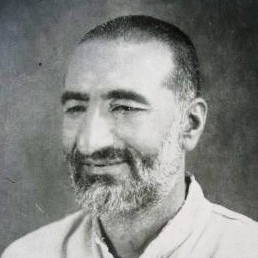
Bacha Khan, Nonviolent Warrior

“I am going to give you such a weapon that the police and the army will not be able to stand against it. It is the weapon of the Prophet, but you are not aware of it. That weapon is forgiveness and righteousness. No power on earth can stand against it.”   Those are the words of Abdul Ghaffar Khan, better known today as Bacha Khan (“the king of chiefs”), speaking to thousands of volunteers, mostly his fellow Pashtun Muslims, who had joined his nonviolent army to work for better conditions in their local communities and also to free India from British rule.   Learning and Teaching   Bacha Khan, born in 1890, was the fourth child of a well-off landowning family in the Peshawar valley, in what is now Pakistan but was then British-occupied India.  His family were Muslims and members of the Pashtun tribe.  Bacha Khan studied at a British school where he admired his teachers’ commitment to learning and to serving their people. He was invited to join the Corps of Guides, a special Pashtun unit of the British Army. The British described the Pashtuns as particularly warlike, an attribute which they found useful as often as ominous. But this did not necessarily lead to respect, as Bacha Khan discovered when he went to visit a family friend who had enlisted in the Guides. A newly arrived British officer began mocking the friend’s Western-style haircut, saying, “Well, damn Khan Sahib, you too aspire to be an English man.”  The friend prudently held his tongue.  Bacha Khan was pained to realize that even the apparently elite Guides were still treated as second-class citizens in their own country.   Bacha Khan decided to pursue education instead of military service. He had the opportunity to study in England, but his mother urged him to remain at home. He obeyed her. In 1910, when he was twenty, Bacha Khan opened a mosque school in his hometown which taught students in both secular and religious studies.  In the following year he began to work with Haji Fazal Wahid, a freedom fighter turned educator who was opening similar schools in other underserved areas.  The British became suspicious of their activities; in 1915 they accused Wahid of  ‘trying to run a parallel government’ and ordered his arrest.  Wahid fled the country.  Bacha Khan remained free, but the school he had started was closed down. He spent the next three years traveling throughout his province and urging towns and villages to open schools, organize, and educate themselves.   Protest, Prison, and Self-Exile   In 1919 the British colonial government passed the Rowlatt Acts, which allowed Indian political prisoners to be jailed without trial.  Work stoppages broke out across India.  Bacha Khan helped to organize these in his region, and he convened a protest meeting attended by more than fifty thousand people.  He was arrested on charges of sedition and kept in jail for six months.   Bacha Khan regained his freedom just as the Khilafat (caliphate) movement was heating up.  Many Indian Muslims regarded the Sultan of Turkey as the Caliph or spiritual leader of Islam, and they were outraged by how Britain and its allies treated the Sultan and broke up the Ottoman Empire at the end of the First World War.  About sixty thousand of them decided to leave British India for Afghanistan, whose Muslim ruler they held to be both faithful and sympathetic.  Bacha Khan went with them.  But Afghanistan found it difficult to absorb such a large group, many of whose members wanted the Afghans to wage a war of liberation against the British in India. Most returned to India; Bacha Khan, again, was among them. Local Reform   Bacha Khan, on returning to his country, also returned to his vision of empowerment through education and community organizing.  In 1921 he was involved in the founding of Anjuman-i-Islah-ul-Afaghana, a society focused on promoting unity among Pashtuns across national borders and lines of family and class through love of religion, cultivation of the arts, public service, and abstention from feuding, alcohol-drinking and overspending. Anjuman started free schools teaching a combination of Islamic studies, secular academic learning, and artisanal skills. There was no charge for the pupils, and no pay for many of the teachers. Bacha Khan took satisfaction in this work but didn’t lose sight of the harm done by colonialism.  He spoke publicly against British imperialism and was arrested again. This time he spent three years in prison, often in solitary confinement. On his release in 1924 he was praised as a hero, and many people joined Anjuman for his sake.   The Servants of God   In 1928 Khan met another peaceful organizer and protester named Mohandas Gandhi.  The two men presented an odd contrast in appearances—Gandhi was small and soft-spoken, Bacha Khan tall and loud—but they seem to have found each other kindred spirits. They spent hours in amiable arguments and eager discussions of faith and politics. The following year, Bacha Khan founded a peaceful army in his own province called the Khudai Khidmatgar, the Servants of God. The organization was open to all, regardless of creed or caste. Most members were too poor to afford uniforms; they colored whatever clothing they had with cheap chocolate-brown dye instead.  The British authorities referred to them as “the Red Shirts,” and some said that they were Bolshevists.  The Khudai Khidmatgar said otherwise. Members pledged: “Since God needs no service… I promise to serve humanity in the name of God. I promise to refrain from violence and from taking revenge. I promise to forgive those who oppress me or treat me with cruelty. I promise to devote at least two hours a day to social work.” “Social work” included teaching, outreach to neighbors in need, and participation in the rising wave of nonviolent protest against British rule.   The colonial authorities struggled to respond effectively to nonviolent protests across India. Some were particularly perturbed by this behavior on the part of the Pashtuns, whom they saw as archetypal warriors. Bacha Khan stressed that peacefulness and forgiveness, in addition to being core Islamic values, were especially important for a people with a warlike culture that too easily slipped into feuding and factionalism, or into violent struggles for freedom which could not succeed against a better-armed foe and were bound to provoke savage reprisals.   The response to peaceable protests was devastating enough. In 1930 Bacha Khan and many of the Khudai Khidmatgar joined protests linked to the Salt March. When Bacha Khan was arrested a crowd of demonstrators thronged the streets, calling for his release.  The British Army opened fire on the unarmed protestors, who neither dispersed not fought back. Some soldiers refused to shoot at peaceable people—and were afterward court-martialed and sentenced to life in prison.  Some obeyed orders. Between two hundred and two hundred fifty demonstrators were killed.  Soon after that martial law was declared throughout the province, the Khudai Khidmatgar was banned, and many of its members were publicly beaten and humiliated.  There was no violent resistance, there were no revenge attacks and there was very little defection—and many people impressed by that display of courage and self-restraint joined the Khudai Khidmatgar, which remained active throughout the struggle for independence.   A Tangled Legacy   Bacha Khan had cause to rejoice when the British finally withdrew from India in 1947, but he was deeply opposed to the partition of India and Pakistan. His first hope was for a united, multi-faith India; his second, for a separate Pashtun homeland separate from both Pakistan and India. Neither wish was granted, and he was vilified by some of his fellow Muslims as a Hindu-appeaser.  In Pakistan he formed an opposition party and was soon thrown into prison again. In Pakistan, as in British India before, he alternated between imprisonment and outside advocacy for freedom and for social justice.  In the end he spent more than half his life in prison. He was nominated for the Nobel Peace Prize, named Prisoner of the Year by Amnesty International, and granted India’s highest civilian award. His own country’s leaders were somewhat less admiring. Bacha Khan died in 1988 under house arrest at the age of ninety-eight.  His funeral was attended by tens of thousands of mourners from Pakistan, India, Afghanistan, and more remote parts of the world. At his own request he was buried in Afghanistan as a last sign of unity across borders.  Pakistani diplomat M. S. Korejo described the huge funeral procession which accompanied him across the border as “’a caravan of peace, carrying a message of love.”     To learn more about Bacha Khan, read Nonviolent Soldier of Islam: Badshah Khan, A Man To Match His Mountains, by Eknath Easwaran, or visit http://www.baachakhantrust.org/AbdulGhaffarKhan.pdf]]>

Categories
News

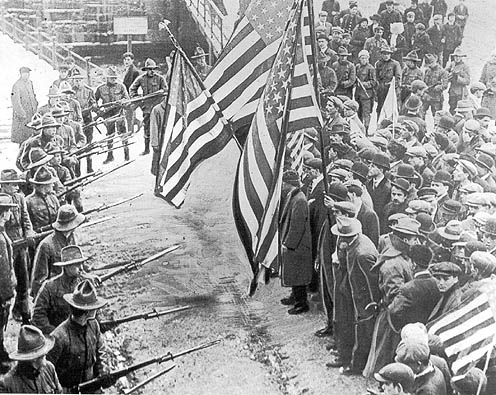
Protests, Immigration and "Fake News" A Century Ago: The Strike for Three Loaves

Run of the Mill: Life Before the Strike   In 1911 Lawrence’s textile mills produced almost 25% of the nation’s woolen cloth. The weaving and spinning machines were loud and dangerous; many workers were injured or killed when their hair or clothing caught on moving parts.  The air was wet and full of fine particles; many workers died of pneumonia and tuberculosis. Most of those workers were fairly recent immigrants from countries including Poland, Italy, Lithuania, Russia, Germany and Syria.  Many were young. Children were officially allowed to work full-time after they turned fourteen.  Eleven- and twelve-year-olds in many poor families got false papers declaring them old enough to work. More than one-third of mill hands died before turning 25. Short Pay! All Out! In 1911 the state of Massachusetts passed legislation cutting the workweek from 56 to 54 hours. Mill owners protested and said they would have to cut pay proportionately. The average weekly wage for a mill hand was $8.76; many made less than $7.  The state’s labor commission called it impossible for a person to live on less than $8.28 a week.  Many lived on less by crowding into small apartments, living on bread and molasses and beans, and wearing clothes until they fell apart. But for these struggling workers the loss of 32 cents a week—the price of three loaves of bread—could make the difference between barely getting by and not getting by at all.   On January 11, 1912.  When Polish women working at one of the mills discovered that their paychecks had indeed been reduced by 32 cents, they cried: “Short pay! All out!” and marched out of the mill. Others joined them. Some broke windows and smashed machinery as they went.  The strike spread from mill to mill until 25,000 workers were out in the streets, singing, chanting, and clashing with strikebreakers as well as police. There were no deaths, but there was a great deal of chaos.   A few of the strikers belonged to the Industrial Workers of the World (IWW or Wobblies), a radical union which accepted members from all classes and ethnicities. They sent an appeal to IWW leaders, asking for help organizing their strike.  Joseph Ettor and Arturo Giovanitti helped each ethnic group set up a national committee to dispense information and encouragement in their own language. They also urged strikers to be nonviolent, to focus on winning public sympathy.   Lawrence’s newly elected mayor called for the Massachusetts militia. Soon armed guards surrounded the mills. Many protestors were arrested and sentenced to one-year prison sentences for rioting.  The sentencing judge explained that “These men, mostly foreigners perhaps… do not realize the gravity of their offense and do not know the laws. Therefore the only way we can teach them is to deal out the severest sentences in this court.”   What they learned is an open question.  Violence lessened as the strike grew better organized, but the massive protests continued. When people were arrested for standing still and blocking the sidewalk, strikers shifted to constantly moving parades that still formed an effective blockage.   Reign of Terror?   On January 20 dynamite was discovered in a tenement district.  Many strikers were arrested, and conservative papers warned of a ‘reign of terror’ spread by foreign agitators.  Other rumors suggested that allies of the mill owners had planted the dynamite, and liberal papers kept running stories sympathetic to the strikers. Donations poured in from outside the city, funding soup kitchens for strikers’ families. On January 27 all those arrested as suspects in the dynamite plot were released, and the police arrested the prominent businessman who had tipped them off about the dynamite; new evidence showed he had planted it himself. That same day, men went door to door falsely proclaiming that the mill owners had met strikers’ demands and it was time to return to work. Furious strike organizers made speeches that didn’t encourage peace. Two days later violent struggles broke out in several places. In one of these Annie LoPizzo, a bystander, was fatally shot—nobody knew by whom.   The militia forbade further parades and public meetings. Many strikers met and paraded on the 28th anyway.  As militia dispersed one of these parades, an eighteen-year-old Syrian striker named John Rami was fatally stabbed.  That same night Ettor and Giovanitti were arrested for inciting the violence that led to Annie LoPizzo’s death.   Children’s Exodus   As tensions rose and hunger spread in early February, many strikers sent their children away to other cities where they might be kept safe and fed by relatives or by sympathetic strangers who had volunteered to help. The children were met by cheering crowds; some articles described that as a heartwarming scene, while others warned that parents were shirking their responsibility for their children.  But as positive news stories and cheerful letters came back from the cities, the strikers planned to send more children away.   Police and militia leaders forbade children from leaving unattended. One small group of parents and children were met at the station and turned back by officials who promised that the children’s needs could be met right in the city; they took one sick child to a local hospital for treatment. Another large exodus—200 children– was planned for February 26.  The police warned strikers to stay home. Forty-six children and their parents showed up at the train station, met a line of armed policemen, and tried to push through onto the trains. They were beaten back by the police.   The next day the streets of Lawrence were full of furious protestors, and newspapers carried vivid descriptions of children and pregnant women being clubbed and knocked down.  Amidst the general outrage President Taft and the U.S. Senate ordered an investigation in the beginning of March. Victory In the first days of testimony before Congress strikers, organizers, city officials and mill owners contradicted each other and sometimes shouted each other down.  Then the strike organizers brought some of the youngest workers and strikers forward to testify.  Children from eleven to fifteen years old matter-of-factly described their living and working conditions and the injuries they had received from the mill machines. When Congressmen asked them about study or recreation they looked blank or said they had no time for such things. Child labor was not a new problem in the US, but it had seldom received so much attention.   Reports on the children’s’ testimony, combined with the accounts of reporters from across the country who poured into Lawrence to see what strikers’ children were being sent away from, swung public opinion in favor of the strikers.  The mill owners called for negotiations, and on March 13, nine weeks into the strike, they came to terms, promising to raise wages by 15%, increase overtime pay, and rehire all strikers. Once again the streets filled with singing and flag-waving workers, but this time they were celebrating not protesting, and the police let them pass.   A Mixed Legacy   Many other strikes had broken out along the East Coast, and most were settled to the strikers’ advantage.  The IWW organizers were acquitted of LoPizzo’s death, and John Breen was convicted of planting dynamite to incriminate strikers. The children of Lawrence got their first municipal playground. In the following year further laws were passed to protect child laborers.   But in April the mills quietly fired workers associated with the IWW; while a few others walked out in solidarity, the mills kept running. The Wobblies were blacklisted. The Lawrence City Council put out pamphlets describing pre-strike Lawrence as a model city, strikers as ‘mobs’ of ‘swarthy men’ terrorizing honest citizens, and reporters sympathetic to the strike as “shoals of theorizing socialists” and “absinthe drinking frequenters of the imitation cabarets of New York.” After a strike-memorial parade included a banner reading “No God, No Master,” Lawrence’s Mayor launched a “God and Country” campaign calling loyal Christian Americans to unite against Socialism.  Wobblies were barred from their inaugural parade; a man who showed up with an IWW pin was beaten and later died of his injuries.   The God and Country Parade continued for decades, and the Strike for Three Loaves was generally remembered as a time of fear. It was not until the 1970s that historians began to revisit the strike and find something there to celebrate again.  By the centennial in 1912 the strike—now known as the Bread and Roses strike, after a possibly apocryphal account of a striker’s banner reading “We want bread and roses too”—was once again seen as something to celebrate.   Read more about the Bread and Roses Strike in Bruce Watson’s book “Bread & Roses: Mills, Migrants, and the Struggle for the American Dream” or here.]]>

Categories
News

The Battle of Changping- The decisive battle of the Warring States

The battle in numbers The powerful army of the State of Zhao had 450,000 soldiers under the command of Lian Po and later Zhao Kuo. At the end of the battle when the survivors of this army had surrendered the youngest 240 soldiers were released, the remainder were executed, buried alive in pits that even today occasionally bone or bone fragments are unearthed. The State of Qin was led by Wang He and he was replaced by the legendary military leader Bai Qi. This change led to the final battle where the tactics of Bai Qi outmanoeuvred those of the Zhao leader. In all over 650,000 soldiers were killed or seriously wounded during the conflict making it one of the most lethal battles in military history.  

Before we look at the battle, we should look at the military equipment and tactics used at that time.

The military chariot was still in use in Chinese warfare long after it had ceased to be used in the Middle East. The chariots use was however in decline during the Warring States Period.   Massed infantry were beginning to excel largely due to the massed use of the crossbow. The increase in use of an infantry force meant the peasantry could easily be drafted and relied less on the nobility to control the chariots. Further back in ancient Chinese history at the Battle of Muye in 1046BC, the victorious Zhou army had 45,000 soldiers and 300 chariots. By the time of the Warring States the military strength of each state had grown considerably. The Qin had an army of over 1 million infantry, 1,000 chariots and 10,000 cavalry on horses. Another factor in the increased size of each army was the increase in casualties with 340,000 killed at the battles of Maling and Yique. The Qin general Bai Qi was reported to have been responsible for close to 900,000 enemy being killed during his military career. At that time records may have been inaccurate and soldiers were paid on the number of enemy they killed so enemy deaths may have been exaggerated. None the less the Warring States was a period of excessive bloodshed. This was largely due to the use of mass infantry units where fighting became more intense and at close quarters. As the aristocracy became less involved on the battlefield their leaders became more despotic as Chinese nobles became part of the literate class and not the warrior class. The chief weapons used were the crossbow, which was mass-produced with training easily accomplished. It was a powerful, accurate long range weapon at the time. The infantry were equipped with several weapons although the dagger-axe was the most popular. They were on a pole of 9 to 18 feet and consisted of a spear with a slashing blade.

Back to the Battle of Changping- the beginning of the conflict

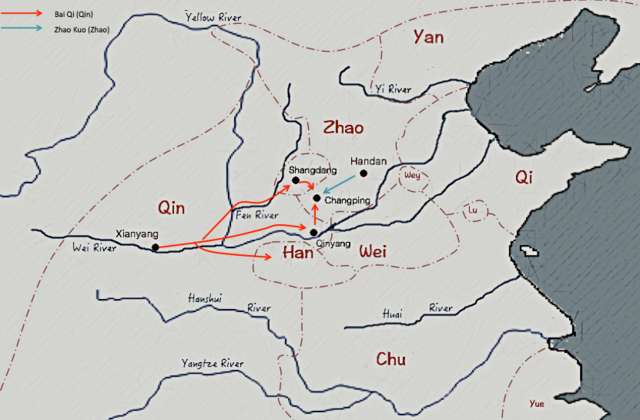
In 265BC, the state of Han was invaded by the Qin. The intention was to take the province of Shangdang. The Qin army quickly passed through the territory with main roads and fortresses all falling within the next four years. Shangdang was cut off from the Han territory and due to fall into Qin hands. In a remarkable act the Han then gave their neighbours, the Zhao kingdom the prize of Shangdang. At that time, Shangdang was of great importance strategically to the Zhao, if it fell into Qin hands then the Zhao heartland would be liable to attack. King Xiaocheng accepted the offer of Shangdang and sent an army under the leadership of Lian Po to quell the threat posed. They met at Changping with Wang He leading the Qin army. Lian Po had already suffered several minor defeats to the Qin during his military career and decided to wait and hope the Qin would eventually go. He had several fortresses built and waited, this turned into a stalemate lasting three years. The Qin did attack one time, even breaching the walls of the Zhao defenders. The attack though did not have sufficient numbers to bring defeat, so the stalemate continued.

A change in strategy

The Qin sent some of their spies into Zhao and Han territory spreading the message that Lian Po was too old and a coward not wanting to fight. The Zhao king removed Lian Po and replaced him with Zhao Kuo, the son of a famous general, Zhao She. Before he died, Zhao She had said that his son should never command an army, Zhao She’s wife had approached the king asking that her son not be given the appointment, the king refused and Zhao Kuo was sent to Changping. In the meantime the Qin had replaced their own general with Bai Qi, a renowned fighter and tactician. Zhao Kuo’s command of the Zhao army began in July 260 BC. He had an army of around 400,000 and he ordered them to invade the Qin camp. During the attack the Qin operated a manoeuvre that looked like a retreat that actually became an ambush. The forward lines of the Zhao army advanced as far as the Qin fortress. The Qin in ambush positions cut off the rearguard of the Zhao forces while simultaneously surrounding the fortress belonging to the Zhao. The Zhao army found itself split into two and all its supply lines were cut off. Bai Qi, the commander of the Qin forces ordered constant counter attacks against the Zhao. The Zhao were positioned on a hillside where they hastily made fortifications and hoped for reinforcements to arrive.

Zhao Foreign Policy

For decades, opportunism had been the focus or drive of the Zhao foreign policy. They had ever shifting alliances with their surrounding states in an effort to stop the expansionism of the Qin state. Since 295 BC they had even had alliances with the Qin themselves when the opportunity suited their needs. On this occasion the states of Chu and Qi would not come to the aid of the Zhao. Meanwhile, the Qin king, Zhaoxiang sent messages to the Henei region in today’s Henan province ordering all males over 15 years of age to assemble south of Changping and block any Zhao supplies and reinforcements. After being besieged on the hillside for 46 days, the Zhao encampment, driven by hunger and despair, made several desperate attempts to escape. They were unable to break out of the stranglehold the Qin had erected. Zhao Kuo, led his finest troops in a last desperate attempt and was cut down by the massed ranks of crossbowmen.  

Surrender and Execution

The remainder of the Zhao army surrendered but fearing a revolt and opposition from the people of Shangdang towards the Qin, Bai Qi ordered the execution of the prisoners. He spared 240 of the youngest soldiers sending them back to their homes to spread the fear about the Qin army. The Battle of Changping is regarded as one of the bloodiest battles in world history with around 650,000 casualties, 450,000 being on the side of the losing Zhao state. Those soldiers executed were mostly buried alive in pits and centuries later Emperor Xuanzong of Tang erected a temple on the execution site which became known as the Temple of Bones.

Aftermath of the battle

Both states of Qin and Zhao were financially crippled and exhausted of domestic supplies after more than three years of fighting. The Qin state was able to quickly recover, however the Zhao state was not able to. In the years leading up to the Battle of Changping, the state of Zhao was one of the stronger participants in the Warring States Period. The Zhao never fully recovered from this defeat and they were conquered by the state of Qin around thirty years later. This gave the state of Qin military superiority over the surrounding states. Further battles took place against the state of Chu before the dominance of the state of Qin led to the unification of China in 221 BC.]]>
Categories
News

Mass-anxiety in Strasbourg: what was the dancing plague of 1518?

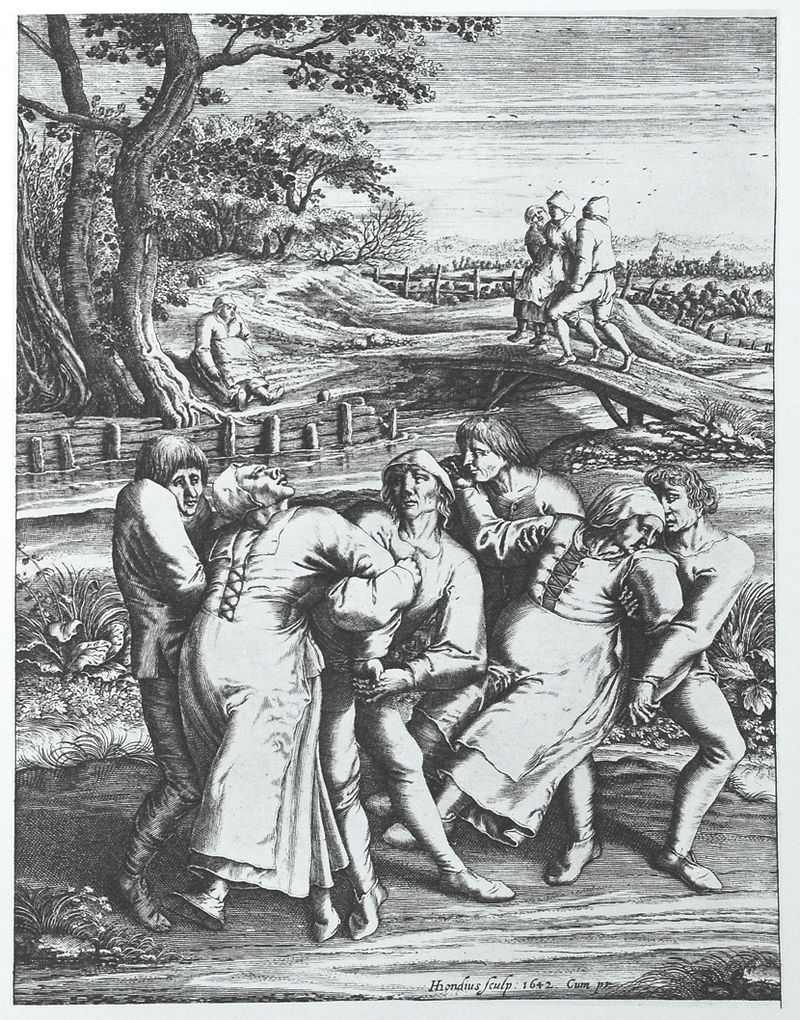
th July 1518, a townswoman named Frau Troffea began to dance in the streets of Strasbourg. For hours she swayed, gathering a small crowd of bemused onlookers. Eventually, she collapsed from exhaustion. When she came to, she recommenced her jig; this time with frenzied abandon, dancing until her feet were bruised and bloody. Rumours flew about the town. Supernatural in their beliefs, the people soon decided that she had succumbed to a dancing curse bequeathed by St. Vitus. To calm divine rage, they carted her off to a shrine in the Vosges Mountains. But Frau Troffea was not alone in this curse. As the days turned into weeks, between 200 and 400 people fell victim to St. Vitus’ Dance. An outbreak of frantic delirium had the city of Strasbourg in its grip. What caused it? What cured it? And what relevance does it have today? As the dancing plague, or choreomania, was a psychological affliction, we must first understand the psychology of the townsfolk. Like much of medieval Europe, Strasbourg was steeped in supernaturalism. Their Christianity functioned on a foundation of saint-worship, and the clergy was responsible for the immortal path of every individual. The local reputation of the Strasbourg clergy had been declining for decades. Repeated accounts of moral indiscretions (the usual: sex, alcohol and excess) were further substantiated when, during times of famine, the Church was unwilling to provide aid to starving townsfolk. In private, ale-fuelled discussions questioned the opulence of the Church, and bitterly remarked on the contrast with Christ, for all his sublime poverty. Famines continued during the years leading up to 1518. The chilling uncertainty of a world in which disease could suddenly sweep away family and friends left people with a constant, bubbling anguish. With death constantly looming, it was essential for one’s soul to be in the hands of a responsible clergy. For the superstitious and anxious residents of Strasbourg, the afterlife was an increasingly alarming concept.   The cult of St. Vitus Psychologically, there’s an argument to say that the victims were expecting demons to commandeer their souls. Legends of dancing plagues, culturally connected to St. Vitus, had passed down generations. Day to day, insults like “God give you St. Vitus” were thrown about, weaving the cult of St. Vitus into common parlance. Perpetuating their worry, the people of Strasbourg believed their own baptisms to be phony, as their priests associated with prostitutes. This pessimism mixed with mysticism to make the people paranoid of the touch of a raging St. Vitus. [caption id="attachment_8660" align="aligncenter" width="640"] Modern Strasbourg. Photo by R Roletschek.[/caption] Finding a cure The city’s council was tasked with finding a cure for the curse. Frau Troffea may have been taken off into the mountains, but the remaining afflicted were subject to panicked ideas of treatment. At first, it was thought that the plague came from ‘hot blood,’ and as such, only continued dancing could sweat it out. The council erected a stage, hired musicians and dancers and made sure that the afflicted continued to dance at a fast pace. Matters worsened. Many of those hired fell subject to the curse, as did petrified onlookers. Within a few days, the council’s theory of forcing the dance to extinguish ‘hot blood’ had been discredited. For the dancers, medical attentions were irrelevant. They needed the mercy of St. Vitus and support from a neglectful Church. Luckily, the flattering attentions of priests were about to be bestowed upon them. They were given sacred red shoes and started a pilgrimage to Saverne. It involved a gruelling climb to a remote monastery, which was thick with incense and candle smoke. This extravagant ritual awoke something in their deep-rooted piety. Between holy relics and religious imagery, they had reason to believe the curse would be raised. and the curse was lifted.   Why did the pilgrimage lift the curse? Dr. John Waller, author of A Time To Dance, A Time To Die, hypothesises that ‘the large number of people who recovered through the power of religious suggestion reveals that even when self-awareness is impaired, our minds can still receive, process and respond to appropriate external stimuli.’ These were a people calling out for attention from the Church. They’d been neglected for years, but in the recent weeks, civic and religious leaders had changed their attitudes toward their flock. Just as neglect has immense psychological potential, so too does religious attention.   Cultural conventions and pathological anxiety In the decades that followed, Martin Luther’s attractively egalitarian ideals diverted the Christian psyche away from supernaturalism. Outbreaks of choreomania disappeared; but the phenomenon provides a fundamental commentary on group psychosis. Biologically speaking, 500 years is not a long time. When under pressure, the human brain still causes relatively expected behaviour. A person may appear to have lost control completely, but they still reflect some kind of cultural prescription. Whether supernatural or not, cultural conventions play a key role in the expression of pathological anxiety. Set in the context of a people who feared St. Vitus, the dancing plague of Strasbourg offers us a fascinating insight into the ways pathological anxiety can play out.]]>

Categories
News

Massive Volcano Eruption at Mount Etna in 1669 Kills Thousands

Categories
News

FDR's Brush With Death that Inspired The Man In the High Castle

Categories
News

The Japanese Soldier Who Spent 27 Years Waiting for Orders

Categories
News

Gilmore Execution Sees Death Penalty Reinstated

Categories
News

50 Years Ago Dr. Bedford Was the First Person Cryonically Preserved