Categories
Breaking News

Did the Romans hunt whales?

A gray area Due to centuries of whaling, the North Atlantic right whale (Eubalaena glacialis) is currently a threatened species, congregating off eastern North America. The Atlantic gray whale (Eschrichtius robustus) has completely disappeared from the North Atlantic and can only be found in the North Pacific. Neither is found in the Mediterranean today. In fact, it has long been assumed that the Mediterranean was outside the historical range for both species. You can read more about the history of whaling here. [caption id="attachment_8733" align="aligncenter" width="536"] Atlantic Northern Right Whale mother and calf. Credit: Wikimedia Commons[/caption]

Calving season in the Med

Due to the migratory nature of both species of whale, their presence east of Gibraltar means that they would have entered calving season in the Mediterranean Sea. Co-author of the study Dr Camilla Speller, from the University of York, says: “Our study shows that these two species were once part of the Mediterranean marine ecosystem and probably used the sheltered basin as a calving ground. “The findings contribute to the debate on whether, alongside catching large fish such as tuna, the Romans had a form of whaling industry.”

Roman scandal

The paper speculates that small rowing boats and hand harpoons could have been used to capture the creatures; similar to the medieval Basque whaling methods used in the following centuries. Lead author of the study Dr Ana Rodrigues, from the French National Centre for Scientific Research, adds: “[The] Romans did not have the necessary technology to capture the types of large whales currently found in the Mediterranean, which are high-seas species. But right and gray whales and their calves would have come very close to shore, making them tempting targets for local fishermen.”

The ripple effect: what this means for other research

If coastal whales were in fact present in the Mediterranean, some previously perplexing sources suddenly make a lot more sense. Anne Charpentier, lecturer at the University of Montpellier and co-author in the study, said: “We can finally understand a 1st-Century description by the famous Roman naturalist Pliny the Elder, of killer whales attacking whales and their new-born calves in the Cadiz bay. “It doesn’t match anything that can be seen there today, but it fits perfectly with the ecology if right and gray whales used to be present.” As a result, the authors of the study are urging historians and archaeologists to re-examine their material in light of the knowledge that coastal whales were once part of the Mediterranean marine ecosystem. [caption id="attachment_8812" align="aligncenter" width="500"] A Roman mosaic with fishing scene, found in Hippolytus House in greater Madrid, Spain. Credit: Alberto Paredes/Alamy Stock Photo[/caption]
The forgotten calving grounds

“It seems incredible that we could have lost and then forgotten two large whale species in a region as well-studied as the Mediterranean. It makes you wonder what else we have forgotten,” concludes Dr Rodriguez.]]>

Categories
Breaking News

Carthage Used Liquid Cooling for Chariots and Horses

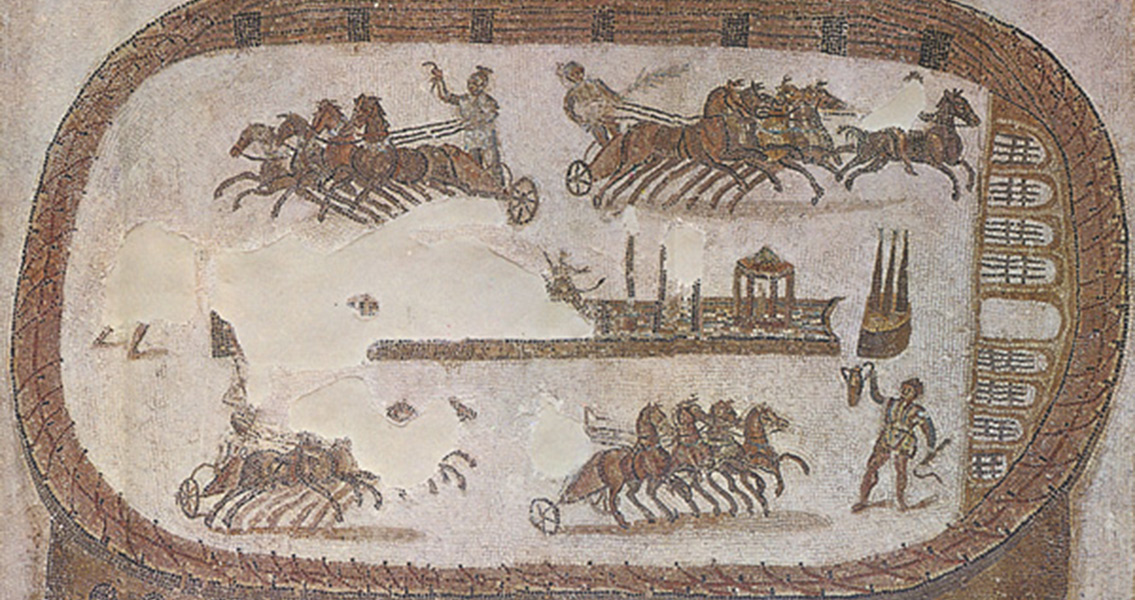
Haaretz, water resistant mortar was discovered within the median strip of the circus known as the spina. This hydraulic mortar, created by mixing lime with pulverized and crushed ceramics, was often used in Roman hydraulic engineering, Tübingen University’s Frerich Schön told Haaretz. The ends of the spina at any circus were often adorned with ornate statues and columns. Archaeologists realized that the spina at the Circus of Carthage had been festooned with water basins, and sprinklers known as sparsores would drop down and dip a clay amphora into each basin in order to sprinkle water on the chariots and their horses as they rounded the corner of the spina, said excavation co-director Dr. Ralf Bockmann. Water basins appearing at the ends of the spina were apparently a common occurrence, as there have been basins found at the Circus of Maxentius, located on the Via Appia outside Rome. Additionally, Carthaginian mosaics depicting the basins, located on the spina of the Circus, have also been found. However, the sprinkling of the chariots as they came around the bend would have been a harrowing job. A career as one of the sparsores meant tossing water from amphorae by hand as the chariots screamed around the arena at high speed, usually from the spina itself. It likely would have required careful organization and timing, Bockmann remarked, adding that it undoubtedly would have been a highly dangerous vocation. The Circus of Carthage was massive in its heyday, as it was at least 500 meters in length according to geophysical surveys undertaken in the 1970s. This is only 80 meters shorter than the Circus Maximus located in the heart of Rome. The Circus Maximus could hold approximately 150,000 spectators at a time, and while Carthage’s chariot ring was slightly smaller, the number of people it could accommodate was also likely to have been quite high. Bockmann, along with co-leader Dr. Hamden Ben Romdhane from Tunisia’s Institut National du Patrimoine, will be studying the Circus for several more years. ]]>

Categories
Breaking News

Ancient Cities Provide A Warning for the Modern World

GSA Today, the authors argue that pre-Republican Rome was a smart city. During this period, Rome’s expansion did not substantially alter the geological features of the area. Natural resources around Rome were managed in order to minimise the environmental damage from over-exploitation. During the pre-Republican era, Rome was an agricultural economy. The small hilltops around the river Tiber’s alluvial plain created remarkably fertile soils, suitable for farming. Access to the river meant that trading of agricultural products was remarkably easy for Romans. Farms were numerous and the city of Rome was self-sufficient. In the same period, Naples had fewer natural resources and was also exposed to more geological vulnerabilities than Rome. As it was based within a naturally-defensible bay, Naples had an economy dependent on sea trade. Naples is also surrounded by very rugged geomorphologic terrain, meaning that the potential for agricultural expansion and economic diversification was limited. Naples, unable to expand outwardly, grew in a vertical manner. The natural marine terraces which bordered the coast became the foundations for Naples’ expansion. Geomorphology, de Rita and Häuber argue, played a key role in constraining Naples’ importance for the Roman Empire. “Geology was a major contributor to the fortune of Rome, which had more resources and reduced risks relative to Naples”, the pair wrote. “Rome could also safely expand toward the Alban Hills area because of the plateau geomorphology, which further provided an easy path for the construction of the aqueducts. The city could also develop agricultural practices that, until Republican times, ensured its self-sustenance.” As time passed, however, rapid urban expansion and population growth led to the over-exploitation of resources. Both cities became unstable and disasters occurred as a result of natural processes, such as flooding and earthquakes. “…many past examples have shown how the indiscriminate use of technology in response to a natural hazard–induced risk, instead of generating security, can lead to higher risk and danger,” the article explains. Häuber and de Rita’s work offers a stark warning for modern cities. Expansion must be managed carefully, allowing for urban growth without out-stripping resources. If we do not heed these warnings, we risk our cities being increasingly vulnerable to natural disasters. For more information: www.geosociety.org Image courtesy of Wikimedia Commons user: Markus Bernet]]>

Categories
Breaking News

Roman Treasure Hidden from Boadicea's Army Finally Uncovered