
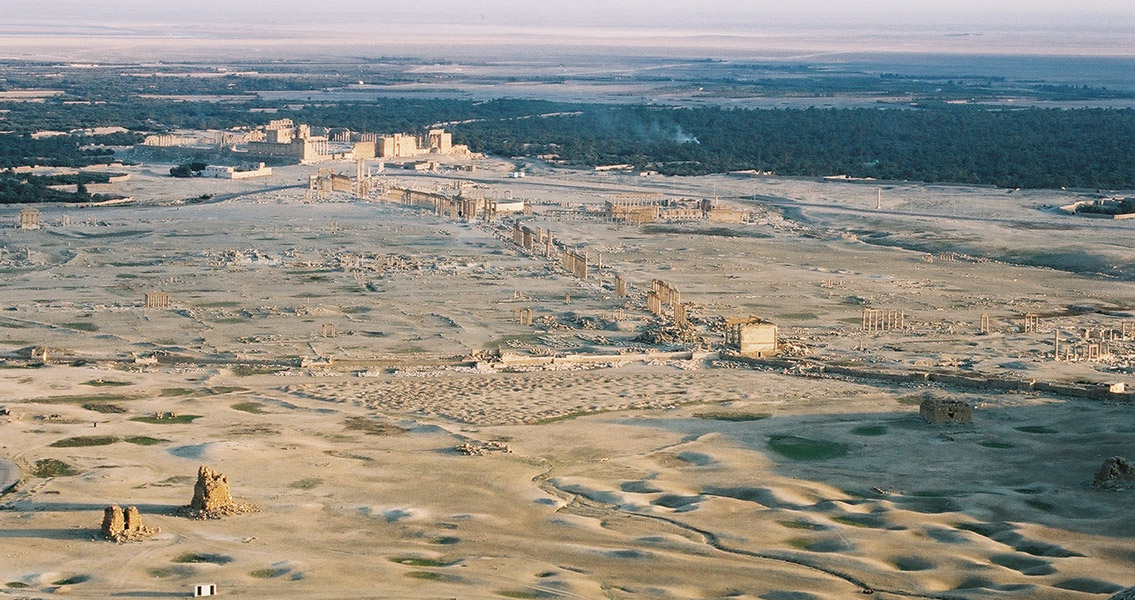
Tagesspiegel newspaper that approximately two-thirds of Aleppo’s old town had been burned and bombed and other sites had been plundered on an industrial scale. She’s branded these types of activities as ‘cultural cleansing’, and has started a campaign called Unite4Heritage to protect important sites. Palmyra was an ancient Semitic city in present-day Syria, with archaeological finds dating back to the Neolithic period. Renowned merchants, the Palmyrenes established settlements along the silk road and did business throughout the Roman Empire. Wealth from the trade caravans allowed the city to build monumental construction projects like the Temple of Bel, the Great Colonnade and the tower tombs. Heavily influenced by Greco-Roman culture, Palmyra produced distinctive architecture and art that reflected both western and eastern traditions. After the recapture of Palmyra early this year government experts discovered statues with the faces chipped off (some interpretations of Sharia law disallow the depiction of the human form) and others that had been left shattered on the floor. Although authorities had taken what they could from the museum as ISIL advanced, larger items and items that were fixed to the walls were left to the mercies of the militants. ISIL left a wide path of destruction on the inhabitants, defenders and ancient treasures of Palmyra. Captured Syrian army soldiers were reportedly executed in the Roman amphitheater, and hundreds of medical personnel, government officials, and the women and children from hated tribal groups were killed in and around the city. It was the death by beheading of the elderly Khaled al-Assaad, the head of the city’s antiquities who refused to reveal where artifacts had been hidden, which garnered the most attention around the world. ]]>


GSA Today, the authors argue that pre-Republican Rome was a smart city. During this period, Rome’s expansion did not substantially alter the geological features of the area. Natural resources around Rome were managed in order to minimise the environmental damage from over-exploitation. During the pre-Republican era, Rome was an agricultural economy. The small hilltops around the river Tiber’s alluvial plain created remarkably fertile soils, suitable for farming. Access to the river meant that trading of agricultural products was remarkably easy for Romans. Farms were numerous and the city of Rome was self-sufficient. In the same period, Naples had fewer natural resources and was also exposed to more geological vulnerabilities than Rome. As it was based within a naturally-defensible bay, Naples had an economy dependent on sea trade. Naples is also surrounded by very rugged geomorphologic terrain, meaning that the potential for agricultural expansion and economic diversification was limited. Naples, unable to expand outwardly, grew in a vertical manner. The natural marine terraces which bordered the coast became the foundations for Naples’ expansion. Geomorphology, de Rita and Häuber argue, played a key role in constraining Naples’ importance for the Roman Empire. “Geology was a major contributor to the fortune of Rome, which had more resources and reduced risks relative to Naples”, the pair wrote. “Rome could also safely expand toward the Alban Hills area because of the plateau geomorphology, which further provided an easy path for the construction of the aqueducts. The city could also develop agricultural practices that, until Republican times, ensured its self-sustenance.” As time passed, however, rapid urban expansion and population growth led to the over-exploitation of resources. Both cities became unstable and disasters occurred as a result of natural processes, such as flooding and earthquakes. “…many past examples have shown how the indiscriminate use of technology in response to a natural hazard–induced risk, instead of generating security, can lead to higher risk and danger,” the article explains. Häuber and de Rita’s work offers a stark warning for modern cities. Expansion must be managed carefully, allowing for urban growth without out-stripping resources. If we do not heed these warnings, we risk our cities being increasingly vulnerable to natural disasters. For more information: www.geosociety.org Image courtesy of Wikimedia Commons user: Markus Bernet]]>

Live Science that the ancient city was marked by a so-called ceremonial route, running from west to east, with only a 3-degree deviation from true east, a remarkable accuracy. This ceremonial route, a perfectly straight line, was lined by as many as 15 flat-topped pyramids which would have stood as tall as 100 feet. Each had a temple on top, which people reached by steps in the pyramids. At the easternmost end of the route there was a structure including three main pyramids along with some other buildings, arranged to face each other. Such triadic structures have been found in other Maya cities as well. In the northern and southern parts of the city were residential areas, again conforming to the overall grid design, Pugh said, and the whole area was encircled by a stone wall for protection. Apparently, Nixtun-Ch’ich was a beautiful, “shiny” city at its height, based on evidence of white plaster that may have been used for the buildings. However, for the people living in it, this design may not have been the most pleasant one due to its strictness, imposing a sense of constant control. This conclusion is based on the atmosphere of early European grid-design cities that started being built during the early Renaissance. Compared to Nixtun-Ch’ich, other ancient Maya cities were more “relaxed” in terms of design, with more open spaces. There is one other city on the land of the former Maya empire, Teotihuacan, which was also built according to a grid design but that city was inhabited by another civilisation about which little is known. Pugh’s research was actually focused on a community building and artefacts dating to a much later period, about the fourteenth century CE. The building was probably the place where the local Maya heirs, the Chakan Itza, held meetings, performed religious ceremonies, and generally conducted matters of state. There were two altars with turtle sculptures in the building, as well as figures of parrots and snakes along the walls. The building, Pugh says, was probably used for about two centuries. The Maya civilisation has been the subject of extensive study since the nineteenth century but the reasons for its decline, which occurred sometime around 900 CE, are still unclear. This was the first geographically focused empire in the region, which at its height spanned the Yucatan Peninsula, Tabasco and Chiapas in what is today Mexico, as well as Guatemala, Belize, western Honduras and El Salvador. The first evidence of Maya culture dates back to 1800 BCE but the golden age, the Classic Period of the civilisation, is considered to have lasted from 250 to 900 CE. Among its hallmarks are the stone pyramids where the Maya worshiped their gods, and the Maya calendar, whose accuracy is still a mystery for modern science. Image courtesy of Wikimedia Commons user: joiseyshowaa]]>