Categories
First Molly Maguires Executed

Quedagh Merchant. The 500 ton vessel was laden with gold, spices and other riches, providing a lucrative haul for Kidd and his crew. Unfortunately, it was partly owned by a minister in the court of the Indian Grand Moghul, who complained to the influential East India Company. Kidd suddenly found himself a wanted man. Seemingly believing he could clear his name on the basis that the vessel was a legitimate target, Kidd handed himself in, but he was undone by changing attitudes towards piracy. The support he expected from members of the political elite, such as his employer Lord Bellemont, never materialised. The trial had become a political event. The Tory party which dominated Parliament attempted to use it to attack the Whigs who had sponsored privateers, and the Whigs responded by turning on Kidd, attacking his character and reputation rather than defending it, to distance themselves from connections to piracy. In early May 1701, Kidd was found guilty of piracy and Moore’s murder, and sentenced to death. ]]>


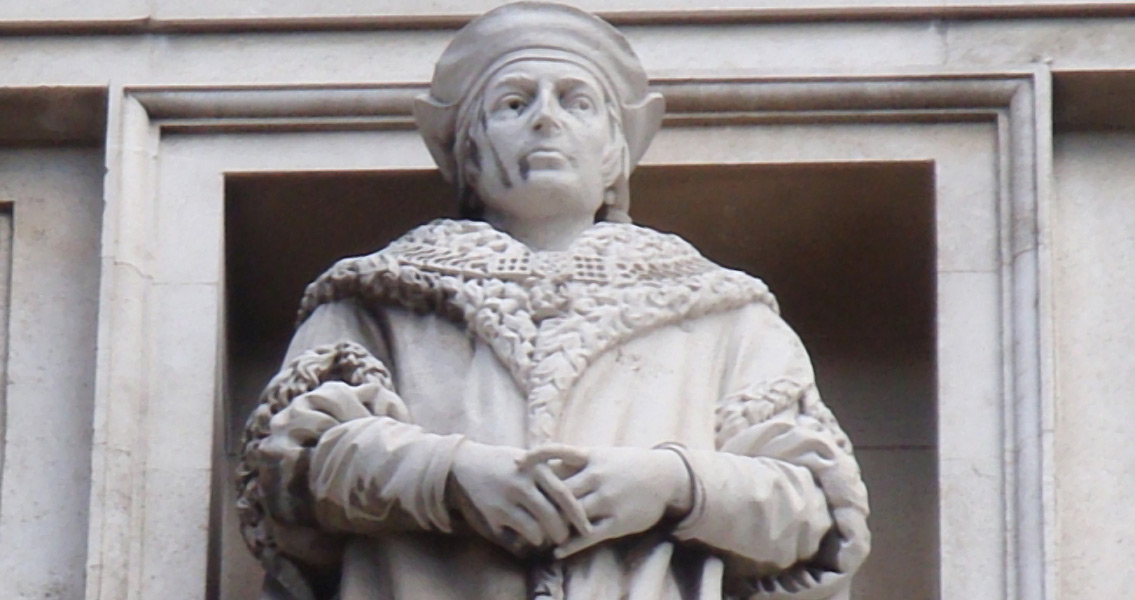
Utopia, is a key piece of political philosophy which remains hugely influential. In it, More describes a fictional society based on equality. It is debated whether More was advocating the world he described, or if the work was purely a means to encourage political debate. Nevertheless, it put forward radical ideas of a society which practiced religious tolerance, gender equality and averted any class systems, making the book seem as radical now as it did in the sixteenth century. More was arrested in 1534, accused of refusing to swear to an oath of succession which essentially confirmed that Henry VIII was a higher authority than the pope, and the head of the Church of England. He was sentenced to death, although he was spared the brutal ordeal of torture reserved for traitors and instead had his sentence reduced to decapitation. Born to a prominent family in London in 1478, More wanted to study Ancient Greek in his youth. Following his graduation from Oxford University, and under pressure from his father, More studied law and became a barrister in 1501. Nevertheless, alongside his legal career More dedicated himself to a study of the Classics while also leading a life of devotion to Catholicism. Such was his commitment to the church that More moved to a monastery just outside London in 1503. Although he ultimately opted to abandon the monastic life in order to serve his country in Parliament, More continued to practice strict regimes of fasting, prayer and penance for the rest of his life. In 1517 More entered the service of Henry VIII and quickly became one of his most important advisers, working among other roles as a diplomat, speech writer and interpreter. In 1521 he was knighted, in 1523 he became the Speaker of the House of Commons and in 1525 Chancellor of the Duchy of Lancaster. The Reformation saw More’s relationship with the king deteriorate drastically. More argued against Henry’s decision to split from the Catholic Church and declare himself the head of the Church of England. He resigned from his position as chancellor, and continued to criticise the king’s decision. It was this defiance which has seen More so widely celebrated by the Catholic church, but it also ultimately cost him his life. Image courtesy of Wikimedia Commons user: Lonpicman]]>