Categories
Breaking News

Human Heel to Toe Stride Finally Explained Through Treadmill Study

Journal of Experimental Biology, explains why human’s walk the way they do Humans are very much set in the way they walk, something which obscures the fact that our stride is actually pretty curious. To Webber it is a particularly pertinent issue. Barefoot runners run in a way that sees them land on the middle or balls of their feet instead of their heels, a stride which would feel unnatural when walking. “Humans are very efficient walkers, and a key component of being an efficient walker in all kinds of mammals is having long legs,” Webber explains in a press release from the University of Arizona. “Cats and dogs are up on the balls of their feet, with their heel elevated up in the air, so they’ve adapted to have a longer leg, but humans have done something different. We’ve dropped our heels down on the ground, which physically makes our legs shorter than they could be if we were up on our toes, and this was a conundrum to us (scientists).” Webber suggests our stride can be explained by limb length. Key to his explanation is the idea that humans move like an inverted swinging pendulum. The body essentially pivots about the point where the foot meets the ground, with the centre of pressure sliding across the length of the foot from heel to toe as we take a step. This means that the true pivot point occurs in the centre of the foot, but at a ‘virtual point’ several centimetres below the ground. Our heel to toe stride then, extends the length of our ‘virtual legs’: the points we pivot around which are longer than our actual legs. “Humans land on their heel and push off on their toes. You land at one point, and then you push off from another point eight to 10 inches away from where you started.” Webber says in the press release. “If you connect those points to make a pivot point, it happens underneath the ground, basically, and you end up with a new kind of limb length that you can understand. Mechanically, it’s like we have a much longer leg than you would expect.” Webber and his team reached their conclusion after monitoring study participants on a tread mill. They compared those who walked normally with those they’d asked to walk toe first. They quickly observed that those who had to walk toe first were slower, and used 10% extra energy in their strides. “The extra ‘virtual limb’ length is longer than if we had just had them stand on their toes, so it seems humans have found a novel way of increasing our limb length and becoming more efficient walkers than just standing on our toes,” Webber said. “It still all comes down to limb length, but there’s more to it than how far our hip is from the ground. Our feet play an important role, and that’s often something that’s been overlooked.” Ancient footprints preserved in volcanic ash in Tanzania show that ancient hominins had a heel to toe stride up to 3.6 millions years ago. Nevertheless, our feet have changed over the years. Early bipeds had longer feet than modern humans – 70 percent of the length of the femur compared to 54 percent in modern humans, which likely helped them become very fast, efficient walkers. Webber suggests that as modern humans evolved the heel first style of walking their feet got proportionally smaller, allowing us to become better runners, possibly as a means to evade predators. “When you’re running, if you have a really long foot and you need to push off really hard way out at the end of your foot, that adds a lot of torque and bending,” Webber said. “So the idea is that as we shifted into running activities, our feet started to shrink because it maybe it wasn’t as important to be super-fast walkers. Maybe it became important to be really good runners.” ]]>

Categories
Breaking News

His Left Foot Was Wood and Iron

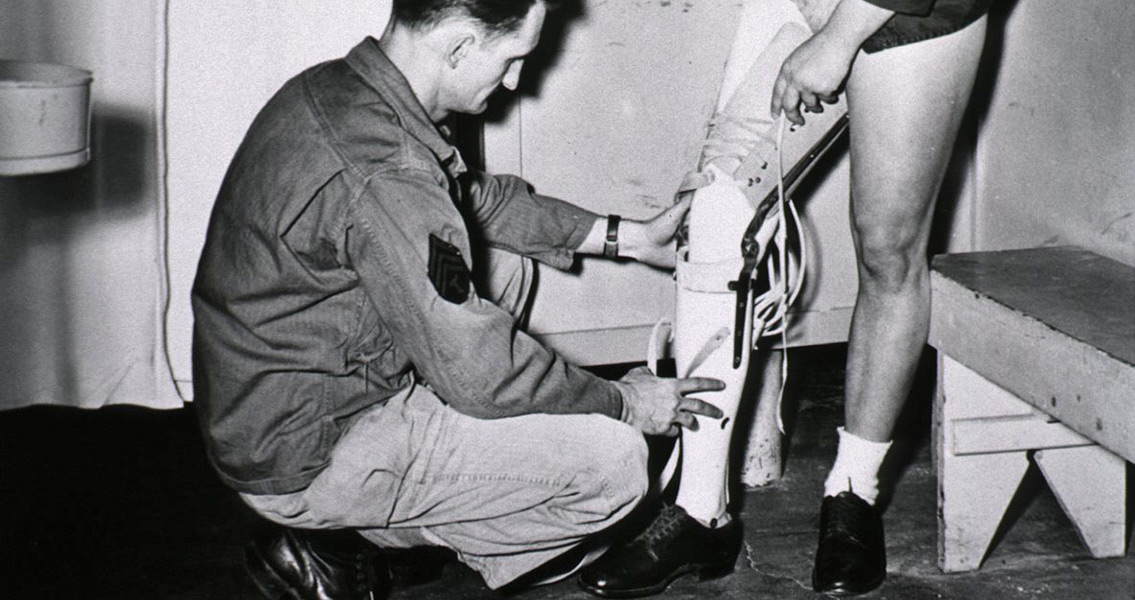
International Journal of Paleopathology. How the middle-aged man found with the prosthetic lost his left foot is unknown. Researchers used radiography and CT-scanning but were only able to determine the man had had a lesion which healed over. Further investigation revealed the man appeared to have recovered from his injury and walked with the use of the prosthetic implant for at least two years Regardless of how this sixth century man lost his foot, he more than likely belonged to a high social class, given he was buried close to a church and also with a sword. During this time period losing a foot, especially when the loss was through the bone as opposed to a joint, as this man’s was, would have resulted in excessive blood loss from the lacerated arteries and would have also been prone to infection – the combination of which would have resulted in death for most people. Finding an injury of this sort which had healed and then finding that person used a prosthetic limb successfully is practically unheard of. The field of human paleopathology (the study of diseases and related skeletal conditions) is generally considered to have started between the mid-nineteenth century and World War I, when a number of anthropologists and physicians pioneered and defined the medical nature and pathologies of ancient skeletons. A review of human paleopathology was published in 1929 by H.U. Williams. Between the World Wars when methods such as radiology, serology and histology began to be applied more frequently, thereby improving diagnosis and accuracy, was when palaeopathology began to truly be considered a scientific discipline. Following World War II, paleopathology started to be viewed as a valuable tool for the understanding of past societies, thus the discipline started its connection to epidemiology and demography. Additionally, new techniques in the field of molecular biology began to add new information to the data already known concerning ancient disease, especially with the introduction of DNA which could be retrieved from centuries old samples. Archaeologists have increasingly used palaeopathology as an important tool for understanding the lives of ancient peoples. For example, in the ancient Maya population where there is evidence of trepanation, which is the practice of drilling holes in the cranium, either once or several times in an individual, paleopathology has determined that patients very often survived the procedure. According to researchers, the latest prostheses discovery is a long way from holding the title of the oldest known use of a prosthetic device. The commonly held belief is that prosthetic limbs were used in the Greco-Roman world as well as in ancient Egypt, although the archaeological proof of this practice before the 2nd millennium CE is rare.]]>

Categories
Breaking News

Homo naledi: Walker and Handyman

Homo naledi, has shown that the hominin was probably equally good at climbing trees as walking, even running, on the ground. What’s more, Homo naledi seems to have been handy with tools, media report. This new examination focuses exclusively on the anatomy of the hands and feet of the hominin and has found that the shape of the bones is very similar in many ways and distinctly different in others from our own. Among the similarities are the shape of the foot, specifically the ankle joint area, as well as the absence of a “grasping big toe”, the researchers say in their new paper, Still, the toes were more curved than ours, which suggests Homo naledi felt comfortable in the trees. Commenting on the paper, Jeremy Da Silva, an anthropologist from Dartmouth College, told Reuters that the foot and leg anatomy of Homo naledi revealed the species was well adapted for long-distance walking and running, with elongated bones, and ankles and knees like modern humans’. At the same time, however, Homo naledi had a lower arch than modern humans, and the toes were curved. Another commenter, William Harcourt-Smith from the American Museum of Natural History, told the BBC that the hominin’s lifestyle probably involved long periods of being on the ground, and going up in the trees to escape predators or to feed. All in all, however, Harcourt-Smith said the species was “much more bi-pedal than not, but not 100%.” The hand bone fossils found in the Rising Star cave in South Africa offered even more fascinating insight into this ancient ancestor of ours. The shape of the hand suggested that although the fingers were more curved than are ours, Homo naledi could manipulate tools. This suggestion could fuel a hypothesis that tool use is not as directly related to cognitive capacity as traditionally believed. Homo naledi’s brain was just a third of the size of ours, something that would usually make scientists think the species was unable to make and use tools, but apparently the case is the opposite. One palaeoanthropologist commenting on the paper, Tracy Kivell from the University of Kent, told Reuters that this discovery “causes us to perhaps rethink the cognitive requirements for tool use.” The Homo naledi fossils were found in August and the discovery was made public in September. Starting with one nearly complete skeleton, so far researchers working at the site have unearthed partial remains from around 15 individuals. Hand fossils alone number almost 150, with one almost complete specimen of the right hand of an adult, while foot bones total 107 so far, with one completely preserved right foot, again of an adult. Luckily for science, the bodies in the cave were not disturbed after they were put there or died there and they did not suffer the effects of the elements, such as floods, which would have dissolved some of the smallest bones, Tracy Kivell told the BBC. For more information: “The hand of Homo naledi”]]>