Categories
Breaking News

Human Stride Older than Thought – The History News of the Week

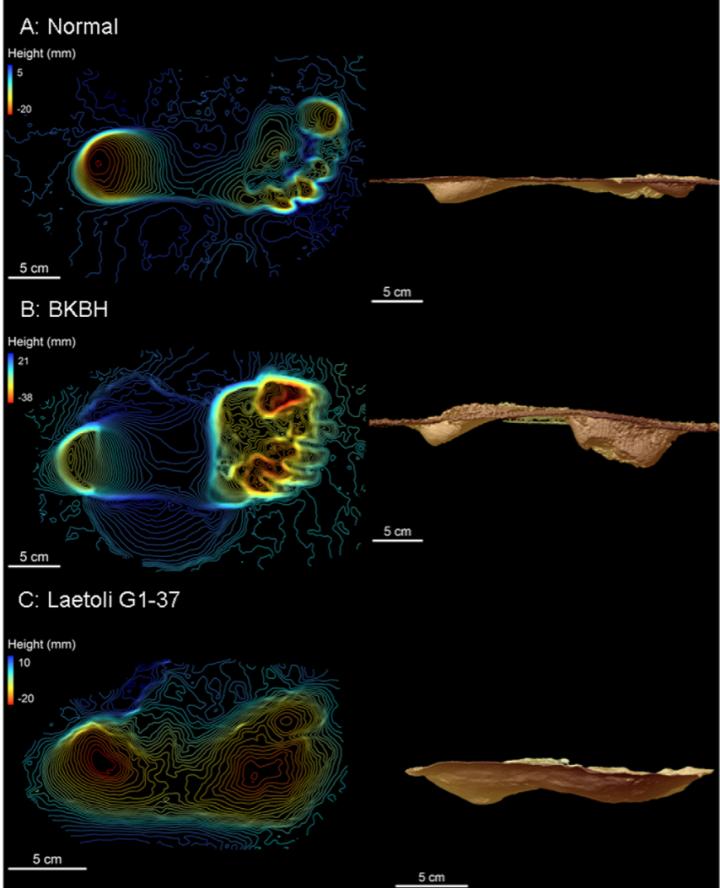
Footprints Show Human Gait Evolved Pre-Homo genus 3.6-million-year-old footprints suggest early hominins may have made the transition from ape like shuffling to upright walking much earlier than thought. “Fossil footprints are truly the only direct evidence of walking in the past,” said David Raichlen, PhD, associate professor at the University of Arizona, in a press release. Raichlen is part of a team analysing the footprints discovered in Laetoli, Tanzania. “By 3.6 million years ago, our data suggest that if you can account for differences in size, hominins were walking in a way that is very similar to living humans. While there may have been some nuanced differences, in general, these hominins probably looked like us when they walked.” It is generally considered that hominins, the name given to human ancestors prior to the homo genus, began walking on two legs around seven million years ago. However, it is also assumed that they had a crouched, bent legged posture while walking. Raichlen and colleagues used footprints and skeletons to reconstruct how these early hominins walked. These tests included comparing the Laetoli footprints with those of eight volunteers walking in an upright or ‘stooped’ (i.e. bent knees) posture. It was found that the volunteers walking upright left footprints closer to those at Laetoli. “This work suggests that, by 3.6 million years ago, climate and habitat changes likely led to the need for ancestral hominins to walk longer distances during their daily foraging bouts,” said Raichlen. “Selection may have acted at this time to improve energy economy during locomotion, generating the human-like mechanics we employ today.” Raichlen recently presented his research at the American Association of Anatomists annual meeting. Origins of the Carambolo Treasure Scientists claim to have found the source of the gold used to create the Carambolo Treasure. Currently housed in the Seville Archaeological museum, the Carambolo Treasure is a selection of gold items from 650 BCE. Discovered by chance in 1958, the Treasure comprises 16 rectangular plates, two breastpieces or pendants, a necklace and two bracelets. The items were discovered hidden inside an oval structure which also contained numerous animal bones and ceramics, leading archaeologists to conclude it was a place of ritual or worship. Ever since its discovery, archaeologists have debated the origins of the Bronze Age treasure. Now, using isotope and chemical analysis, a team of scientists from the UPV/EHU’s Geochronology and Isotopic Geochemistry Service – Ibercron, have concluded that the gold originated from a deposit 2km away from the site of the discovery, and not thousands of kilometres away has been suggested. [caption id="attachment_8598" align="alignnone" width="720"]The Carambolo Treasure Image of the Carambolo Treasure © Consejería de Cultura de la Junta de Andalucía / J. Morón[/caption] The scientists behind the study deployed an innovative method to avoid damaging the priceless artefacts. Using a form of laser ablation, they made a hole of around 0.1mm in size in the gold, in order to analyse it. This laser ablation is combined with plasma mass spectrometry, “with which we not only do isotope analyses but also elemental analyses directly on solid samples with the minimum possible impact”, according to Dr Sonia García de Madinabeitia, who worked on the study. “We base ourselves on a kind of footprint of the lead,” explained the researcher. “The isotope ratios of lead vary in terms of the function of the materials used and the age of the materials, and we determine the isotope ratio that the lead has. The fact is that there are considerable differences between some mineral deposits and others.” In addition, the scientists also carried out ‘trace and ultratrace’ analyses on the Carambolo Treasure, “because we know that mines, however much they may be gold or silver mines, never consist of pure materials, but have a series of trace and ultratrace elements that subsequently allow links between the archaeological materials and the geological materials to be established,” added García de Madinabeitia. Lessons From the World’s Oldest Peace Treaty ‘The world’s oldest peace treaty’ is challenging our image of antiquity and shedding new light on ancient conflicts. In preparation for a new exhibition at the Berlin Pergamon Museum, archaeologists have been analysing a 3,200-year-old peace treaty between Ramesses II and Ḫattušili III. They claim that contrary to the popular idea that ancient conflicts were settled through the total humiliation of the loser, complex negotiations were in fact at play. “More than 3,200 years ago, Egyptians and Hittites ensured each other mutual support in the treaty; neither of them triumphed. This must have been preceded by much negotiating, as is evidenced by extensive correspondence between the rulers”, write Director Prof. Dr Achim Lichtenberger and Curator Dr Helge Nieswandt of the University of Münster’s Archaeological Museum, in a press release. “Although the ‘victorious peace’ dominates over the ‘peace of reconciliation’ in peace images of antiquity, our research shows that the latter also existed.” In addition, the researchers claim that many ancient peace images were actually created in times of conflict. They cite the example of the Roman goddess of peace, Pax, who was present on Roman coins even at times of war. “Despite the glorification of war in antiquity, which undoubtedly existed and alienates us: images of the ideal of peace were particularly widespread during wars,” says Nieswandt. “When the order of the Roman Empire fell apart in the 3rd century AD, and when mostly short-lived soldier emperors took turns, there was an ‘inflation of peace’ on coins.” The exhibition, entitled Frieden. Von der Antike bis heute (Peace: From Antiquity to the Present Day), opened on 28th April at the Berlin Pergamon Museum. Featured Image: Footprints from (A) a modern human walking normally, (B) a modern human walking with a stooped posture known as the “bent knees, bent hip,” or BKBH, posture, and (C) 3.6 million-year-old hominin footprints found in Laetoli, Tanzania. The team’s analysis suggests ancient hominins probably walked in a way that is very similar to modern humans. Credit: David Raichlen, University of Arizona. ]]>
Categories
Breaking News

Human Heel to Toe Stride Finally Explained Through Treadmill Study

Journal of Experimental Biology, explains why human’s walk the way they do Humans are very much set in the way they walk, something which obscures the fact that our stride is actually pretty curious. To Webber it is a particularly pertinent issue. Barefoot runners run in a way that sees them land on the middle or balls of their feet instead of their heels, a stride which would feel unnatural when walking. “Humans are very efficient walkers, and a key component of being an efficient walker in all kinds of mammals is having long legs,” Webber explains in a press release from the University of Arizona. “Cats and dogs are up on the balls of their feet, with their heel elevated up in the air, so they’ve adapted to have a longer leg, but humans have done something different. We’ve dropped our heels down on the ground, which physically makes our legs shorter than they could be if we were up on our toes, and this was a conundrum to us (scientists).” Webber suggests our stride can be explained by limb length. Key to his explanation is the idea that humans move like an inverted swinging pendulum. The body essentially pivots about the point where the foot meets the ground, with the centre of pressure sliding across the length of the foot from heel to toe as we take a step. This means that the true pivot point occurs in the centre of the foot, but at a ‘virtual point’ several centimetres below the ground. Our heel to toe stride then, extends the length of our ‘virtual legs’: the points we pivot around which are longer than our actual legs. “Humans land on their heel and push off on their toes. You land at one point, and then you push off from another point eight to 10 inches away from where you started.” Webber says in the press release. “If you connect those points to make a pivot point, it happens underneath the ground, basically, and you end up with a new kind of limb length that you can understand. Mechanically, it’s like we have a much longer leg than you would expect.” Webber and his team reached their conclusion after monitoring study participants on a tread mill. They compared those who walked normally with those they’d asked to walk toe first. They quickly observed that those who had to walk toe first were slower, and used 10% extra energy in their strides. “The extra ‘virtual limb’ length is longer than if we had just had them stand on their toes, so it seems humans have found a novel way of increasing our limb length and becoming more efficient walkers than just standing on our toes,” Webber said. “It still all comes down to limb length, but there’s more to it than how far our hip is from the ground. Our feet play an important role, and that’s often something that’s been overlooked.” Ancient footprints preserved in volcanic ash in Tanzania show that ancient hominins had a heel to toe stride up to 3.6 millions years ago. Nevertheless, our feet have changed over the years. Early bipeds had longer feet than modern humans – 70 percent of the length of the femur compared to 54 percent in modern humans, which likely helped them become very fast, efficient walkers. Webber suggests that as modern humans evolved the heel first style of walking their feet got proportionally smaller, allowing us to become better runners, possibly as a means to evade predators. “When you’re running, if you have a really long foot and you need to push off really hard way out at the end of your foot, that adds a lot of torque and bending,” Webber said. “So the idea is that as we shifted into running activities, our feet started to shrink because it maybe it wasn’t as important to be super-fast walkers. Maybe it became important to be really good runners.” ]]>

Categories
Breaking News

Homo naledi: Walker and Handyman

Homo naledi, has shown that the hominin was probably equally good at climbing trees as walking, even running, on the ground. What’s more, Homo naledi seems to have been handy with tools, media report. This new examination focuses exclusively on the anatomy of the hands and feet of the hominin and has found that the shape of the bones is very similar in many ways and distinctly different in others from our own. Among the similarities are the shape of the foot, specifically the ankle joint area, as well as the absence of a “grasping big toe”, the researchers say in their new paper, Still, the toes were more curved than ours, which suggests Homo naledi felt comfortable in the trees. Commenting on the paper, Jeremy Da Silva, an anthropologist from Dartmouth College, told Reuters that the foot and leg anatomy of Homo naledi revealed the species was well adapted for long-distance walking and running, with elongated bones, and ankles and knees like modern humans’. At the same time, however, Homo naledi had a lower arch than modern humans, and the toes were curved. Another commenter, William Harcourt-Smith from the American Museum of Natural History, told the BBC that the hominin’s lifestyle probably involved long periods of being on the ground, and going up in the trees to escape predators or to feed. All in all, however, Harcourt-Smith said the species was “much more bi-pedal than not, but not 100%.” The hand bone fossils found in the Rising Star cave in South Africa offered even more fascinating insight into this ancient ancestor of ours. The shape of the hand suggested that although the fingers were more curved than are ours, Homo naledi could manipulate tools. This suggestion could fuel a hypothesis that tool use is not as directly related to cognitive capacity as traditionally believed. Homo naledi’s brain was just a third of the size of ours, something that would usually make scientists think the species was unable to make and use tools, but apparently the case is the opposite. One palaeoanthropologist commenting on the paper, Tracy Kivell from the University of Kent, told Reuters that this discovery “causes us to perhaps rethink the cognitive requirements for tool use.” The Homo naledi fossils were found in August and the discovery was made public in September. Starting with one nearly complete skeleton, so far researchers working at the site have unearthed partial remains from around 15 individuals. Hand fossils alone number almost 150, with one almost complete specimen of the right hand of an adult, while foot bones total 107 so far, with one completely preserved right foot, again of an adult. Luckily for science, the bodies in the cave were not disturbed after they were put there or died there and they did not suffer the effects of the elements, such as floods, which would have dissolved some of the smallest bones, Tracy Kivell told the BBC. For more information: “The hand of Homo naledi”]]>

Categories
Breaking News

Prehistoric Kangaroos Were Too Large to Hop