Categories
Breaking News

Chinese Fossilized Fish Sheds New Light on Jaw Evolution

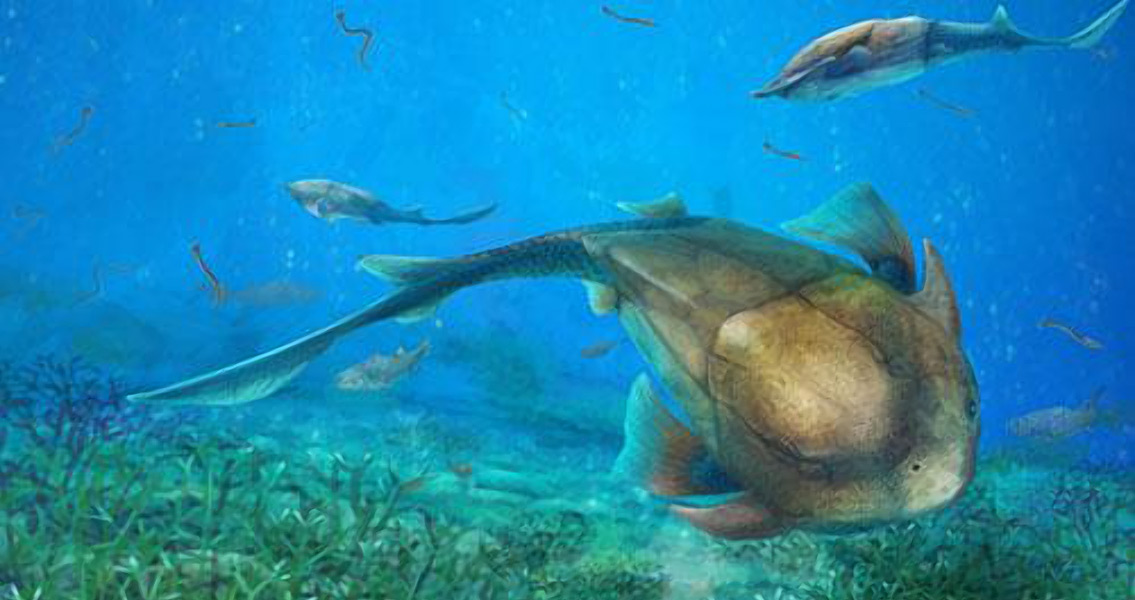
Qilinyu rostrate, a fish-like Silurian placoderm species, has led to new information regarding the evolution of the jaw in vertebrate species. The roughly 423 million year old fossil is approximately 126 millimeters in length – with an estimated total body length for the creature of 20cm – and is associated with several different species including the Guiyu and Megamastax (classified as osteichthyans), the Entelognathus (a maxillate placoderm) and the Dunyu (a galeaspid). Osteichthyans, which include tetrapods and bony fish species, have facial and bone structure differences when compared to placoderms. The discovery of Entelognathus revealed a placoderm with many facial characteristics more suited to osteichthyans, but the relationship between Entelognathus’ development and the rest of the placoderms from the same time period remained uncertain until this new discovery. According to a recently published research study by the Chinese Academy of Sciences, Sweden’s Uppsala University, and the Institute of Vertebrate Paleontology and Paleoanthropology of Beijing, the new Qilinyu fossil bridges the gap between placoderms such as Entelognathus and osteichthyans. The new specimen, according to the team of international researchers, has dentary, premaxilla, and maxilla structures that are constructed in the same way as the gnathal plates of less advanced placoderms while also predating the addition of certain lower jaw bones that characterized the evolutionary move away from gnathal jaws to maxillate ones. According to Uppsala University professor Per E. Ahlberg, one of the authors of the new study, examining the jaw bones of both Qilinyu and Entelognathus reveals that both fish species combine the characteristics of placoderm gnathal plates and bony fish jaw bones. Extrapolating from these findings, Professor Ahlberg remarked that if gnathal plates from placoderm species represented an inner jaw arcade that was similar to certain bones of bony fish species, there would be an expectation to find gnathal plates in distinct locations in Qilinyu and Entelognathus. With no evidence of these gnathal plates, the professor states that one interpretation of this is to conclude that the jaw bones of humans are lightly remodeled gnathal plates of placoderms, accomplished through several hundred million years of evolutionary process. Based on the team’s findings, Professor Ahlberg remarked that it looks as if substantial anatomical details of humanity can be traced back even beyond early bony fish species, into the Silurian period in the form of these “ungainly” placoderm species. The scientific community has largely agreed with the team’s findings, with John Long, the Society of Vertebrate Paleontology’s president and professor from Australia’s Flinders University, commenting that the new insights into Qilinyu help to fill a large gap in the evolution of vertebrate jaws. The new research study, published recently in the journal Science, can be found online here Image drawn by YANG Dinghua]]>
Categories
Breaking News

Quicksand – Bane of the Dinosaurs?

Washington Post, Jim Kirkland, a paleontologist for the state of Utah, remarked that the initial thought was that he and his team had stumbled across a small body of water where animals might have frequently drowned or fought, but this didn’t fit the bill because of how the fossilized remains were found – encased in a type of sandstone that differed from the surrounding geology. In an attempt to understand the strange find, Kirkland allied with Edward Simpson, a paleontologist from Kutztown University in Pennsylvania, to determine what might have happened to these Utahraptors. The answer, it seems, is deceptively simple: quicksand. Quicksand, Kirkland explained, does not operate under the same rules that Hollywood productions throughout history have assumed. A mix of sand and water, quicksand appears solid until something (like a heavy dinosaur) steps on it. At this point the quicksand becomes more liquid temporarily as the extra weight disturbs the equilibrium of the mix of water and sand, turning the area into a soupy mix. However, once the water and sand are given time to separate again the mixture solidifies, trapping whatever may have stepped within. Kirkland, Simpson, and several colleagues were able to reconstruct the events that led to the entrapment and death of at least nine Utahraptors in eastern Utah more than 100 million years ago, by studying how quicksand traps behaved near Lake Powell, a man-made reservoir that straddles the Utah-Arizona border. However, the key was in the discovery of a second dinosaur species within the sandstone block alongside the Utahraptors. The remains of iguanadonts, beaked plant-eating dinosaurs, were also found within the fossilized quicksand, researchers revealed. The iguanadonts that became trapped within the quicksand likely died there, attracting predators and scavengers such as the Utahraptors to the location as well. Each of these carnivorous dinosaurs would have become trapped, but it’s unclear if the group arrived one at a time or all at once. Researchers hope to continue studying the giant rock slab in the future in order to reveal that piece of the puzzle; for now though, work has been halted temporarily in anticipation of a crowdfunding campaign to raise sufficient funds to ensure fossil preservation and to enlist the aid of noted paleontologist Scott Madsen. Regardless, the revelation that this series of Utahraptors died in rapid succession due to quicksand is groundbreaking, according to Kirkland. The paleontologist remarked that the accompanying research paper is the first of its kind to publish findings revealing a quicksand-related predator death trap. The paper revealing the findings are available from the journal PALAIOS here ]]>

Categories
Breaking News

Infant Titanosaur Fossil Reveals Early Dinosaur Life

Science, can be found here Image courtesy of Kristi Curry Rogers]]>

Categories
Breaking News

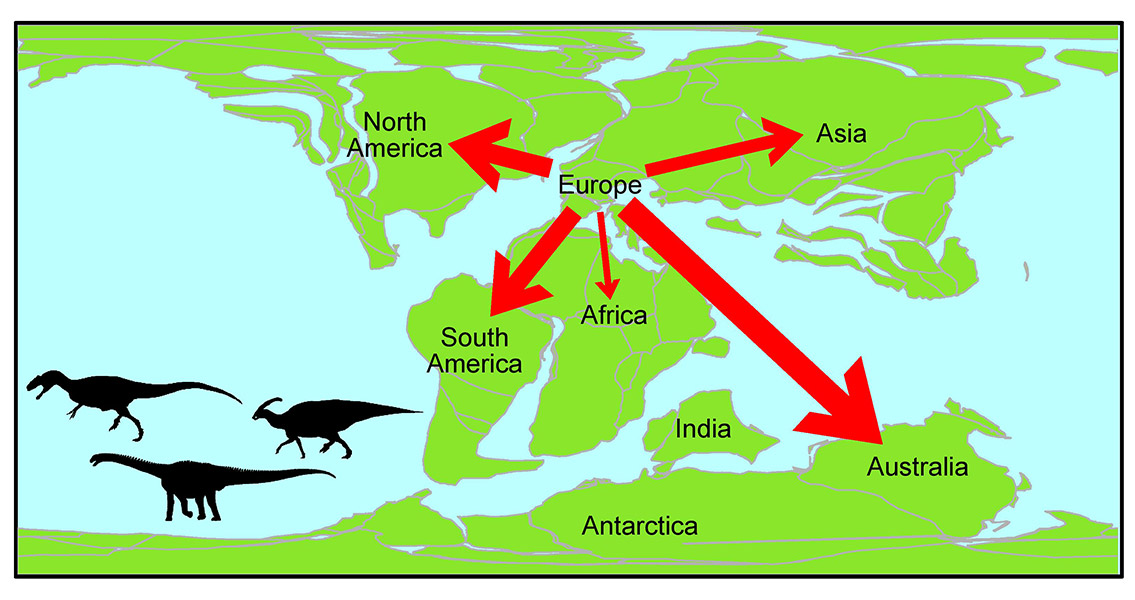
Dinosaur Movement Research Reveals European Exodus

www.onlinelibrary.wiley.com Image courtesy of Alex Dunhill, University of Leeds ]]>

Categories
Breaking News

New Research Reveals “Tully Monster” Was a Vertebrate

Tullimonstrum gregarium, have been found exclusively in the state of Illinois, deep in its coal quarries. The bizarre visage of the Tully Monster – with its long, eel-like body, fins on its tail resembling that of a squid’s back end, and long, tentacle-like neck ending in a mouth reminiscent of a crab claw – has captured the imaginations of scientists and cryptozoologists alike. Because of the strange agglomeration of body parts – which included a pair of stalks that ended in blob-like ovals thought to have been eyes – researchers have been flummoxed as to how to classify the Tully Monster. However, the new research study, headed by University of Leicester PhD student Thomas Clements, managed to reveal some of T. gregarium’s secrets, specifically by investigating those strange eye stalks. In a university press release, Clements recounted how it was the distinctiveness of those stalked structures that inspired the study. Bizarre anatomy in a fossil makes it difficult to choose a starting point, the PhD student added, which led the research team to focus on what they thought was the most interesting feature of the Tully Monster. The idea panned out in a big way. The researchers, who joined forces with colleagues from the University of Texas in Austin and the University of Bristol, found that the dark blobs at the ends of those stalks were composed of microscopically small granules, hundreds of thousands of them, and they were identical chemically and physically to melanosomes, organelles instrumental in the creation and storage of melanin. Almost every animal is capable of producing this pigment, according to the University of Bristol’s Dr. Jakob Vinther, who was also involved in the study. Melanin is instrumental in the wide range of hair and skin color in humanity, for instance; however, it’s also found in the eyes of a large number of animals, where it plays a role in blocking excess light from entering the eye, and allowing a clear visual image to form. What this means for the Tully Monster – finding melanosomes in such high concentrations in the two terminal bulbs on its stalks – is that it has been conclusively proven that the dark blobs were eyes. The team also found that there were two differently-shaped melansomes in the Tully Monster’s eyes. This is a characteristic found exclusively in vertebrates. In other words, not only has it been proven that T. gregarium had eyestalks but also that it was indeed a vertebrate, unlike previous research that suggested the Tully Monster lacked a backbone. These new revelations – the fact that the Tully Monster had rather good vision and that it was indeed a vertebrate – suggest that the animal might have been a fish. A rather bizarre fish, Thomas commented, but a fish nonetheless. The research study, which was published in the journal Nature, can be found online here Image courtesy of University of Leicester]]>

Categories
Breaking News

Remains of Massive Ancient Crocodile Found in Tunisia

M. rex’s body but several turtle and fish remains that have yet to be identified. The giant crocodile was likely a scavenger or an ambush predator and was most definitely capable of hunting while in the water, according to the research team. The scientists compare the large head and short teeth of M. rex to modern crocodiles, leading to the claim that the bite force of the newly-discovered specimen was likely to have been incredible. With the ability to crush nearly anything and everything its jaws wrapped around, the prehistoric monster crocodile would have found it easy to crack open turtle shells, Fanti added. However, the revelation of the newest and biggest entry into the world of prehistoric crocodiles is important on a number of levels, especially when it comes to redefining the timeline for the species and its closest cousins. The other Machimosaurus species, such as M. hugii and M. mosae, were not only smaller than M. rex but were thought to have gone extinct around 150 million years in the past as the Jurassic came to a close. However, M. rex has been dated to just 130 million years ago – which means the species either evolved after the hypothesized mass extinction at the end of the Jurassic or somehow survived it. Fanti states that this could lead paleontologists to reconsider the strongly-held mass extinction theory in an attempt to understand just what went on at the tail end of the Jurassic. The research study detailing the findings of Fanti and his team, which was published recently in the journal Cretaceous Research, can be found online here Image courtesy of Wikimedia Commons user: Nobu Tamura]]>

Categories
Breaking News

Gap Between Dinosaurs and Their “Cousins” Narrows

www.pnas.org Image courtesy of Wikimedia Commons user: Márcio Luiz]]>

Categories
Breaking News

Snakes Lost Their Legs to Burrow Rather than Swim

Dinilysia patagonica. The scientists subjected a D.patagonica skull to CT scanning and then constructed three-dimensional virtual models in order to compare the ancient snake’s bony inner ear structures to those of modern snakes and lizards. The results point to snakes losing their legs around when they began to adapt to digging and burrowing in the ground, and not when they slipped into the sea. The lead scientists, in the research study published recently that described their findings, say that D.patagonica was likely to have been a burrower – and that modern crown snakes had ancestors that burrowed as well. The researchers used the shape of the inner ear to provide ectomorphic indicators for snake habits, as these details are often not preserved in fossilized remains. These specialized cavities in modern snakes control their ability to hear and their sense of balance, much in the way that the inner ear structures of D.patagonica are suggested to have done. The use of 3D modelling, based on the data gathered from the CT scans of the fossil, revealed distinctive structures that were analogous to those that burrowing animals have to provide them with additional abilities to avoid predators and hunt prey. These specialized adaptations are markedly absent from modern snakes that live above ground or spend time in the water. Such activities were common before modern snakes developed, but Dr. Norell and Dr. Yi claim that burrowing was an exclusive habit for evolutionary ancestors of crown snakes, as both D.pataognica and a theorized crown snake ancestor both possessed large inner ear chambers that have been associated with the ability to detect low-frequency sounds. This suggests that crown snakes had the ancestral ability to detect vibrations in substrate in order to detect predators and prey alike. The new findings may help paleontologists begin to fill in the gaps left in the narrative of snake evolution. The scientists said that the snake was easily more than 1.8 meters in length from snout to tail, crowning it as the largest burrowing snake ever. Additionally, the research findings have offered clues about an even older ancestor that may be the originator for all modern snakes alive today. For more information: www.advances.sciencemag.org ]]>

Categories
Breaking News

New Dinosaur Species Reveals Evolutionary Transition

PLOS ONE, is just one of many that Fowler and Horner have plans to publish from the results of their fieldwork in the region. Image courtesy of Wikimedia Commons user: Danny Cicchetti]]>

Categories
Breaking News

520 Million Year Old Brains Preserved in Fool’s Gold

Fuxianhuia protensa – small, shrimp-like arthropods that thrived during the Cambrian Period – have been uncovered and positively identified. Many of these fossilized brains have been found with an overlay of pyrite, a mineral that is commonly referred to as “fool’s gold” because of its passing resemblance to the precious metal. The Cambrian Period is known as a turning point in the evolutionary development of life on Earth. Prior to the Cambrian, most of the planet’s forms of life were decidedly simple. However, an evolutionary event referred to today as the Cambrian explosion saw the complexity of planetary fauna blossom overnight in a geological sense, leaving massive marks on the fossil record. F. protensa is one of the many creatures that flourished in the wake of the Cambrian explosion, with these small sea-bottom dwelling creatures a common fossil find from the era. However, Strausfeld and his research team say that their excavation efforts have uncovered not one F. protensa fossil with an intact brain but a total of seven – the first such find of its kind since the discovery of just one such specimen in 2012. In a paper written by Strausfeld, it is revealed that the little arthropod had a very complex brain structure for creatures in the Cambrian. With a three-sectioned brain consisting of regions referred to as the protocerebrum, deutocerebrum and tritocerebrum, F. protensa had a brain that turns out to be strikingly similar to its modern relatives, which include insects, crustaceans, and other arthropods. Additionally, the research team discovered how such soft tissues, usually completely obliterated during the fossilization process, could have survived for hundreds of millions of years. In the paper, the researchers say that the fossilized brains appear as dark shadows overlaid in a high-carbon film over other fossilized tissue, which tends to be lighter in color and to carry a heavy iron content. In many of these instances, the carbon brain film is also sketched with fool’s gold as well. The key to preserving these brains in this way is likely to rely on very rapid burial of the specimens in question. Strausfeld and his team suggested an underwater mudslide as one path to this. Sediments within the mudslide would have prevented oxygen from eating away at the remains while also “dewatering” the brains of these arthropods by forcing out the moisture held within them. This would have caused the so-called “brain films” to appear on the fossil. For more information: www.cell.com]]>