Categories
Breaking News

New Horned Dinosaur Usurps Triceratops Throne

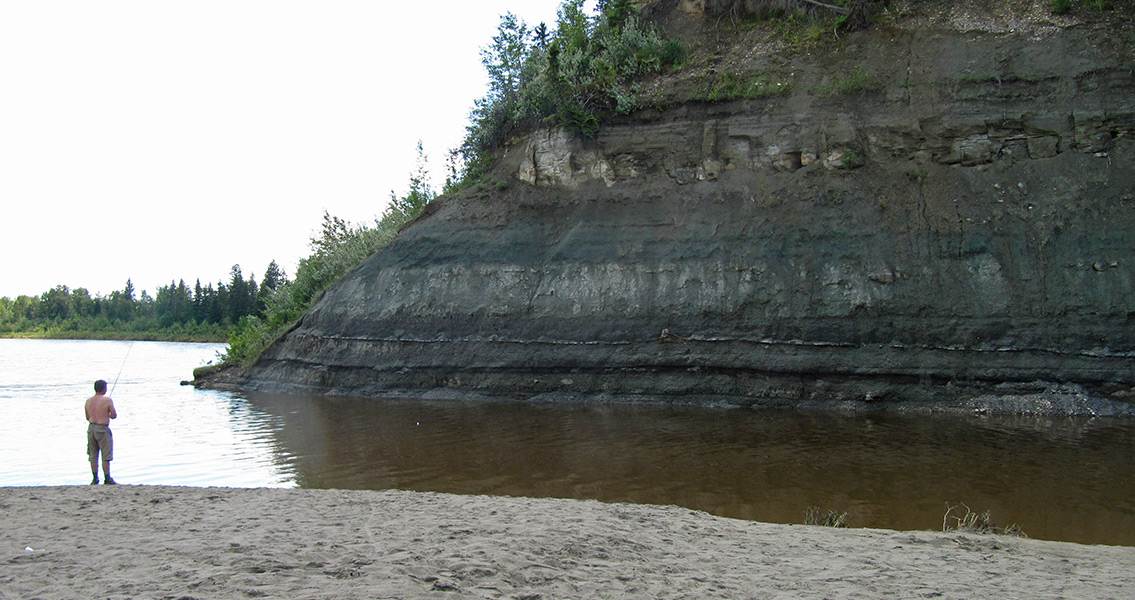
regaliceratops peterhewsi, the new species is is indeed related to the triceratops but represents an evolutionary convergence between the more well-known dinosaur species and older, less-developed species that preceded it; the most noteworthy physical manifestation of this legacy is the crown-like frill regaliceratops sports on the back of its skull. The fossil was originally discovered in 2005 by Peter Hews, a geologist from Calgary, when he was surveying a cliff in southwestern Alberta that ran alongside the Oldman River. Hews contacted the Royal Tyrell Museum – the same museum New Historian reported being shipped another paleontological find of five fossilized fish discovered in a Calgary basement last week – and researchers excavated the fossil. After years of study and analysis, the new species, which was named in honor of Hews to commemorate his discovery, is now on display at the museum. The process for extricating the fossilized skull was a painstaking one, thanks to the presence of bull trout in the river below. As a protected species in Canada, the fish had to be provided specific protections by the excavation team, including preventing any dirt or debris from the excavation from falling in the river. Taken together with the extremely hard rock within which the fossilized bones were encased, the museum teams found the entire experience “hellish,” according to paleontologist Caleb Brown in an interview with CTV News. The extreme difficulty of the dig, combined with the unique nature of the small, almost stunted-looking horns located over the eye sockets that carry a close resemblance to a certain otherworldly science-fiction and comic book character, led to the dinosaur being nicknamed “Hellboy” by the excavation team. Brown says that the region where ‘Hellboy’ was found doesn’t have a reputation for being particularly rich when it comes to fossilized remains. Regions located farther east from the mountainous terrain are much more likely to yield fossils, but the museum paleontologist remarked that with the new regaliceratops find, research efforts will be expanded within the area, even with the possible difficulties that may be faced by research teams attempting to remove subsequent fossils. After careful examination of Hellboy’s skull, museum researchers say that the regaliceratops was likely to have weighed around 1.5 tons in life. Its massive frill was topped with jagged, tooth-like protrusions that resembled a spiked crown. The skull, once exhumed painstakingly from the cliff above the river, turned out to be nearly intact – only the beak and lower jaw were missing. Brown said that with less than one percent of dinosaur remains actually surviving the fossilization process, there could have been millions of regaliceratops roaming the world 70 million years in the past. Image courtesy of Wikimedia Commons user: Royal Tyrell Museum Drumheller, Alberta]]>

Categories
Breaking News

Five 60 Million Year Old Fish Fossils Uncovered in Alberta

Categories
Breaking News

Arguments About the Connection Between Fin and Fingers Finally Resolved by Researchers

Categories
Breaking News

New Dinosaur Species Usurps Tyrannosaurus Rex as Largest Predator

Categories
Breaking News

New Species of Flying Dinosaur Discovered

Categories
Breaking News

Dinosaurs May Have All Had Feathers

Kulindadromeus zabaikalicus, which had feathers. For nearly two centuries it has been taught that dinosaurs were large reptiles that had tough scales and a lizard-shaped head. The recent discovery may prove years of schoolwork wrong. The dinosaur found was 4.5 feet (1.5m) long, beaked, with large legs, short arms, a long tail and is thought to have been bipedal. This is actually not the first feathered dinosaur of its kind to be found. Way back in the 1990s, scientists have found at least five species of dinosaurs in China that had feathers. These dinosaurs were theropods (a type of dinosaur) and  carnivores. The infamous Tyrannosaurus rex is a part of this group. However, the dinosaur that was recently found was a herbivore and from a different dinosaur family, which meant that it could not have been related to the older feathered species found. The Kulindadromeus must have evolved differently than the rest of these dinosaurs, and hence many other dinosaurs may be the same way. Because of this, scientists are rethinking what dinosaurs may have looked like. The Kulindadromeus genus of dinosaur lived in Siberia, near the Kulinda River. Its legs and elbows were feathered, and there were streamlined feathers on its back. At least six skulls of this dinosaur was found in a fossil bed at the bottom of a lake, and they were all juveniles, which has scientists believe that they did not die in a catastrophe, but rather separate events. The skulls were buried under volcanic ash, preserving much of the feather imprints on the fossil bones. “Kulindadromeus” means “Kulinda River running dinosaur”, while “zabaikalicus” relates to the region of Siberia where it was discovered, Zabaikalsky Krai. The skin of the dinosaur resembled the skin of some birds, which provides even more evidence that today’s birds have evolved from the dinosaurs, according to the study. Lead author on the paper, Pascal Godefroit, is a paleontologist from the Royal Belgian Institute of Natural Science in Brussels. He and his colleagues state that while this find is significant, more studies should be done on this subject. There is a lack of evidence that feathers developed in all dinosaurs, since fossil records with feathers are in the minority. Before this, birds were thought to have come from the line of the archaeopteryx and other winged creatures. These feathers may have served as a method for insulation, such as in the case of Kulindadromeus, which lived in colder climates. Larger dinosaurs also may have had fewer feathers than smaller dinosaurs, as they would conserve heat more easily. We’re still a long way off from confirming whether or not all dinosaurs had feathers, but what it does mean is that feathers did not start off with birds, instead they evolved very early in history with the dinosaurs.]]>

Categories
Breaking News

Age Horse Skull Unearthed in Yukon

Categories
News

Dinosaurs May Have Been Neither Cold or Warm Blooded

Science, the dinosaurs may have been neither cold-blooded nor warm-blooded – they were somewhere in-between. Some paleontologists call this scientific phenomenon and the fact that dinosaurs are related to birds as “the last big one”. The lead scientist in this study, John Grady, an ecologist at the University of New Mexico, states that dinosaurs may have been able to generate body heat, but they could not keep their body temperature constant. The term that describes this condition is called mesothermy. This allowed them to move fast and grow larger than any other animal in existence in those times. This adaptation enabled them to live longer than the slow-moving reptiles in existence in those times. In this study, 381 different species of animals were compared, with 21 being dinosaurs. The dinosaurs looked at included the Tyrannosaurus, Allosaurus, Apatosaurus, Tenontosaurus and the Troodon. The other species looked at included a range of mammals, birds, sharks, fish, snakes, lizards and crocodiles. All these animals are either warm-blooded or cold-blooded. The researchers looked at the metabolism of the dinosaurs by looking on the size of their bones, and deduced their body mass. By measuring the growth rings in their bones, the scientists could estimate the growth rate of the animals, which is a similar method arborists use to determine the age of a tree. After all the comparisons were completed, they found that dinosaurs did not grow in the same way warm-blooded animals did, neither did they grow in the same way cold-blooded animals did. They did not grow like any of the mammals, birds, reptiles and fish that were a part of the experiment. These dinosaurs had the best characteristics of both worlds that enabled them to grow and move the way they did. These characteristics include the fast firing or muscles and nerves in warm-blooded animals, and the ability to burn fuel more slowly and grow larger than mammals in cold-blooded animals. This makes sense as large dinosaurs such as the Tyrannosaurus and the Apatosaurus would need to eat 24/7 in order to fuel their large bodies if they were warm-blooded like a mammal. These dinosaurs may have had to hunt for days for their food, so they could not survive if they were warm-blooded. Grady says that the notion that animals today must be put into two groups, warm-blooded or cold-blooded, is too vague and simplistic. There are a few animals today that share the same in-between characteristic that the dinosaurs had. These animals include the echidna (a mammal that looks like an anteater but lays eggs), the leatherback turtle, the great white shark and the tuna.]]>